


How do you build a one-person business in 2026?
Well, you do everything you would have done before, but you use AI to do it faster, with higher quality, and with less guesswork.
You still generate traffic.
You still write content.
You still write emails/newsletters.
You still create a product or service.
You still create a customer avatar.
You still formulate a compelling offer.
You still build a landing page.
You still write persuasive copy for that page.
You still put the offer in front of people and see if they buy.
But that’s a lot. Very few will do it.
Before AI was such a big thing, social media was the thing that allowed one-person to build what we call a “lifestyle business.”
But of course, now that the barrier of entry is lower, anyone can try to do this, meaning there is more “competition,” but most people barely try, and they especially don’t improve and iterate, and when things get rough they try to just have AI do it all for them. So, the barrier of entry is lower, but the skill cap is higher. If you take what you learn here, I feel like you’ll have a solid starting point.
For the sake of this letter, we’re going to set the goal of making $1 million as one person just so we can make this tangible.
I’m going to share exactly what you need to learn, how to use AI better than everyone else, and prompts that you can use today to start your business in about a week.
Note: We are not going to be using crazy agent workflows in this letter, but we may in the future if you want them. We are going over the fundamentals. The fact of the matter is that most people using things like OpenClaw and Claude Code are wasting their time and money. They just get a dopamine hit from watching an agent do stuff and thinking they’re “doing 10 peoples worth of work” yet they have nothing to show for it. I’m not saying agents aren’t useful, I’m saying people don’t understand what they’re doing. They think an agent absolved them from learning.
How To Make $1 Million As One Person, Without The Gimmicks
Before we start, let’s break down a few realistic paths to get to $1 million a year as one-person. 
You need to at least believe this is possible before you do it. 
$1,000,000 / 12 = $83,333 per month
$83,333 / 30 = $2,777 per day
Now, there are a few ways to do that.
Sell 18 $150 products a day (i.e. a course)
Sell 111 $25 subscriptions a day (i.e. Substack)
Land one $5000 client every other day (i.e. freelancing)
Land one $10,000 client every 4 days (i.e. coaching / consulting)
A combination of both. 1-2 clients a week and a few product or subscription sales a day.
Or whatever other combination and price point there is to hit $1 million.
If you go the client route, you will either need a team at some point or be good enough to orchestrate AI/agents to fulfill on the service. One person can only do so much client work, but it can be done. Either way, going the client route is a good option for beginners - because you don’t have an audience yet and can focus on reaching out to people individually. As a beginner, it’s much easier to sell a $1000-$5000 service to one person than it is to sell 100-200 Substack subscriptions or courses.
If you go the product or subscription route, like a book, course, niche vibe coded software, or membership community, you will need a lot of traffic. You probably aren’t going to go viral randomly when nobody knows about you.
How do you get enough traffic to make that many product or service sales?
At a 2.5% conversion rate on a landing page that allows people to purchase your product, you need 720 people to visit that page a day to make 18 sales on a $150 product. Or you need a post to go viral once or twice a month, resulting in huge spikes in traffic, but I wouldn’t bet on that, because virality usually doesn’t result in a lot of sales.
Where do those 720 people come from?
Social media, ads, SEO, or some other form of influencer marketing or word of mouth. As a beginner with little money to spend on testing ads until they work, social media is probably your best option. It’s free and building an audience is leverage.
So, if we assume you become skilled at social media (yes, social media is a skill, with a little bit of luck involved), you can:
Get 10-50,000 views per YouTube video
Get 500k to 1 million impressions on social media per month
Yes, it will take some time to do that, maybe a year of non-distracted execution, but it’s possible, and we’re taking on the big goal of $1 million a year. Many people would be happy with a tiny fraction of that.
That means out of that many people, you need only 720 people a day to click on your landing page in order to make $1 million a year.
That’s pretty doable.
For those who are used to time and labor as their source of generating money, it is a bit “out there” to think it can be that simple. That’s what your employer does to make multiples on top of what they pay you to execute one specific part of the process that makes them money.
But of course, it’s simple not easy yada yada I get it.
It can take 2-5 years to get really good at offer creation, social media marketing, and copywriting.
But if we “train” AI on the principles of them all, and feed them data from legendary marketers, you’d be shocked how well AI can do those things for you.
How To Build A One-Person Business With AI, The Entire Workflow
The core difference between building a one-person business this year vs a few years ago is this:
You have AI. Not to do everything for you, but to help you learn, execute, and iterate faster. An entire course can be a prompt. You can chat with your favorite guru’s content to get “coaching” from them without paying them. You don’t have to scour the internet for niche information anymore. That’s incredible.
This is the template we are going to go over (read the ‘how to use’ document inside). I’d highly recommend using it and working through it on a desktop. Save the link as a reminder in your phone if you have to.
If you follow this exactly, and use the provided templates, you will have the 3 pillars of a modern, successful business. At minimum you will have a great starting point.
Brand – Who you are, what you help people achieve, and why people should care about both.
Content – Your ideas, opinions, and teachings that attract people to your brand.
Offer – Your product, service, and compelling landing page you can send people to from your content.
Of course, no matter how smart AI is, all of this stuff is variable. Running through this once isn’t going to instantly make you successful. You will need to notice what doesn’t work, try something else, and continue repeating until you see results. And even then, you’ll need to repeat the process because once something works, it eventually stops working. Thanks, human nature making novelty normalize.
That said, I’ll also provide a way to do that with AI, so you don’t get stuck.
1) Personal Brand Strategy
As one person, on social media, you are starting a personal brand.
Why?
Because if you want to make money, you need something to sell and a way to get people to see it. A personal brand is neither of those things, but you can think of it like a digital storefront (or resume) that adds a layer of trust - trust is a moat in the age of AI. Your offer is what you sell, your content is how you get people to it, your brand is the umbrella for both.
Oh, and I don’t care how cringe you think the word personal brand is. That’s what you’re doing if you are posting as a person on social media. If it helps, just think of it as a vessel for meaningful work.
We’ve discussed this plenty of times before in past letters and videos, so I’m going to be brief.
This is my recommended strategy, not the only strategy, for social media.
You are the niche. Your beliefs, experiences, and interests give you a unique point of view that reflects in your content and products.
You need a few content pillars: one skill or interest you plan to monetize, and two complementary interests that you can’t shut up about.
You need to ground those content pillars in pain points, foundational content topics, and high-performing ideas.
You need to turn all of that into a 1-2 sentence social media bio that gets across the most attractive parts.
From there, everything is easier to do. It’s easier to generate product and service ideas, create a content calendar or cadence, and more.
How do you use AI to make this process easier?
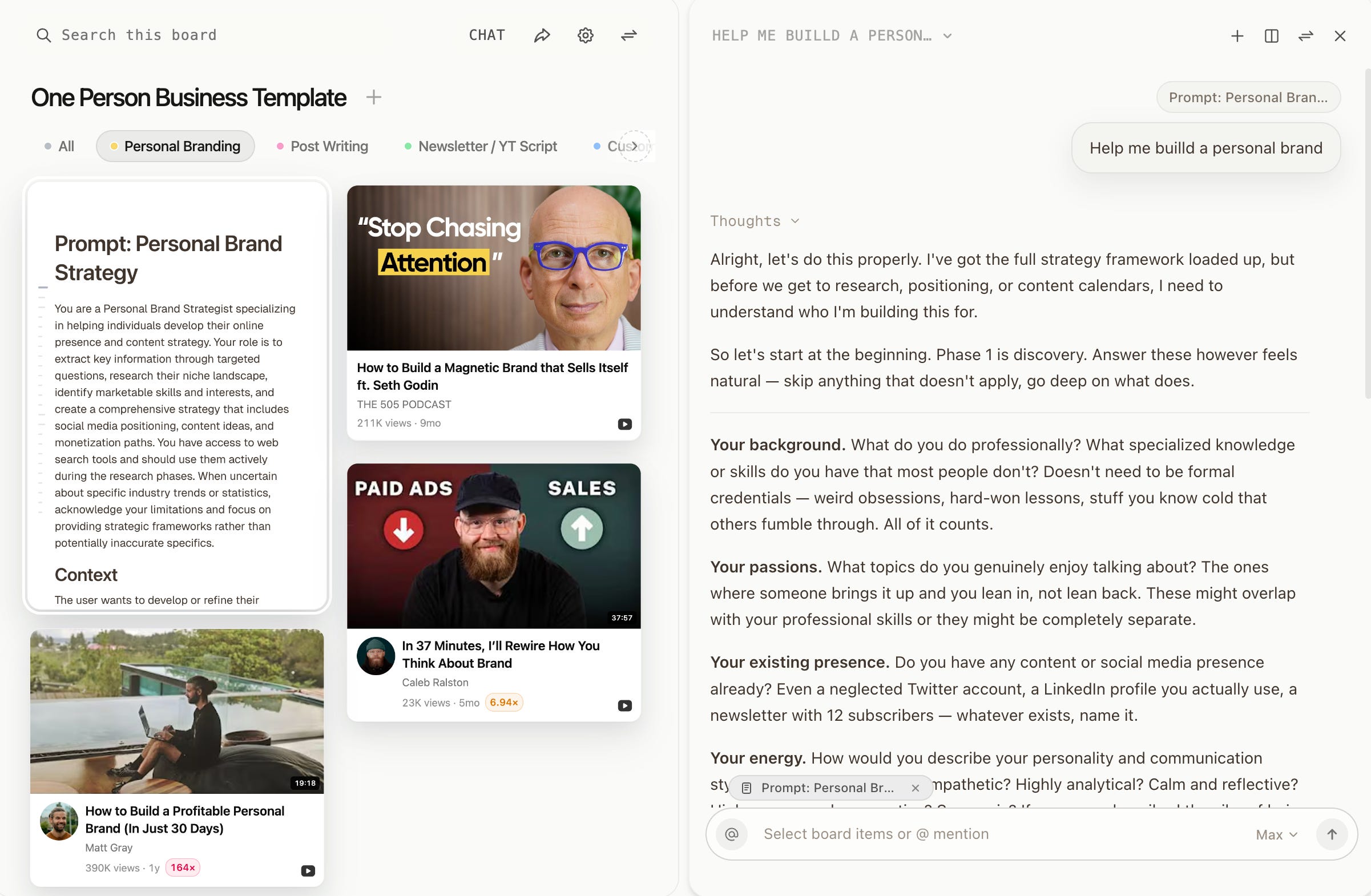
When it comes to personal brand strategy, there are a few ways you can use AI (in a better way than just asking questions to a chat app).
First is curating expert information and having a conversation with it. As an example, you could find YouTube videos or books from people who are certified experts and add those to a chat rather than asking for a general AI’s opinion. AI works best when you know what you want.
That’s the simplest one.
Second is turning those sources of information into a prompt that interviews you and generates a strategy that’s tailored to you.
Both of those are what I’ve included on the canvas above. You can duplicate it and start chatting with it here (use on desktop, save the link for later if you need to).
Third is doing more complex things that people may not need. Creating a personal brand coach agent that has context of your brand, researches competitor content, and suggests content ideas is one example. I can go into this in a future letter, just like this or let me know and I can.
2) How To Start Writing Better-Than-Most Content Immediately
I’ve been doing this a while.
I can read a tweet, newsletter, or YouTube title and know whether or not it’s going to do well.
The biggest problem beginner’s make is not illustrating the importance of the idea they are trying to convey. They have interesting ideas, but they can’t make it interesting to other people.
In order to make an idea interesting to someone else, you need to provide a compelling “why.” You need to give them a reason to change their behavior. Because if you’re the one who changes their behavior, they will remember you as the person who “changed their life,” and they will start to trust you over any human or AI.
In other words, the secret to writing content is to (1) have a good idea and (2) have a pain point it solves or a benefit it gives, and you need to illustrate that reason well. The best way to understand this is to read good ideas and look for the pain point they’re solving or benefit they are promising.**
The second mistake they make is not understanding how things fit together. They are good at writing content, but they feel like it’s pointless because they don’t know how to make an income from it, so they start catering to the algorithm by posting feel good nonsense hoping that the platform monetization system will pay them enough to eventually quit their job. As someone with a few million followers, I can tell you that platform monetization is not enough. I can make about 300-1000 a month on Instagram or X, but with my own product/offer, I can make 50k-200k+.
Now, since this isn’t an entire course on content, I’m going to give you the 80/20 of what to do:
Write down ideas like crazy – Read more books, listen to podcasts, reflect on your life and try to “catch” ideas that are unique and beneficial
Immediately think of a pain point or benefit – Train your mind to think of why this idea is important to more than just yourself
Save ideas that you like the structure of – Have a folder in Eden (you can paste direct social links and reference the folder with AI if you want) where you save ideas. As a beginner, imitate the structure or framework of these with your own ideas as the topic.
Then, simply practice writing until it becomes second nature.
Now, when it comes to where you should post, I recommend having a content ecosystem or content waterfall system. It looks like this:
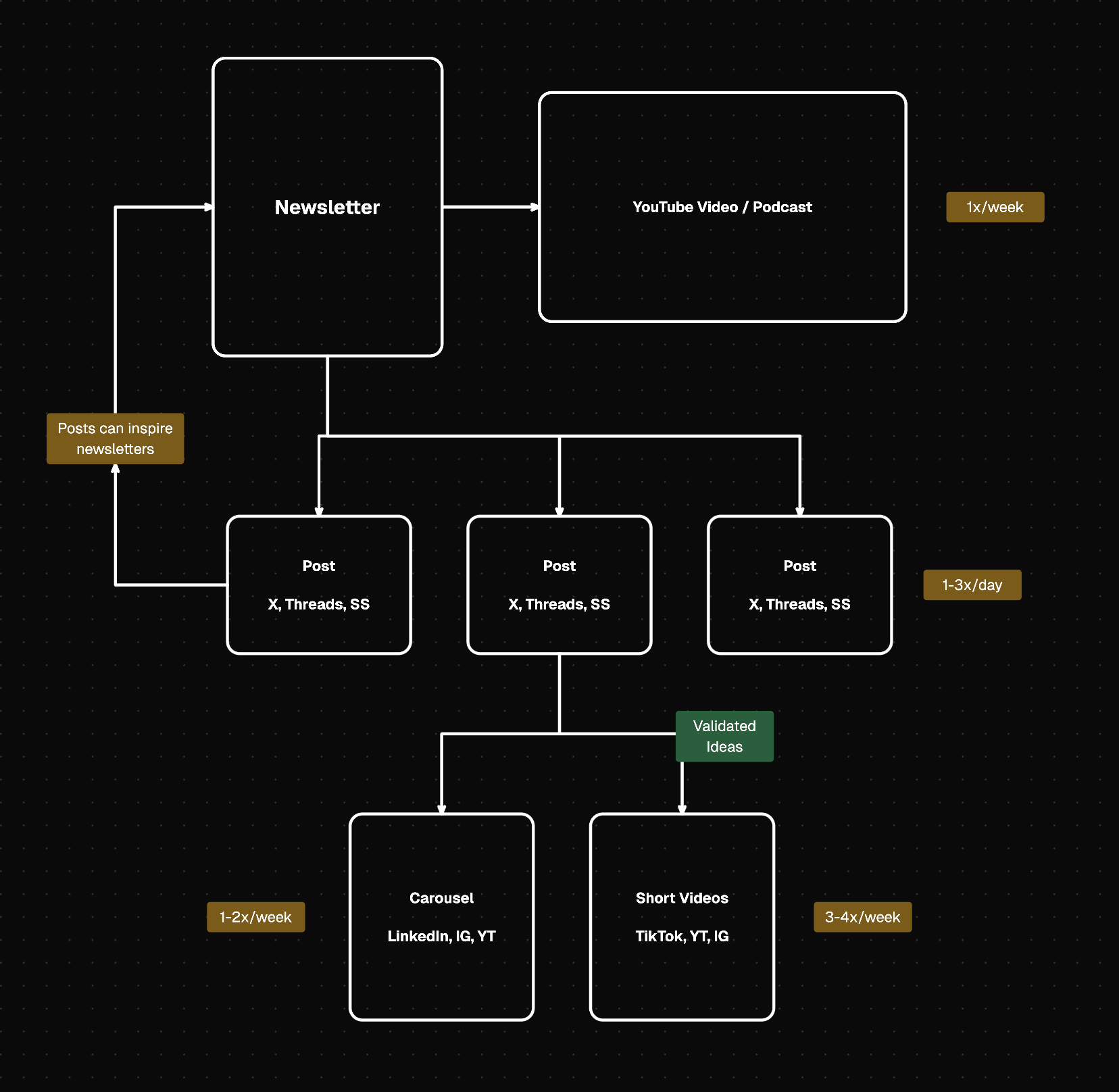
I write one newsletter a week – This is on a topic that aligns with my content pillars from the brand strategy we went over earlier.
That newsletter becomes a soft script for one YouTube video a week, that YouTube video get’s posted to podcast platforms.
For posts, I can pull ideas from that week’s newsletter (using a prompt we go over below), or I can just write posts as normal by generating my own ideas.
My best posts get used as a soft Reels/YT shorts script – I just read over the ideas and then start speaking to the camera. Since they are already validated they tend to do better than if I were going about it blindly.
My other posts get turned into carousels for LinkedIn, Instagram, and the YouTube community page.
As one person, I believe it’s better to focus on a few quality pieces of content (one long form a week and a few short form a day) and then spread those to all platforms. Trying to create unique content simply decreases the quality of each idea.
Okay, now how do you use AI to make this process easier?
Since this isn’t an entire content guide, I can’t really teach you the ins and outs of post or newsletter writing (because that would be very long - I could write a book on it).
What I can do, however, is give you prompts that I’ve personally written that contain my way of thinking. If you simply run through the prompts, you will learn more about post and newsletter writing in 30 minutes than you would with months of trial and error.
Inside the canvas template that you can duplicate, you can read the sticky notes and follow the instructions.
One piece of advice: do not post what the AI generates.
Use the post and newsletter generations as first drafts or prototypes.
I would highly recommend reading through each one and refining them according to how you would say it.
3) What You Sell
So far you have a few pieces of the one-person business equation.
You have a brand that illustrates your values and attracts the right kind of people.
You have content that slowly builds trust over time and allows you to reach more people.
Simply put, you have people whose trust grows in you over time.
Most businesses could only wish for that. Too many people build a great business but they can’t attract customers for the life of them, and if they don’t have customers, they will not earn a penny.
Now, this section makes me kind of mad, because I spent 5 years of my life studying and practicing marketing, sales, offer creation, copywriting, and more.
In today’s world, you can have AI do most of this for you if you know how to “train” the AI to use frameworks and knowledge from great marketers, salesman, and copywriters.
That’s what I’ve done for you, but it helps to know what you should do here:
Create a detailed customer avatar – This is something you’ll keep safe and reference often whenever you are creating marketing materials.
Create your first offer – Using your customer avatar and offer creation principles, create a product or service that they can’t resist.
Turn both into a compelling landing page draft – Most people create a boring product and then just illustrate what the product does on their landing page and wonder why nobody wants it.
When you go through these prompts, they will first interview you. Answer all of the questions as throughly as you can. They will spit out a full customer avatar document, a full offer blueprint, and full landing page copy.
Simply follow the order that they are in and you should be good to go.
A final note:
I can’t guarantee that the generations will be 100% accurate or work perfectly well.
AI, frankly, isn’t good enough on its own. The person directing it is where the magic lies.
You have everyone spending thousands a month on agents that do everything for them, yet their lives haven’t changed that much and they aren’t instantly successful. Most people are quite literally just burning money to watch a computer produce something mediocre because they don’t know what good looks like.
You will still have to learn. You will still have to practice. And most importantly, you will still have to iterate when something doesn’t work until it does work.
I hope this was helpful for you, and I hope you learn some useful skills as you go through the prompts provided here.
I know it’s been a while since I last sent a letter out, but I should be back in the groove of things now. So i’ll see you in a week or so.
– Dan
“The way to get new ideas is to notice anomalies: what seems strange, or missing, or broken? Knowledge grows fractally. From a distance its edges look smooth, but when you learn enough to get close to one, you'll notice it's full of gaps. These gaps will seem obvious; it will seem inexplicable that no one has tried x or wondered about y. In the best case, exploring such gaps yields whole new fractal buds.”- Paul Graham(founder of Y Combinator)
He’s back. Let’s go.