


This quote has been living rent-free in my head for the past year:
In my little group chat with my tech CEO friends, there’s this betting pool for the first year that there is a one-person billion-dollar company. Which would have been unimaginable without AI and now will happen.
– Sam Altman
A few years ago, I started to notice a few people who had built $1 to $10 million one-person businesses. Mostly education-based creators selling a mix of coaching and courses with social media as their way to attract an audience (because that’s what tech enabled one person to do - building an audience is free, creating information is free, both can be done with minimal time investment as one person compared to other business models like e-commerce or freelance/agency work).
But now things are different. Much different.
You can do much more as one person now than just last year, and the average person is completely oblivious to this opportunity, or they just think “AI bad” because their favorite celebrity said so.
The beautiful thing about it is you don’t need to get anywhere close to $1 billion, or even $1 million, to live a great life.
Most people just want to replace their salary and be able to afford minor luxuries without worrying about how low their bank account balance is.
For myself, when I started this whole online business thing, I just wanted to be able to afford Chipotle for lunch every day. I’m grateful to say we are well past that.
Ever since I was a kid, I never wanted to go down the default path.
I was very observant to those around me, and it seemed like going to school for an education that would be useless in 10 years, getting a job that you become dependent on, marrying someone you despise, and being promised retirement but never really being able to stop working was the norm. It disgusted me.
So I realized that some form of entrepreneurship was the only path out. The only path that would put me in control of more than just my financial situation.
And that’s what I did.
I failed over and over again. Fitness YouTube channel, dropshipping minimalist wallets, selling blue light glasses, freelance SEO, Facebook ads, and web design until I finally had to get a job because the student and credit card debt was piling up.
I saw that job as a deadline. If I didn’t make it work soon, I’d get complacent like everyone else does.
About 7 years ago, I was able to quit that job and do freelance web design.
About 6 years ago, I started on social media, and made around $10,000 with digital products.
The next year, $100,000. Then $800,000. Then around $4 million (my tax bill had officially quadrupled to what my old salary was). Then as I dove into software, my personal income stabilized around $1-2 million (pre-tax) while I started building something more long-term.
I have a lot to share about this one-person business thing, especially when it comes to doing more than I was able to do now that AI gives a massive advantage to those who are able to use it.
With that, let’s begin.
Real quick, the next Creator Bootcamp starts in 3 days.
If you want to create your niche of one, gain clarity on what to talk about, master short and long form content, and learn growth strategies that don’t make you dependent on the algorithm - join before then here.
Your interests (unique value) + Social media (free distribution) + AI (cheap force multiplication) = A profitable one-human business
As a one-person business, you’re going to post on social media.
Boooo, I know. It’s so hard to write a few words for 30 minutes in the morning and post it where everyone else in the world has the potential to see it. But social media is where the attention is right now, and you probably don’t have the capital to invest in paid ads or paying creators $2500 to post one reel about your product (yes, the prices are that absurd nowadays).
One piece of content can be spread to millions of people for free, if you understand how to make it good. For most people, you can probably get 100-500,000 impressions a month. All you need to do is get a tiny fraction of those people to buy your product or service.
I’m also assuming that you don’t care to start a service business and drown in client work. You want some form of freedom and a creative lifestyle. I personally prefer writing content and building products that can run while I sleep.
I’m going to give you a few “AI employees” you can just start using immediately below, but it helps to know what comprises this type of one-person business.
1) Brand - How you present yourself or your business to the world.
In your personal life, when people think of your name, what do they associate with you? Do they think you’re cool? Fun to be around? Helpful and trustworthy?
Brand is that, but for your business. Like a digital storefront.
It’s what makes people buy your app, course, product, or service over someone else’s, even if it’s a worse product. It’s what shapes how you market your product and who you market it to. This is how marketers made 10x more than indie programmers in the past, because they gave people what they wanted.
As a one-person business, in today’s world, your brand is probably going to be a personal brand. And even if you aren’t a one-person business, look at Elon Musk, Mr. Beast, and the rest. A personal brand is one of the most effective growth strategies, if you can pull it off.
It’s your values, worldview, and story externalized.
I’ll help you create a unique, irreplaceable brand that gives you all of your content pillars in just a bit. It’ll be worth it.
2) Offer - What people pay you for that helps them get a result.
You need a product or service.
That’s obvious... you can’t make money without one.
But an offer is the perceived value of that product or service. It’s how you package it. It’s the deal. This is one of the most profitable skills you can learn, because once you nail the offer, the landing page, copywriting, marketing, and the rest become that much easier.
That’s what you compete on. Not the product you’re selling, the deal you’re offering. The amount of value compared to price.
You can look at a tool like 1of10, which is great for YouTube research, but with Eden, you get research for all platforms, AI usage, social scheduling, an entire second brain and workspace, and more. The choice is obvious if you’ll allow me to brag a bit.
Offer creation is the art of pulling 4 levers.
The dream outcome - what the customer actually wants
The delivery mechanism - how you get them there (course, coaching, supplement, etc)
The speed of results - how fast you get them there
The guarantee - what happens if it fails
I’ll give you an AI you can chat with to learn about offer creation and create one people can’t refuse.
3) Distribution - How you spread your brand and offer.
Build distribution, then build whatever you want.
– Jack Butcher
We’re living in the internet age where attention = leverage.
You can have the best brand, you can have the best product, but none of that matters if nobody knows you exist.
Distribution, for what we’re concerned with, is everything from marketing to sales to content to ads to your landing page and website.
It’s how people find you, learn about you, and pay you (that’s what a “funnel” is).
As an example, you found me through social media content. You are reading this via email on Substack or X. And if I can display the value of my knowledge enough, you may grow to trust me to the point of using Eden (the greatest content research/creation tool) or enrolling in the Creator Bootcamp. Not because I swindled you into it, but because you see it as something useful for your own goals.
I could also run paid ads, sponsor other people’s newsletters, sponsor podcasts, or other things like that (and I have), but as a beginner who probably doesn’t have capital to invest in that, we aren’t going to focus on it now.
Right now, the way you generate attention as a small digital business is social media. You don’t need millions of views to get anywhere close to replacing your current income.
Social media is free to start, and content is permissionless leverage.
If you learn the skill of personal branding, offer creation, and content marketing, you will do quite well.
Pair it with AI and you’re ahead of almost everyone.
The AI team that used to cost $500k per year
Okay.
Let’s simplify this.
To start this one-person business, this is your daily routine:
Post 1-3 times a day on a short-form platform of choice. Substack, X, LinkedIn, Instagram, etc. Pick the one you vibe with the most. They all work. Start with one short-form platform. Get good at it. And once you have a backlog of ideas that have done well, take those and grow faster on other platforms.
Post 1 long-form piece a week. Substack or X. Probably Substack because your followers are email subscribers. If your main platform is X, then cross post the article there too.
Write content for 30 minutes and a section of your long-form piece for 30 minutes. 1 hour a day is really all you need.
Promote your offer once a day. Plug it inside your long-form piece. Link to it in a reply under your best post for that day. If you don’t ask people to buy your product, you obviously aren’t going to make any money.
Personally, I like to promote in my newsletter/article, then link to that article as a reply to one of my short-form posts - that way people subscribe to my newsletter, and if they read it, they’re more likely to buy my offer.
There’s a bit more to this of course, but this is the base.
You will have to go through quite a bit of trial and error until you start gaining traction on your posts, and it may be wise to research and experiment with various growth strategies depending on the platform (don’t just try one, fail, and cry because it didn’t work.)
Now, there are a few things we can have AI do here.
Brand Strategist - Create a personal brand strategy so you don’t blend in with everyone else, and study how your content is doing to propose growth tactics.
Content Strategist - Researches what’s performing across social media, understands all of your prior content, pairs them with your brand strategy, and delivers a week of ideas for you to post about (or have it draft content for you to edit if that’s your cup of tea).
Long-Form Specialist - Understands long-form frameworks and retention strategies, helping you outline a newsletter, article, or video script with your ideas in a well-structured way.
Short-Form Specialist - Takes your rough ideas and turns them into post drafts you can review, edit, and schedule to go out on all platforms.
Offer Consultant - Helps take your experience, interests, and expertise and turn it into a compelling offer, and helps you decide between what product or service to start with.
Marketing Strategist - Takes your offer, brand strategy, and customer avatar, then helps generate social promotions, email promotions, and landing page copy.
I’ve actually created all of these for you if you don’t want to go through the effort of creating them yourself.
Simply using these will put you ahead of almost every creator. Not kidding.
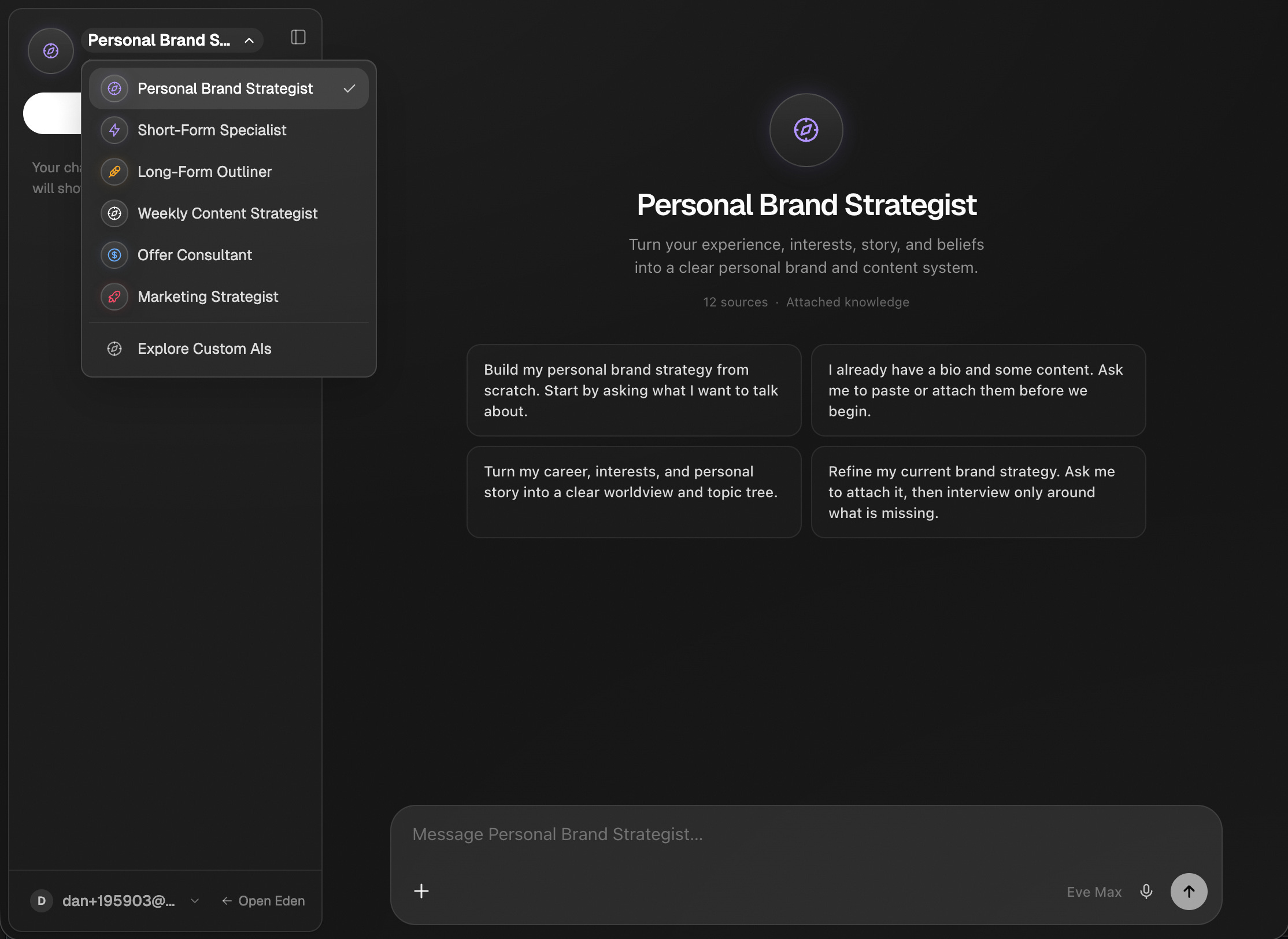
» You can find all of them here. One click and you can start chatting.
These work best in Eden, because it can research trending posts, see what works, and schedule content - but there are also skills you can quickly install into GPT-6 Astra (because it’s popular right now), Claude, or any other agent.
I’d recommend going in the order they are listed above. Start with brand strategy, then content, then once you have clarity on those, consider the offer consultant and marketing strategist.
Beyond those, and once you understand the process, then you can have AI start drafting content and potentially scheduling it for you, which is done in Eden. However, I don’t think it’s wise for beginners to do that.
You’ll notice that none of those involve having AI write for you, and that they do not automate the process that makes branding and content unique.
If you want to have AI do those things for you, I’m not opposed to it. It’s just not something I’ve chosen to do yet, even though I think it will be the future of how we write. My mind is starting to change on that front, which deserves another newsletter.
How to create your own AI team (the best way to use AI in general)
This section is going to lose quite a few people.
Because even though we’re talking about AI, it’s a difficult process in a world of cheap dopamine seekers. It takes a certain level of systems thinking to understand and implement.
The problem with AI is that people think of it as some kind of all powerful being.
And since it’s not an all powerful being, when it doesn’t do exactly what they want (because they don’t know what they want), they just assume it’s only capable of generating slop.
Yesterday, I saw some guy was begging businesses to not create their website with ChatGPT or AI because it “looks bad” and you can tell it’s slop.
If you actually use AI, you find this laughable.
It’s true... if you just have it one-shot the entire website and put no effort in beyond that. But if you give it examples and clear instructions, you’re off to at least a better start. After that, you have to start digging into the details. You have to tell it to tweak the border radius, the drop shadows, the padding, the column layout, and everything else you would already do in Figma, Photoshop, Webflow, or Framer. The process hasn’t changed, but the toolbar filled with knobs and numbers has turned into natural language.
Telling AI to “create a website” or “write a newsletter” or “write a viral tweet” today is like using a Wordpress template in the past. People can tell. There was just as much slop in the past as there was today, but AI is some special case that people really dislike.
You can stop there and have a pretty terrible website that does not make your brand stand out in the slightest, or you can use that as a starting point and iterate further, just like you can build an app and resolve the issues for weeks on end until it’s actually a good app.
The baseline for what is considered a modern Wordpress template will continue to rise, forcing people to either develop taste and experience or default to being perceived as average.
This is part of why my opinion around writing with AI is changing, because if you treated it like you did when you actually write, you’d realize you’d have more control, more creativity, and more opportunity to create something truly unique that nobody has even thought to do before. But people say “write this newsletter like me” and expect it to account for the hundreds, if not thousands of decisions they make when actually writing... obviously the AI isn’t just going to pull those out of your head and do exactly what you want, because you didn’t tell it to do that.
It only sounds like AI slop because the person chose to post it in that state, and doesn’t have the taste to notice it or the knowledge to iterate until it becomes something only they could create.
With that out of the way, how do you actually do this?
How can we create something like a weekly content strategist that’s actually good?
1) You need to know what good looks like, or have an example of what good looks like
When it comes to “good” content, there’s a lot at play.
There’s the structure of the post, article, or newsletter. There’s the creator’s vibe or energy signature. There’s the throughline of their brand and big ideas they incorporate consistently to get their worldview across. And there’s the unique ideas they stumble across that help them stand out from everyone else. All of this needs to be accounted for.
No AI is going to tell you that. You can only find it through experience or mentorship from someone who has that specific knowledge (that’s why reading this gives you a slight advantage).
But now that you know you need those things, you need the reference, example, or instructions to give to the AI because it doesn’t know how to do it on it’s own.
That means YouTube titles and transcripts of videos that represent the type of content you want to create. It means reels transcripts, Substack notes or articles, X posts or articles, or ample examples of the style of writing you like.
For web design, this usually just means giving the AI a ton of screenshots as you work through each section of the page you’re creating, or writing out in detail what you want.
That’s how I start almost every AI or agent chat that isn’t just a simple question.
If I know what I want, then I give detailed instructions. I’ve written 2000 word prompts teaching it to write tweets like I do, and it gets extremely close. You wouldn’t be able to do that just by asking it to look at my best tweets, because it will try to templatize those and doesn’t account for the thinking process that went into writing them.
If I don’t know what I want, then I start researching and asking questions until I have clarity and fill the context with the right information.
Meaning, I don’t just say “write me a newsletter.”
I ask questions that help me decide what a good newsletter looks like.
In your case, you could ask something like, “I want to write one of the greatest, most engaging newsletters in the world. Something that stands out and doesn’t sound robotic. Let’s treat this as a brainstorming session until we land on a style that I like. Start by asking clarifying questions on what you need from me to make this happen. We’ll go from there.”
At the end of that conversation, ask it to condense everything into one document.
Now you have a document you can reference in other chats at any time.
2) You need to understand the process that gets results, or start with someone else’s process until you develop your own
For a content strategist, this isn’t as simple as “research top performing posts and give me ideas.” That’s what the slightly above-average person would do. The average person would just ask the AI to write viral posts.
When I think of my own process, it’s something like this:
Read books, save ideas, have conversations with friends, listen to long lectures for ideas that nobody is talking about online
Pick an idea at the intersection of (1) what I am excited to write about (2) what people will massively benefit from and (3) what is already validated and performing well
Brain dump title ideas for the article/script, and find the best ideas that would fit into that piece
Consider which long-form structure would be the best to house those ideas and start outlining it
From that outline, brainstorm 10-20 short-form content ideas that I can take and run with
This is also considering I have the branding side of things down, which is an entirely different story - that’s what would allow the content strategist to understand my worldview, influences, mission, brand enemy, and more that would further refine the ideas and make them unique to me.
The difficult part is turning that into a process that AI can help with.
It obviously can’t read books for me or discover ideas for me. That’s the edge that can’t be outsourced.
But I can capture all of this into my Eden library, which auto-tags and connects ideas, so the AI can pull from that bank of ideas each week to give me a few options that are likely to do well. Meaning, I can focus more on reading and learning rather than treating it as something to outsource, because I enjoy that process.
Then, the main thing I need to do is instruct the AI on how to perform good research, what ideas are worthwhile (celebrity posts that went viral aren’t a signal as to what’s performing on social media. Small to mid-size account’s outlier posts are), how to match the right topics to my own novel ideas, and examples of my own content structures that have worked in the past.
Then you have it spit that out into a table I can work from and you have something like the Weekly Strategist AI that runs on autopilot every week.
3) You need to continuously improve and iterate the system you build, as you’ve always needed to do.
We are building a system here.
And if you’ve ever used a Notion template or had any form of morning routine... you understand that sometimes a system isn’t always reliable, or you outgrow it, or something throws a wrench in it and it doesn’t work for that specific situation.
But that isn’t a reason to think that the system doesn’t work altogether. And it doesn’t mean that you abandon it entirely. It means you iterate and make it adaptable.
With AI, this means that whenever you notice something wrong, you tell it what’s wrong. You improve the system. You propose a solution or converse until you decide on a better way of doing it.
I think most people are too afraid of uncertainty.
This doesn’t click for them.
And that’s fine, those people need to step into the arena and stop trying to outsource everything to AI before they even know what to outsource.
But for those who do understand this, it is truly revolutionary what you can do in today’s world.
I hope this was helpful, and I hope the custom AIs serve you well. They are pretty darn powerful if you use what you learned in this letter.
Talk soon.
– Dan
Last call - Creators Bootcamp starts in 3 days.
When everyone can create and build, the value of creating and building goes to zero and shifts to knowing *what* to create (and then into knowing how to get that creation in front of people it will benefit most).
Gone are the days where a scattergun, volume approach would work. People are drowning in AI-generated slop and content that is produced for content's sake. The value now is in authenticity and proof-of-human. So wherever possible, don't use AI in place of your own demonstration of that. Use it to streamline processes, offload trivial or mundane tasks or the boring parts of building. But don't let it do the part that matters most: creative, authentic, demonstrably human work.
That's what will set you apart.
(More on why you should avoid using AI to write for you here, from both a reader and writer's perspective: https://hereisyourbrain.substack.com/p/ai-generated-content-mind-virus)
Interesting ideas.
The dots are starting to connect for me now.