


Your ability to think determines the outcome of your life.
That is not an exaggeration, and learning to think has never been more important.
Especially if you consider yourself a smart person, because you are the most likely to think like an idiot.
I mean, it’s all over social media. There isn’t a day that goes by where you see a person with a verifiably high IQ fall into obvious traps.
There are plenty of smart people who live in their moms basement who are one french fry away from a heart attack, and there are plenty of dumb people who are abnormally happy, healthy, and wealthy.
Rather than talking about first-principles thinking, systems thinking, meta cognition, or anything else that you can ask ChatGPT to teach you about, I want to give you something different.
We’re going to start with one-dimensional thinking and slowly work our way towards 5d thinking.
If you read carefully, you will experience what it’s like to think on a new level.
If you’re so smart, why are you broke?
Faith is much better than belief. Belief is when someone else does the thinking.
– Buckminster Fuller
Thinking tip number one:
If you want to understand what something is, like genius level thinking, then it helps to understand what it is not.
That way, we can identify and avoid stupid thinking.
When we observe what stupid thinking looks like, we come to a few insights:
Stupid thinking is one-dimensional. People try to jam everything into their own perspective and have difficulty seeing outside of it.
Stupid thinking is reductionistic. Experts in one domain, like business, try to reduce everything to a “strategy” problem, as an example.
Stupid thinking is tribal. You only trust your group, party, or tribe and consider everyone else wrong because they don’t conform.
Stupid thinking does not question. Your justification is “that’s just how it’s done.”
As a whole, stupid thinking is about closing your mind off once you’ve reached the limits of what you know.
Stupid thinking is to stop thinking too early. To reach a point where you react with your pre-programmed thoughts and fail to reach any novel insight.
With that, we can start to guess at a worthy definition of genius thinking, which could be:
The ability to hold threatening ideas in the realm of possibility, paired with the intention to understand rather than just know. The mark of genius thinking is illustrated by the width, depth, and height at which you can think without being cut off from venturing further, often due to holding an idea as absolute. It’s your ability to traverse the full, universal web of ideas (reality, all potential knowledge) and pull them together into something coherent or useful, if not something entirely new.
The question then is, what’s the difference between knowing and understanding? And how do you develop width, depth, and height of thought? What if you can take it even further than that?
Knowing is horizontal. You learn a lot and memorize facts about a specific domain until you become competent. People who know a lot are “experts,” but we don’t need more experts in today’s world.
Understanding is vertical. It’s about how sophisticated your entire cognitive operating system is. One can understand a lot while knowing very little and use that insight to take an action that leads to a more worthwhile result.
The “smart but dumb” phenomenon stems from being horizontally advanced but vertically stuck. A businessman who has all the money in the world but finds himself unhappy. A creative with beautiful work that can’t make a living. A meathead that can’t hold a steady relationship. They know a lot in their respective domain, but can’t see outside of their bubble of knowledge, and that bubble of knowledge does not provide enough surface area to identify and solve problems that lead to suffering.
That’s why learning how to think is so important.
Because your mind is how you interact with reality.
You process information → make sense of it (thinking) → make a choice → receive information as feedback → respond to that feedback and repeat the cycle.
Thinking, then, determines the outcome of your life.
Every passing moment where you engage in stupid thinking contributes to a compounding effect, digging you into a rut so deep you can’t even access the idea that would lead you out.
Altitudes, levels, and lines of thinking
You can’t solve a problem from the same level of consciousness that created it.
– Albert Einstein
Let’s work from the ground up.
Lines of thinking are domains you can know a lot about.
Lines represent horizontal development (width).
These can be anything. Marketing, astrophysics, politics, social dynamics, religion, etc. When you attempt to learn domain specific knowledge, you are increasing the width of that line of thinking. It’s like gaining experience in a video game.
(By the way, if you’ve studied Ken Wilber at all, you can see what I’m getting at here, just applied to thinking).
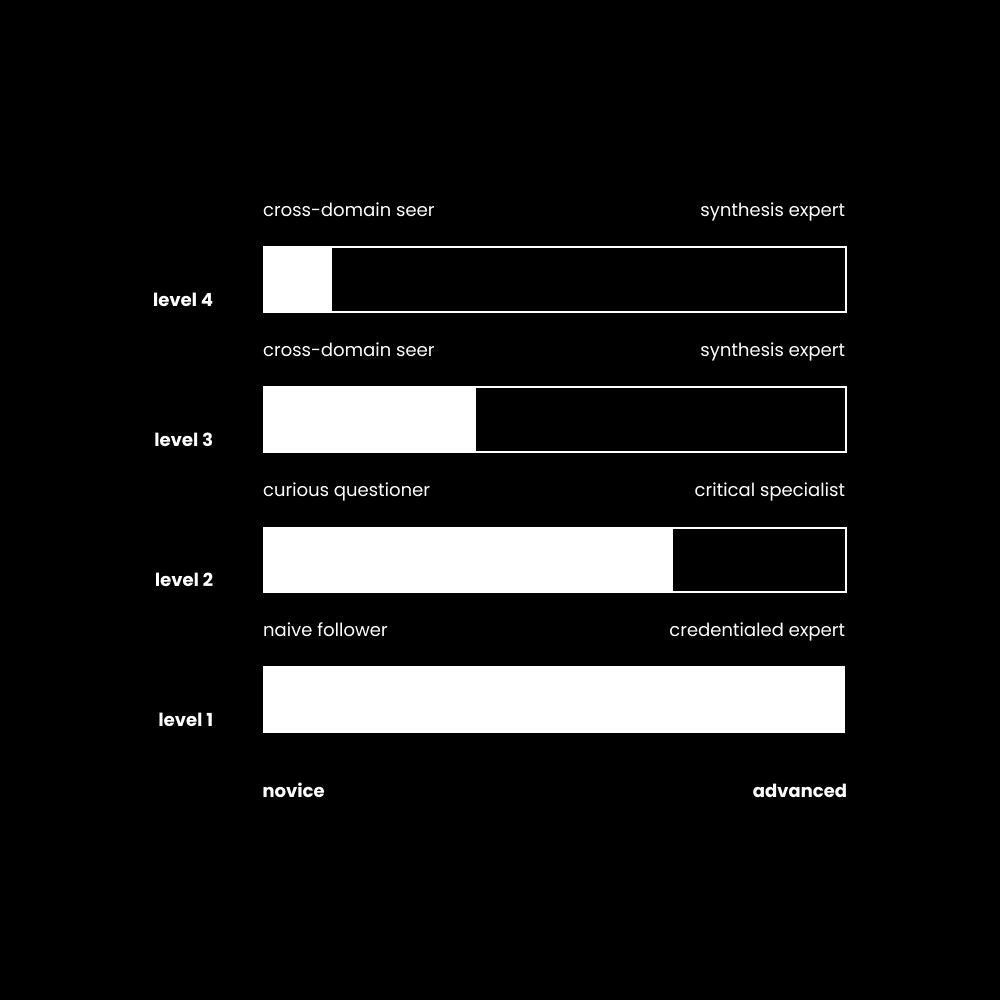
Levels of thinking are how you think about each line.
Levels represent vertical development (depth).
When we observe how cognitive development evolves in collectives and individuals over time, we can notice 5 core patterns:
Instinctual (Level 0) – You are born act out of the need for pure survival. You react to stimuli with little thinking in between.
Conformist (Level 1) – Black and white thinking. You follow rules and obey authority without questioning. You adopt others perspective.
Individualist (Level 2) – Critical thinking emerges and you construct your own model. You build your own perspective.
Synthesist (Level 3) – You see your model as one among many. You hold contradictions and use perspectives as tools rather than law or some unquestionable truth.
Generative (Level 4) – You create original perspectives that didn’t exist before, or you come to ideas without outside influence.
Levels 1 and 2 can be considered “first tier” thinking, which is overly dogmatic. I’m right you’re wrong.
Levels 3 and 4 can be considered “second tier” thinking, which reject dogma and seek the ultimate truth that lies in the middle.
In the domain of meaning, you are often indoctrinated into one belief system, then you question that belief system and come to your own conclusions (often rejecting the prior), then you start to see truths in all belief systems, and finally you have the ability to create a more expansive one.
In politics, much of the fighting and violence we see is do to the general population operating within levels 1 and 2. My group vs yours. Neither side can think beyond their bubble.
Again, and I want to make this exceedingly clear because it is such an easy trap to fall into:
Genius thinking is the ability to continue thinking.
At each level of thinking, your ability to navigate that space of both known and unknown ideas continues to expand. When you are born, you don’t really think. When you are a conformist, you think until you reach a point where you have “the” answer, then you start defending that answer. When you are an individualist, you do the same thing, but with your answer. When you reach synthesist, you can think far and wide, but your ability to create new lines of thought is not fully developed yet.
Reaching your highest ability to think, and thus providing the runway for your highest potential in this life, boils down to the simple practice of noticing when your mind feels threatened, being honest with yourself, and at minimum, staying open to new perspectives.
Altitude of thinking is the average of all your levels.
Altitude represents cross-dimensional development (height).
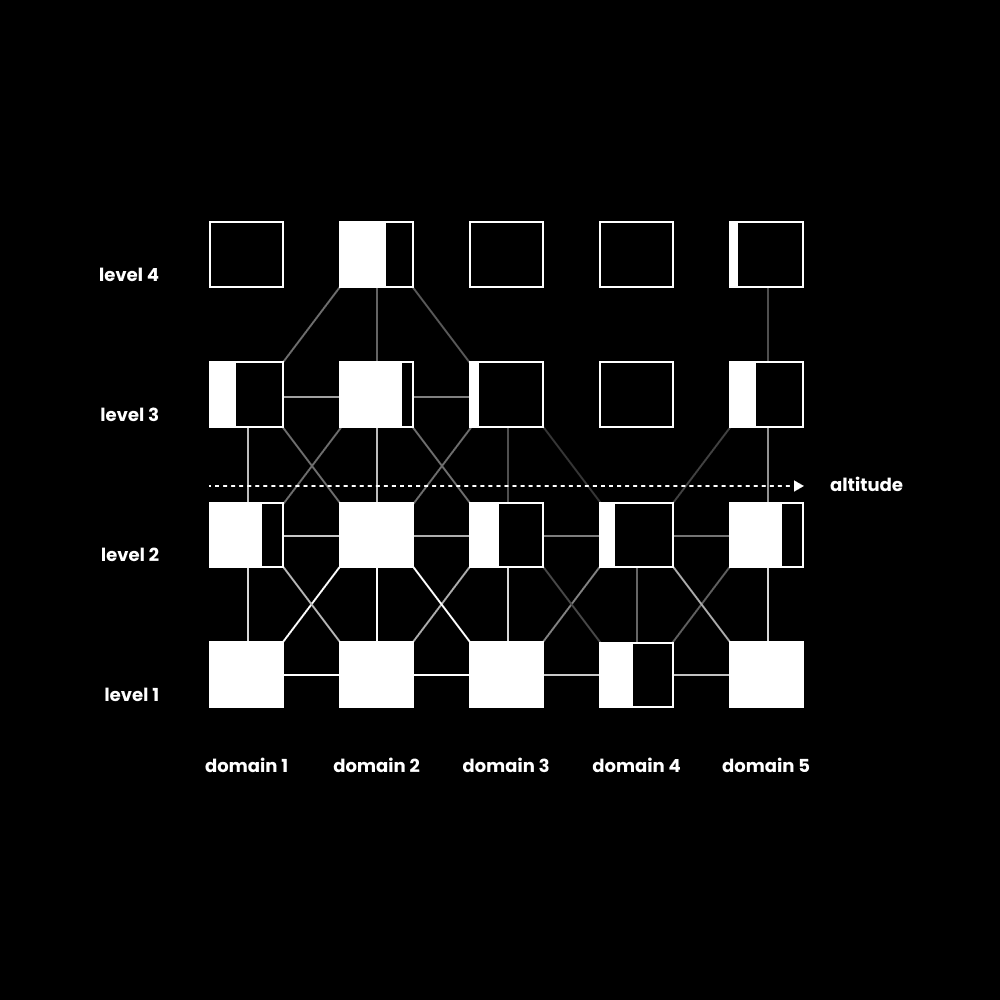
To best understand this, and to almost complete the thinking puzzle, it helps to visualize thinking as a skill tree.
In a video game, you can put “points” into certain traits that allow you to do more inside the game. You can take on higher challenges, have more fun, and continue playing. The same holds true with the mind.
The thing is, higher level traits can only be unlocked once you meet a specific requirement of lower level traits. You can’t access “level 3” of dexterity without reaching “level 4” of strength, as an example.
In the real world, imagine you started a business. You learned everything about marketing, sales, and product. You’re verifiably smart. You make a good amount of money. But then you try to take it further, and you hit an invisible road block. You can’t identify what’s wrong and then blame it on what you know: “the market just isn’t big enough,” or some permutation of that. Your mind is closed and there is no way forward.
Further, business isn’t all there is to life, obviously. If the rest of your life is falling apart, you, as a business person, will try to jam a circle into a square hole. You may relieve the issue temporarily, but you never understand the root cause.
This is mostly why the domains of politics, religion, and others like nutrition are so hostile and polarizing. It’s a bunch of smart but dumb people calling each other idiots because they’ve stopped thinking and only defend what they believe is the one right way.
Back to business, the problem is that you can’t see the actual problem. It could be that you don’t know how to lead a team. It could be a time management issue. It could even be a spiritual issue, but you’re too business minded to even entertain that possibility. At a minimum, that perspective could birth the insight that leads to further progress. This is why generalists and polymaths win.
In other words, you can’t reach Level 3 of business because you haven’t “put points” into the other required domains that would unlock that level.
How to unlock 4-dimensional thinking
There is a fourth dimension to thinking.
Well, it’s not really a fourth dimension like time, but it does increase your ability to think by the power of four.
You see, there are 4 “dimensions” of reality.
These dimensions are perspectives. You can change how you look at a belief, idea, situation, or problem in 4 major ways.
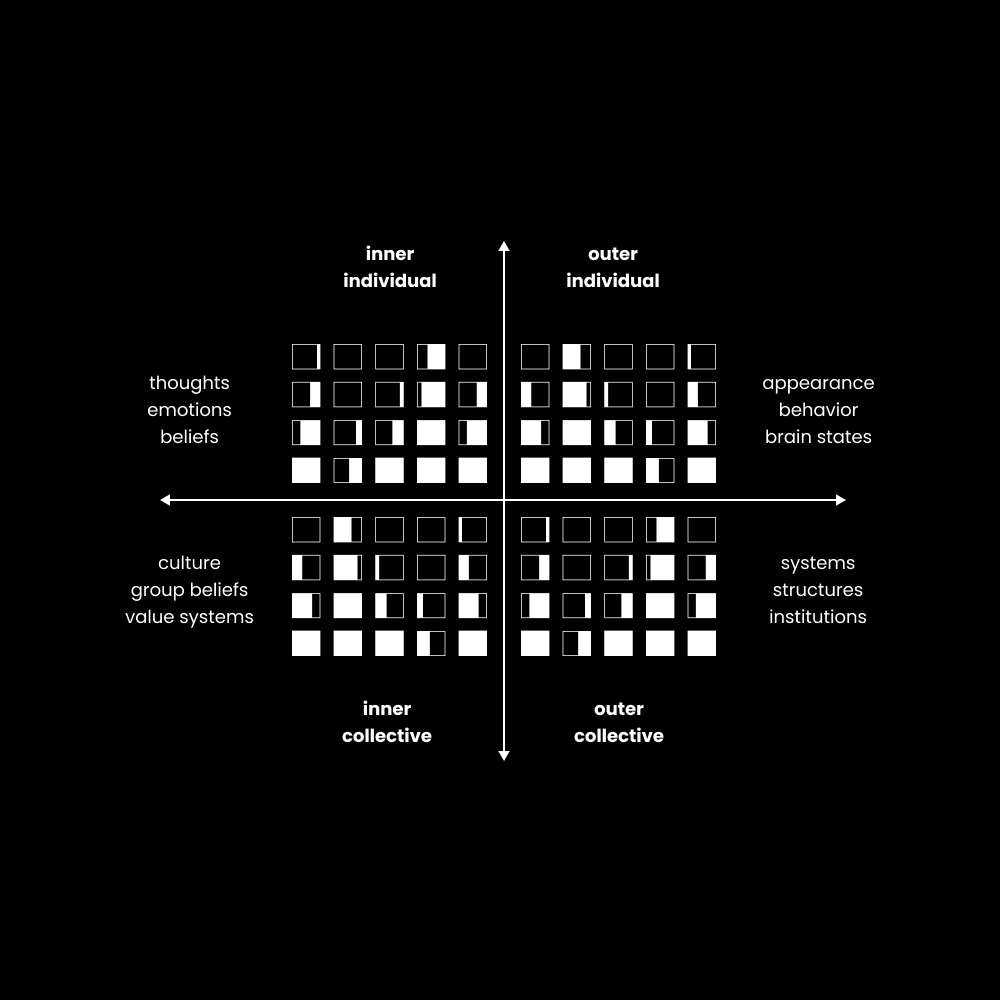
There’s the inner world and the outer world, and there’s collective and individual segments of both.
The inner world is mental. By that I mean psychological and cultural. Your individual inner psychology contains your thoughts, emotions, beliefs, and consciousness. The collective inner world, or culture, contains group beliefs, value systems, and ideologies.
The outer world is physical, which sounds less woo-woo, but you can’t deny that you can think about the mental, which is what we’re here to talk about. Your individual outer world is your visible appearance, behaviors, and physical brain states or measurements. The collective outer world is composed of systems, structures, and social institutions.
To illustrate the power of understanding this, let’s walk through a thinking progression.
I learn a lot about marketing and use that knowledge (line of thinking)
I practice, fail, and experience enough to understand that there isn’t “one proven framework,” but I have such an understanding that I can create outperforming marketing campaigns of my own (levels of thinking)
I pursue interests like psychology, fitness, and personal development which gives me deeper pattern recognition that further removes me from dogmatic frameworks (altitude of thinking)
From there, things start to get interesting, and it can go in so many different ways.
One thing we forgot to mention is that thinking is usually done for the sake of solving a problem. That’s what humans do. That’s how we grow. That’s what we find fulfillment in. And the minute you stop growing (and thus thinking), problems multiply and life becomes ever more chaotic.
So, if we identify a problem like “the world is becoming corrupt and meaningless,” we can continue our thinking in that direction.
How does society control attention and market their ideas to the masses? (collective inner world)
How can your behavior change, more than it already has during this process, to have a positive impact on society? What would be the steps to reaching such a point of influence that you can leave your mark? (individual outer world)
What does the current job market look like? Is a job an actual path to achieving such a thing? What about AI? Can I utilize the technology available to me to have that impact? (collective outer world)
Am I thinking about this the right way? Or is there more? What am I missing, and how does this make me feel? Motivated? Inspired? Hateful? (individual inner world)
We could go on and on, but I think you get the point.
Genius thinking is the ability to direct attention in a useful direction. You gradually encourage your mind to zoom further and further out, and from there you have a more enlightened vantage point to zoom in on the original problem you sought to solve.
How to tap into the 5th dimension
It is no measure of health to be well‑adjusted to a profoundly sick society.
– Krishnamurti
Yes, I know, this isn’t actually the 5th dimension.
It’s the fourth dimension (time), but I’m trying to practice my thinking here by making things up, and when you apply time to all four dimensions of reality we just talked about, your ability to think continues to rocket upward.
In all previous examples, we never tapped into the power of history. And if you understand history, specifically the evolutionary patterns rather than memorizing the events, you can aim your thinking in a more accurate direction.
This illustrates the difference between knowing and understanding. You can know a lot of facts about specific moments in history, and that’s a great thing, but if you can’t zoom out to see the essence of what that moment represents, you may fail to spot that pattern across different domains.
There are 5 things you need to know to begin thinking effectively about history. These aren’t exhaustive, and there is far more to it, but this is a good enough starting point.
1) The master pattern is Transcend and Include
A materialist would say that reality is composed of atoms, and they’d be correct.
A mentalist would say that reality is composed of qualia, and they’d be correct.
But if we zoom out for the sake of understanding, the pattern is clear that reality is composed of whole parts (wholes that are also parts of a greater whole).
Matter → Life → Mind
Word → Sentence → Paragraph
Machine → Computer → Artificial Intelligence
Human → House → City → State → Country → Continent → Planet → Solar system → Galaxy
Each is a whole that transcends and includes the one before it. Meaning, if you remove the thing that allows another thing to exist, the entire chain self-destructs (which is why environmentalists are so worried about climate change. If the biosphere collapses, humans go down with it).
This will make sense with examples.
2) How individuals evolve physically
This one is simple since most people can see it, touch it, smell it, etc.
Atoms → Cells → Molecules → Organs → Organism
You can think about the physical world by how individual things develop, not just humans.
3) How individuals evolve mentally
Humans develop through an increasing circle of care.
First, we care about ourselves and our survival (egocentric).
Then, we care about our tribe, group, or culture (ethnocentric).
Next, we care about all groups regardless of differences (worldcentric), but since the master pattern is transcend and include, we still care about ourselves and our tribe, and that must be accounted for in our thinking. We do not sacrifice ourselves or our values simply because caring about others sounds virtuous. This is usually where the arguments between most groups happen, because some use “caring about the equality of everyone” as a moral high ground that can often be self-destructive, which is counterproductive to caring about everyone.
At the most developed levels, we care about reality as a the ultimate whole. This clearly requires one to be able to think through vast amounts of complexity to come away with anything practical.
4) How societies evolve physically
Social structures follow technology.
We went from tribes to villages with the invention of the hoe that enabled small scale farming.
We went from villages to empires with the invention of the horse-drawn plow (because a surplus of food allowed people to focus less on farming and more on exploring, discovering and conquering.)
We went from empires to nation-states with the invention of machine agriculture.
Now, with computers in our pockets and AI at our doorstep, I’ll let you think about where things could go.
5) How societies evolve mentally
Since individuals compose the collective, societies evolve through a similar pattern of egocentric, ethnocentric, and worldcentric.
Collectives have an identity too.
The tribe can only care about itself and it’s survival. Then, it can expand into a larger empire or nation-state, holding multiple sub-groups within it.
In this case, we call these worldviews pre-rational, rational, and post-rational. First we conformed to authority, then we sought progress through science (the enlightenment), then we began to realize the blind spots of both while integrating the good parts.
But how would you actually use this knowledge to “think?”
Here’s a few ways out of many:
Identify where individuals are when you encounter an idea, movement, or conflict. Who do you want as a politician when entering the age of AI?
When engaging in debate (political, business, personal) notice the level people are operating from. Individuals at higher levels of development often need to meet people where they are.
Look at the technology of societies and organizations. A business still operating on industrial era methods (and are too dogmatic to adapt) will probably fail.
The most useful application is to locate where your own center of gravity is. I would encourage you to reread this letter at another time while thinking about your own development.
We missed something important
Stupid thinking is when you stop thinking.
We know that.
But what makes a person stop thinking? What makes them turn from open to defensive, closing themselves off to further learning and growth?
The answer is identity.
Specifically, latching onto ideas, beliefs, or constructs and making them a part of who you are.
Because if you are a diehard republican or democrat, you will never be able to think outside of that bubble. Therefore, you will never be able to find the truth of the situation. That doesn’t mean that you can’t adopt certain values from either side, it simply means that you don’t need to feel threatened when someone else disagrees with you.
The same applies to identifying with a specific religion, group, vocation, or anything else we’ve discussed prior.
You must also consider how you came to those beliefs.
Most people, in today’s world, have never thought for themselves a single day in their life.
They were born into a specific part of the world.
That part of the world was at a specific level of development.
They were told what to believe by parents who probably hadn’t questioned their own beliefs.
Those beliefs shaped how far you could think, which probably wasn’t very far.
And remember, your mind is how you interact with reality.
You process information → make sense of it (thinking) → make a choice → receive information as feedback → respond to that feedback and repeat the cycle.
The space in which you can think determines the outcome of your life.
If you only think within the confines set by your parents, teachers, employer, and peers on social media, the outcome of your life may not be that pretty. Just observe where the average person ends up and it’s not hard to see.
So, the next time you feel threatened, do not collapse in on yourself.
Sit with it. Question it. Realize that your mind wants to feel safe, because that’s how it’s wired.
Our brain is still wired like our hunter-gatherer ancestors, but we do not live in that world anymore, and the world will only change faster.
Those who practice thinking will win.
– Dan
I heard a term the other day about having T shirt shaped knowledge. Some breadth across many areas, and some real depth in one or two. Personally, I think if we zoom out too much, we risk getting stuck in a kind of nihilism.
Maybe life is more like using a microscope. Sometimes you zoom in to see the fine details. Sometimes you zoom out to understand the bigger picture. What matters is the movement. Zooming in and out, back and forth, to see the shape of your thinking.
in a day to day basis, while talking to someone, we should try to see their life, decisions, and statements from different perspectives. i feel like that's a basic skill a lot of people lack.