


There are two versions of you walking around right now.
One of them is the version you perform.
The one with the LinkedIn headline, the job, the goals that sound respectable at dinner parties, the five-year plan you recite when relatives ask what you’re doing with your life.
This version is competent. This version is impressive on paper.
This version is, statistically, probably miserable.
The other version only shows up for about forty minutes on a Sunday afternoon. Usually when you’re alone. Usually right after you’ve finished something you actually care about.
For those forty minutes, you are not tired. You are not anxious. You do not need to check your phone.
You feel, for a brief and infuriating moment, like your life is actually yours.
Then Monday arrives and the first version takes back over.
The gap between those two versions is the most important problem in your life. Everything else (the discipline issues, the motivation problems, the vague sense that something is off) is downstream of it.
I call that gap a failure of Identity-Lifestyle Fit.
Product-market fit is when what a company builds matches what the market actually wants.
Before you have it, every day is a grind. Founders describe it as pushing a boulder uphill, convincing people to care, tweaking the pitch, and burning cash.
After you have it, the market pulls the product out of your hands.
It’s the day you’ve been waiting for.
Identity-Lifestyle Fit is the same phenomenon, but the product is you and the market is how you live.
When you have it, your calendar is inviting rather than daunting. The work you do feeds the person you’re becoming. Discipline stops feeling forced and starts feeling effortless. You wake up and rather than hiding from the day by pressing snooze, you can’t wait to get up. Very few people can say they have this type of life.
When you don’t have it, you are in a constant but quiet war with your own life.
You set goals and miss them.
You build habits and drop them.
You achieve the thing you said you wanted and feel nothing.
You spend your twenties optimizing a life you never consciously chose, and then wonder 40 years later why you did that at all.
Most productivity and self-help advice is a bandaid over this, so it’s important that we get to the root, which is deep in your head.
You don’t need a better morning routine.
You need to figure out whose life you’ve been living.
Why this letter may give you an existential crisis
In the next few minutes, I’m going to show you three things.
First, why the beliefs running your life were installed before you were old enough to consent to them (and the research that proves this isn’t just a feeling).
Second, how to surface the specific belief that’s currently keeping you stuck in whichever area of your life feels most off right now.
Third, a seven-day protocol for testing that belief against one you’d actually choose.
If you do this honestly, you will not finish the week the same person who started it.
That’s the point.
This will be incredibly comprehensive.
We are going to dig deep into your psyche.
All I ask is that you set aside time to actually read this.
Resist the urge to get distracted, even if every sentence doesn’t give you a little hit of dopamine. You have to earn it with this letter.
If anything, atleast read to Phase 2, The Inversion Test, of the belief interrogation... because that alone made me question much of my life as I wrote it.
I - How life-determining code got written in your head without your permission
Every person alive is running on a set of beliefs about what will make them happy.
These beliefs are mostly invisible to the person holding them.
They feel less like opinions and more like how reality “obviously” is.
The person grinding toward a million dollars genuinely believes the million will fix something. The person chasing the relationship genuinely believes the relationship will save them. The person building the business, the body, the audience, the farm, the family... all of them are right, in the sense that they’ll feel a real hit of meaning when they get there.
And all of them are wrong, in the sense that the hit wears off in weeks and they’re left standing in the same body with the same nervous system, wondering why the thing didn’t do what it was supposed to do.
This is how the mind works.
We move toward what we believe will make us whole.
The problem is almost nobody stops to ask where those beliefs came from.
A thousand years ago in ancient Japan, there was an old Zen monastery holding a sesshin (their enlightenment intensive). These were multi-day retreats where monks would meditate for their enlightenment.
During an intensive, an annoying cat wandered into the room and began meowing. At first, the monks ignored it, but the cat kept going to the point where the monks became agitated by the noise.
The Zen master instructed one of the young monks to go tie the cat outside in the front of the monastery by a post so it couldn’t sneak back and disturb them.
The sesshin continued, and it turned out to be a retreat where more monks than usual achieved their enlightenments during that intensive.
Centuries later, monasteries throughout Japan would adopt the practice of tying a cat outside the front door.
One young monk, new to the monastery, was tying up the cat when he asked the Zen master, “Why are you forcing me to tie this cat outside? What’s this going to do?”
The Zen master replied, “This is the cat of enlightenment. When we tie this cat outside, it causes more of the monks to have their enlightenments. So do as you’re told.”
And the young monk did just that.
Whether the story is literally true doesn’t matter.
What matters is that you are the young monk, and your entire life is full of cats you tie up every day without asking why.
Your operating system was installed before you were old enough to object
Between the ages of roughly two and seven, your brain runs in a state called theta wave dominance. It’s the same brain state adults pay hypnotherapists to access.
You absorb everything.
You don’t even really have the ability to determine whether or not the information is good.
The tone your mother used when money was tight. The way your father talked about his boss. Whether ambition was celebrated or resented at the dinner table. Whether curiosity got you praised or told to sit down. Whether you were loved when you performed or loved when you existed.
By the time you’re a teenager, those patterns have hardened into what feels like your personality, or at least that’s what we call it.
By the time you’re twenty-five, they’re foundational pillars in your psyche. You can’t just remove them or else everything the pillars support will crumble.
This is why the twenty-nine-year-old who “suddenly” quits the corporate job to start a business isn’t what most people think. He’s not impulsive or taking a massive risk.
Instead, he’s been running a script his parents wrote in 1998, and somewhere around his late twenties he accumulated enough contradictory evidence to finally question it.
The script breaks.
He either writes a new one or finds a new script to follow.
Most people find a new script.
Your job (if you want your life to feel like yours) is to write one.
The data is unfortunately, uncomfortably specific
If you think I’m just speaking nonsense, the research is worse than you’d guess.
The World Values Survey has tracked the beliefs of over 100 countries since 1981. It’s the largest dataset on human values ever assembled.
The core finding, after four decades of research: your values are overwhelmingly predicted by the survival conditions of your childhood.
That is, the economic and cultural pressure you grew up inside.
People raised in scarcity prioritize security, tradition, obedience, and in-group loyalty. People raised in abundance prioritize autonomy, self-expression, creativity, and meaning.
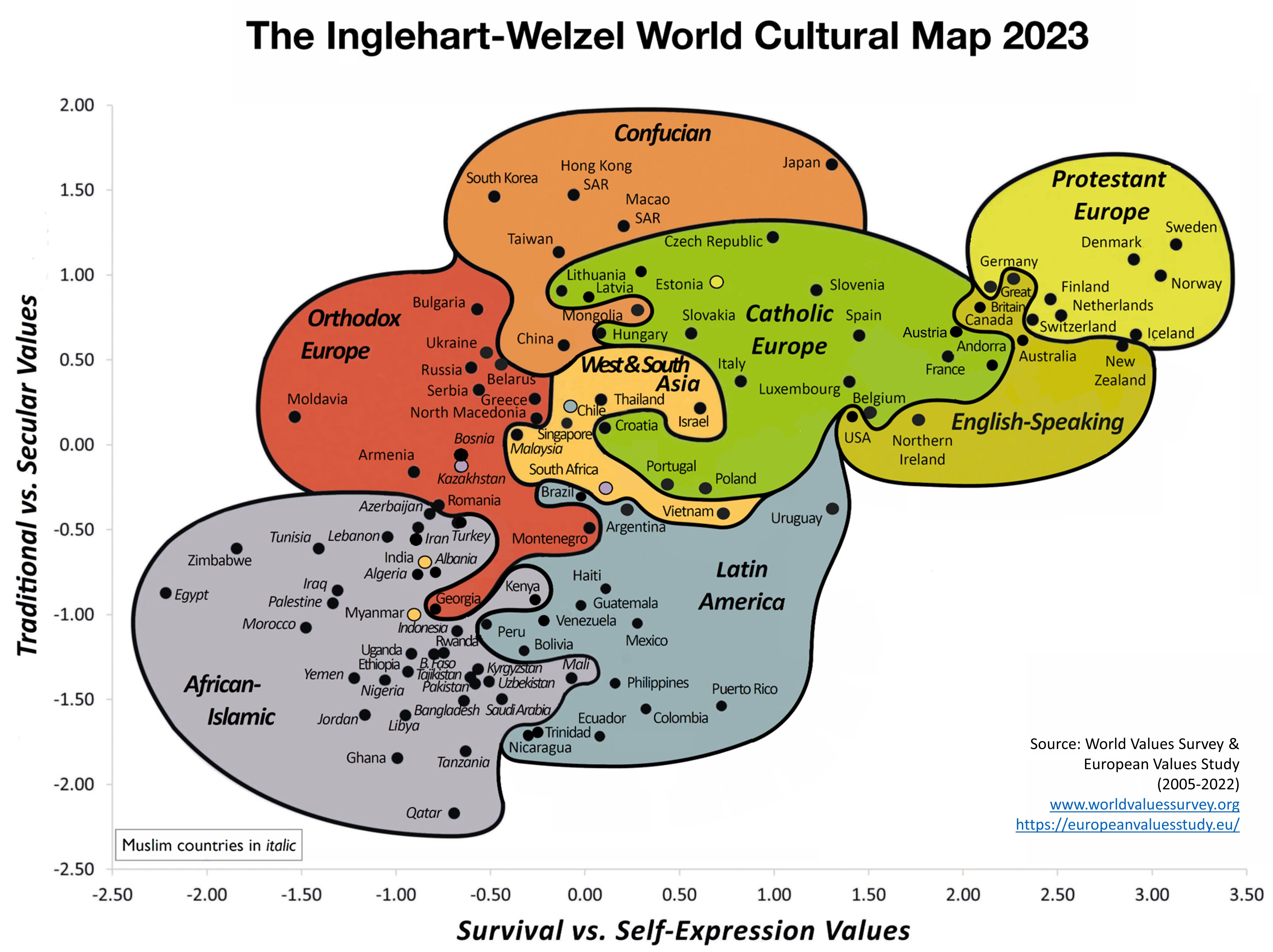
This means the “values” you’re defending as your “deepest truth” are, statistically, a pretty accurate readout of your parents’ tax bracket and country they lived in 1998.
For understanding, you can argue that Christianity (or whatever belief system) is the one true religion, but if you were born on the other side of the world, you would not believe that. You would be a completely different person on a different life trajectory. You can talk about abundance and energy as a laptop lifestyle bro who moved to Bali, but you can’t deny the fact that the culture and ability to live like a king largely shaped those beliefs.
That should bother you.
It bothers me.
If you never interrogate the script, one of two things happens
Option one: you succeed at it.
You hit the milestones assigned to you. You get the job, the salary, the partner, the house, the kids, the retirement account on track.
And somewhere around thirty-five or forty, you realize you are exhausted in a way sleep doesn’t fix, and the life you built doesn’t feel like a life. It feels like a performance you can’t stop performing because too many people are watching.
This is the “midlife crisis.”
But you can have this crisis well before midlife if you want, because waking up inside someone else’s goals is the cause, rather than age.
Option two: you fail at it.
You can’t sustain the discipline to chase goals that aren’t yours, so you drift. You half-start things. You consume other people’s lives on your phone for three hours a night.
You tell yourself you’re lazy, or broken, or unmotivated, when the truth is simpler and more humiliating:
You can’t commit to the life because the life isn’t yours to commit to.
There is a third option, but very few people take it.
Because it requires doing the one thing the script was specifically designed to prevent:
Questioning the script while you’re still young enough to write a different one.
That’s what the rest of this letter is for.
II - How to recreate yourself by interrogating your beliefs (a 7-day protocol)
It is only those who are in constant revolt that discover what is true, not the man who conforms, who follows some tradition.
- Krishnamurti
There are two types of beliefs operating your life:
Inherited beliefs - the ones installed during childhood by your environment, parents, culture, and survival conditions. These are unconscious. You didn’t choose them.
Chosen beliefs - the ones you consciously decide to live by after examining your life. These are intentional and iterative. They change when experience demands.
Most people don’t even think about these.
Or worse, they think they have certain beliefs and their actions say otherwise.
This is why most people feel unfulfilled. Their stated values and their actual values are different values, and they don’t know it.
The next seven days are a protocol for finding out which is which.
Before you start, pick one domain of your life that feels most off right now. Health, career, creativity, finances, relationships.
Just one for now.
You can pick other ones if you want to repeat it for future weeks, and if you do, those 5-6 weeks will be the most transformative era for you.
III - Phase 1: The Excavation (Days 1-2)
Before you can test a belief, you have to find one.
This is harder than it sounds.
Your inherited beliefs are not labeled. They show themselves in your daily actions, but those actions are too normal for you to notice. They feel exactly like your own opinions.
In fact, they feel more like your own opinions than your actual opinions do, because you have never had to defend them.
They’re the water you’re swimming in.
The only reliable way to surface an inherited belief is to work backwards from your behavior.
What you actually do, every day, is a confession. Your calendar, your bank account, your screen time, and the things you say yes and no to... these are the honest signals of what you believe, regardless of what you tell yourself or anyone else.
This phase takes two days. The goal at the end of it is one written sentence (one belief) that you can test in Phase 2.
Day 1: The audit
Answer these four questions in writing.
Not in your head. In writing.
(You should be pulling out a paper or notes app right now).
The act of forming the words is where the belief shows itself. It will resist being named, and you’ll watch yourself soften the answers as you type.
Don’t let yourself.
The more the answer embarrasses you, the closer you are.
Remember the area of your life you chose above. The one that feels the most “off” like health, relationships, money, creativity, etc.
Question 1: In this area, what do I say I want?
The polished version. The one you’d give at dinner with trusted friends.
“I want to build a side-business.”
“I want to be in the best shape of my life.”
“I want to do meaningful creative work.”
Whatever your stated goal is, write it down exactly as you’d say it out loud.
Question 2: In this area, what does my actual behavior reveal I want?
Now look at last week.
What did you actually do? No masking the truth by focusing on the one productive block where you got something done. Think about the entire week.
Where did your time go? Where did your money go? What did you open your phone to do when nobody was watching?
Write the answer as if you were describing a stranger whose life you’ve been observing.
This is an important part.
The stranger’s wants are different from the wants you claimed in question 1.
Name them.
Question 3: What would I have to believe for the stranger’s behavior to make sense?
No man can think, feel, will, nor even dream, without everything being defined, conditioned, limited, directed by a goal which floats before him.
– Alfred Adler
This is the question where the work you’re hiding from reveals itself.
A person who says they want to build a business but spends their evenings watching other people build businesses on YouTube must believe something that makes consuming feel like progress.
A person who says they want to be in the best shape of their life but has skipped the gym for three weeks must believe something that makes skipping feel acceptable.
Behavior is never random. It is always the output of a belief and a goal. Usually one the person would deny holding if you asked them directly.
I beg of you to understand this.
It’s the difference between saying and displaying.
You may say you want to build a business, but you display that you just want to stack evidence that you tried and it didn’t work, so you stop trying without having to admit you were scared to actually succeed.
Back to question 3, write down what that belief would have to be for your behavior to make sense to a stranger. Phrase it as a sentence starting with “I believe...” and finish it in a way that would actually produce the behavior you described.
Examples of what might come out:
I believe that preparing to start is the same as starting.
I believe that if I commit fully and fail, I will not survive it.
I believe that I am only lovable when I am producing.
I believe that wanting something publicly is humiliating unless I already have it.
I believe that rest is something I have to earn and I haven’t earned it yet.
None of these sound like beliefs a thoughtful adult would choose.
That’s the point.
You didn’t choose them. You inherited them.
Question 4: Who in my life, living or dead, would nod if they read that sentence?
Somebody taught you this.
Not with a lecture. With a thousand small moments.
A parent’s tone of voice when you came home with a C. A coach who only gave you praise after a win. A friend group that mocked anyone who tried and failed publicly (for some reason it’s cringe to be a try hard). A grandparent who survived something hard and passed the survival posture down as a family value long after the danger was gone.
Name the person, or the type of person.
We’re not blaming the person here. We’re just deepening the identification of the belief.
You are doing it because a belief whose source you can see is a belief you can question.
Day 2: The confirmation
Day 2 is for checking whether you actually found the belief, or whether you found a decoy.
Because the mind is tricky, and it will always try to deceive you.
They look like real beliefs but the ones that sound deep but wouldn’t actually change anything if you inverted them.
A real inherited belief, named correctly, should make you slightly nauseous to read back. It may even trigger full on disgust. So much disgust that you can’t imagine yourself believing it anymore.
If your Day 1 sentence feels noble or admirable or insightful, you haven’t found it yet. You’ve found something you’d post on Instagram.
Run the sentence through these three tests:
Test 1: The specificity test.
Does the sentence point at one specific area of your life, or is it a general platitude?
“I believe I’m afraid of failure” is a platitude.
“I believe that if I launch the business and it fails, my father will finally have proof that he was right about me” is a belief.
The first one is a theme. The second one is a pillar in your psyche that if removed will be painful, but will then allow the potential to recreate yourself. You can decorate an old house, but if the foundation is rotting, you’re solving the wrong problem.
If your sentence reads like a book title, go back and write the version you wouldn’t say out loud.
Test 2: The prediction test.
If your sentence is the actual belief, it should predict your behavior in situations you haven’t considered yet.
Try it. Given this belief, what would you expect yourself to do next time you had a chance to publish something? Ask someone out? Raise your rates? Spend a Saturday alone?
If the belief accurately predicts your behavior across three unrelated scenarios, there’s something there.
If it only explains the one behavior you started with, it’s probably a narrower belief masquerading as the root one. Keep digging.
Test 3: The resistance test.
Read the sentence out loud. Then read it again.
If a part of you wants to add qualifiers (well, it’s not exactly that, it’s more like...) that resistance is the signal.
You’re close. The belief is defending itself.
Let the resistance happen, then write the sentence one more time, more honestly than before.
The final version is the one you take into Phase 2.
What you should have at the end of Day 2
One sentence. Written down.
Specific enough that you could explain it to a stranger in thirty seconds. Uncomfortable enough that you don’t want to share it with anyone.
That sentence is the belief you will invert in Phase 2. Everything downstream of this moment depends on it being honest, so spend the time to get it right.
Most people will not.
Most people will write something vaguely self-critical, feel proud of themselves for the introspection, and move on without changing anything.
You are welcome to do that. It will feel productive for about a week and then your life will return to exactly the shape it had before you started reading this.
The alternative is to write the sentence you don’t want to write.
IV - Phase 2: The Inversion Test (Days 3-5)
This is where it gets uncomfortable.
Because testing requires you to act against the exact instinct that has kept you safe your entire life.
Your nervous system does not distinguish between “this belief is outdated” and “if I act against this belief, I will be cast out of the tribe and die.” It treats them the same.
That is why inversion feels like physical risk even when nothing is actually at stake.
The goal of this phase is to design one small action that contradicts the inherited belief you surfaced, take the action, and watch what your mind does in response.
The watching is the work. Not the action.
When you act against an inherited belief, your brain will flood you with reasons the action is a mistake.
You do not need to fight it. You need to see it clearly, name it, and keep going.
Here are seven inversions, each targeting a belief I see chewing up ambitious people in their twenties and thirties.
Pick the one that makes your stomach drop.
That’s the one you need.
1. “I need to finish learning before I start.”
You’ve bought the courses. You’ve read the books. You have a Notion database of strategies you’re going to implement “once you’re ready.”
You’re not going to implement them.
You use learning the way other people use Netflix. It’s a way to feel productive while not actually risking anything.
Inversion: This week, publish something unfinished.
A post, a product, a landing page, a first client offer. Doesn’t matter.
Ship it before you feel ready. You will not feel ready.
You will probably feel like your survival is at stake.
Watch for that feeling specifically. It is the one you’ve been organizing your whole adult life around.
2. “I just need to be more disciplined.”
Every time you fall off a habit, you conclude you need more discipline.
So you build a harder system. You buy a new planner. You try the 5am thing again. It works for a few days and falls apart.
You blame yourself.
Inversion: For three days, do not try to be disciplined. Do not force a single habit.
Instead, track what you naturally do. What you reach for when no one is telling you to do anything.
Most people discover that when they stop forcing themselves to do things, the life underneath isn’t one they actually want to live.
And that’s okay, that can be changed.
That’s what you’re trying to realize here... that you don’t lack discipline. Instead, you just don’t want to do it, and you should probably act toward the thing you want.
3. “I’ll pursue what I want after I have financial security.”
You have a number in your head.
Six figures saved.
Enough to quit.
Enough runway.
The number keeps going up.
Every time you get close, the goalposts move, because while you think the belief is about money, it’s not. You’re waiting for permission.
You are waiting to be told it’s okay.
Inversion: This week, spend 90 minutes on the thing you would do if money were handled.
Not “work on the side project.” The actual thing. The one you’re embarrassed to say out loud.
Write the novel. Sketch the building. Draft the album.
You live in the 21st century. You can do whatever you want.
Do it badly. Do it in secret if you need to.
The goal is to prove to your nervous system that pursuing the thing does not kill you. Which is what it currently believes.
4. “I need to build a personal brand.”
You post because you’re supposed to post.
You’re building an “audience” for a product you haven’t made, teaching a skill you haven’t mastered, performing a version of yourself that you curated by studying three creators you kind of resent.
You tell yourself this is self-actualization.
Even though this is something I preach and recommend, the last thing I want is for you to be assigned a belief by the person who tells you not to be assigned beliefs.
Inversion: This week, write one piece of content that would cost you followers.
Share the opinion you’ve been softening. Say the thing your niche doesn’t say.
If your output is so calibrated that it couldn’t possibly alienate anyone, you aren’t building a respectable brand. Everyone is unfortunately a clone nowadays. I’m personally taking weeks off at a time to prevent this.
Find out what happens when you aren’t trying to perform.
Usually, the people who were going to unfollow were never your audience anyway.
5. “I should have figured this out by now.”
You are 26, or 29, or 32, and you have a clock in your head telling you you’re behind.
It’s humorous when you gain perspective.
Your friends are getting married. Your college roommate got promoted. You look at LinkedIn and feel nauseous.
You work harder to catch up to people whose lives you do not actually want.
Inversion: For seven days, delete the apps that tell you what other people are doing. All of them. Instagram, LinkedIn, X, whatever you use to benchmark yourself.
Do not replace the time with more work.
Just let it be empty.
Most people discover within 2 days that the urgency they’ve been running on wasn’t theirs. It was manufactured by watching a highlight reel of strangers.
The belief running this pattern is “my life is a race against people I don’t know.”
Remove the input and see if the feeling survives.
It usually doesn’t.
6. “I’ll be happy once I hit the goal.”
No you won’t, and you know it.
You have hit goals before.
You hit them and felt a three-day high and then felt nothing and set a new goal.
This has happened enough times that a sane person would update their model.
You have not updated your model, because updating would require admitting that the thing you’ve organized your life around doesn’t produce what it promised.
Inversion: Write down every meaningful goal you’ve achieved in the last five years. Next to each one, write how long the satisfaction lasted.
Be honest.
For most, the satisfaction maybe lasts a week maximum.
Now look at your current goal (the one you’re grinding toward right now) and ask, without flinching, whether there is any evidence at all that this one will be different.
7. “I don’t want to be like them.”
There is a person, or a group, whose life disgusts you.
The corporate lifer. The Instagram wellness girl. The crypto bros. The non-tradwife. The 9-to-5 middle manager.
You organize a lot of your identity around not being them.
Your career choices are partly negative. Not because of what you want, but because of what you refuse to become.
Inversion: Sit down and write what you’d do with your life if the person you most define yourself against did not exist.
If there was no one to be unlike.
Most people discover that a surprising amount of what they call “their path” is just the inverse of someone else’s.
Finding out what you want in the absence of an enemy is one of the most clarifying exercises available to you.
How to actually do this
Pick one.
Not three. Not all seven. One.
The instinct to do all of them is itself a form of avoidance. If you’re busy running seven experiments you don’t have to fully commit to any.
Pick the one that made your stomach drop when you read it. For me, it’s number 7. That’s the belief doing the most damage.
Run the inversion for three days.
Keep a note on your phone (not a journal, a note) and write one sentence every night: what did the old belief say today, and what did I do anyway.
That’s it.
At the end of three days, you will have done something almost no one does. You will have generated firsthand data about whether the beliefs running your life are actual pillars or just loud.
Everything after this point is a matter of what you decide to do with that data.
V - Phase 3: The Verdict (Days 6-7)
By now, you have have a lot of power in your hands.
You surfaced a belief running your life without your permission. You designed an experiment to test it. You ran the experiment and watched what your mind did in response.
You have five or six days of data/evidence about what happens when you act against the script.
The last two days are for deciding what to do with that evidence.
Sit down with your notes and answer three questions.
These are not prompts. These are decisions.
Did acting from the chosen belief feel more alive, even when it was uncomfortable?
Alive is the key word.
Not happier. Not easier. Not more productive.
Alive. Meaning present, engaged, awake in your own life in a way you usually aren’t.
If the answer is yes, the chosen belief is closer to the truth of who you are than the inherited one.
And the discomfort you felt is a sign of growth. You have learned that the thing you feared has not, in fact, killed you.
Did the inherited belief hold up under examination?
Sometimes it does.
This is not a failure. Some of what you inherited is worth keeping.
But keeping it consciously, after examination, is different in kind from keeping it by default.
The inherited belief you chose to keep is now a chosen one.
That upgrade alone was worth the week.
What will you refuse to go back to?
This is the decision that matters.
Not what you’ll do. What you won’t.
Write one sentence, specific and non-negotiable, that names the version of your life you are no longer available for.
I will no longer live as if I need permission to pursue what I want.
I will no longer treat rest as something I have to earn.
I will no longer perform a version of myself to keep people who don’t know me comfortable.
Whatever it is. Write it, date it, and keep it somewhere you’ll see it.
That sentence is the only real output of this entire week.
Everything else was scaffolding to get you to the point where you could write it honestly.
VI - Please close the gap
Go back to the beginning of this letter.
There were two versions of you walking around. One was the version you performed. The other was the version that showed up for forty minutes on a Sunday when nobody was watching.
The entire point of this protocol was to start closing the gap between them.
Not by discovering some hidden true self buried beneath your conditioning (there is no such self, and the people selling you one are charging too much for it).
But by noticing, in real time, which version of you is making each decision. And slowly, deliberately, giving more of your life to the one that actually feels like yours.
That is what Identity-Lifestyle Fit is.
It is a practice of choosing, on repeat, over years, the beliefs that compose your mind and behavior.
The belief you questioned this week is one of probably fifty that are still running. You’ll surface the next one when you’re ready.
The work does not end. The work becoming conscious is the thing that changes.
Here is what I can promise you:
If you do this honestly (this week, and again next month, and again the month after) your life six months from now will not look like your life today. At all.
All without optimizing your routine more or working 12 hour days.
Because you stopped spending your one finite life performing a script written by people who did not know you, could not have known you, and in most cases meant well anyway.
The version of you that shows up on Sunday afternoon is a preview of what your life feels like when it’s actually yours.
Most people never get more than forty minutes of it.
You are not most people, or you would not have read this far.
– Dan
Aristotle said, “the faculties that guide us are sense, reason, and desire.”
Mindset = what we see (sense) + how we interpret it (reason) + what we actually want (desire)
The gap you’re describing isn’t just psychological — it’s structural. Most people don’t suffer from a lack of discipline or clarity; they’re running a life that was assembled from signals that were never theirs to begin with. That’s why it feels like effort all the way through.
What stood out to me is the Sunday version. That’s not some hidden “true self” — it’s just what happens when the noise drops and your behaviour lines up, even briefly, with your nature.
I think the real question is simpler and harder than a 7-day protocol:
What are you consistently drawn to when there is no audience and no reward?
Because that’s the only place where alignment actually starts. Everything else risks becoming another, more sophisticated script.
Most people won’t close the gap because the performed version is socially rewarded. It pays, it signals, it protects.
But if you keep choosing it, you don’t get a dramatic collapse — you get something quieter:
a life that works, and still doesn’t feel like yours.