


Nobody knows what skill to learn right now.
AI? Coding? Marketing? Am I wasting my time if I go to school while everyone else is vibe coding apps they’ll never get traction on? Do I start a YouTube channel? What about a Substack? Should I even try getting a job? Or should I build my own thing?
There is more opportunity than ever, yet that opportunity paralyzes more people than ever. There are so many options, but you feel like if you start learning one thing, it will be irrelevant in the next 1-2 years.
However, there is one skill that will never go out of style.
A meta-skill, if you will, that once you learn it, increases the power of any other skill you learn.
What is that skill?
Human nature.
Because if you understand how the human mind works - what makes it tick, what makes it pay attention, what makes it take action... then you can make any business successful. You can work your way into new opportunities. You can make friends and influence people. You can navigate through life with elegance and grace because you are no longer a slave to your mind, but a master of it.
How else are you going to succeed outside of a job? Humans are the ones with the money to pay for your independent work. Humans are the ones who have access to the resources and opportunities you want. And even if your goal is to get a job, how are you going to get your dream job if you do not understand this?
But how in the world do you “learn” something as intangible as human nature?
In this letter, that’s what I hope to provide: The steps and principles that you can apply today that will give you a competitive advantage against everyone else who is racing to succeed as fast as possible because they think AI will somehow save them from their lack of experience.
Subtle reminder: If you want to build an audience via writing on social media (to attract people who support your independent work), the bootcamp starts in 5 days. Enroll before then here.
The Anatomy Of Human Nature (And How To Exploit It)
The mind is a story engine.
That’s what humans can’t help but pay attention to.
Robots are useful for utility. Nobody would care (aside from the DMV workers) if the DMV was completely automated and made efficient. Who in their right mind looks forward to standing in a long line for hours just to get a new picture for your driver’s license?
Same with fast food, or riding in an Uber. Nobody likes when the cashier gets your order wrong. Nobody likes riding in a dirty back seat while someone you don’t know asks about your day simply because they want you to tip them.
Let the robots solve utility, that way, humans can abstract out to meaning, purpose, and narrative.
Humans love stakes. Our chest gets tight when their team is about to lose in the final inning. Humans love novelty. We travel across the world to dine in a 5-star restaurant.
Mastering human nature is about mastering story.
But I’m not going to teach you how to write a novel. No. Instead, I’m going to teach you the principles of value creation. If you understand these, you will write better, speak better, create better products, attract more customers, make more friends, and understand how to create value for others, thus increasing the value of yourself.
In essence, I am teaching you marketing, sales, and how to influence people all in one go.
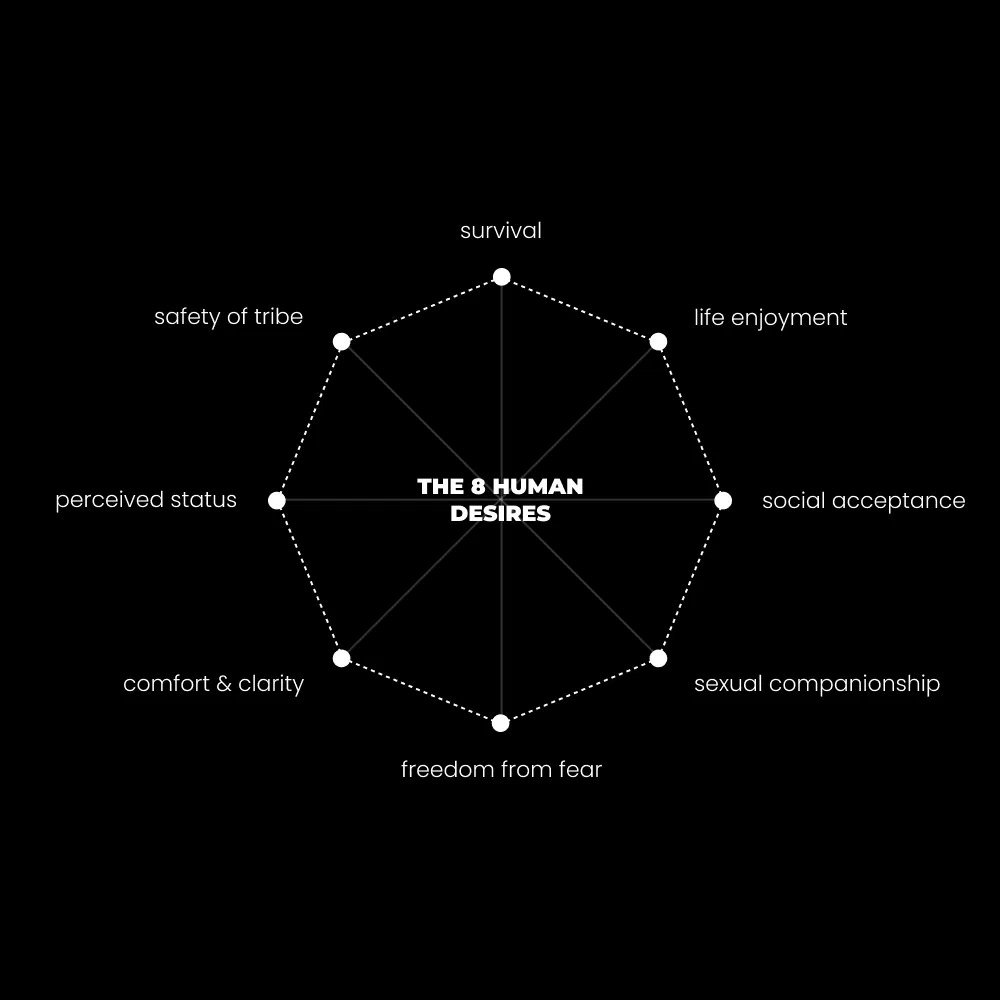
The mind has three pressure points. Press any one of them, and attention is almost involuntary (if you’re speaking to a person who is prone to that specific tension). And if you press all three, you have a grip on someone that logic alone can’t break.
If you nail The Three Tensions into your head and remember them every time you write, speak, or interact with someone else - you will be surprised with how much opportunity comes your way.
1) Survival Tension
The mind is a story engine, but it is also a set of survival strategies.
We’re in constant, subconscious threat detection mode because we still have the same wiring as our hunter-gatherer ancestors. We don’t want to die, obviously, so we desire safety and solutions to problems (and if you can make someone aware of a problem, then provide a solution, that’s sales in a nutshell.)
But “safety” doesn’t only apply to physical life or death situations here. It lives on a spectrum. Even the smallest problems can seem like the end of the world if we let them take over our mind. Those problems can be financial, social, or even just about a missed opportunity that could put you ahead (or have better chances at survival).
A few examples:
You wake up at 30 and realize you’ve been living on autopilot, and the gap between who you are and who you want to be is so large that change feels impossible.
You spend a decade building someone else’s dreams just to find that they don’t care about you at all.
There are people dumber than you making 10x more than you because they don’t think about the risk.
As you may already be able to tell, those sound like some of my social posts, and they did really well, because they hit the psychological lever that makes people stop, think, and desire a potential solution.
2) Identity Tension
Survival goes much deeper than physical survival.
While animals only attempt to reproduce the information in their genes, humans attempt to reproduce the information in their consciousness.
This is why you feel threatened when your sports team is about to lose, and why you may get in a fight if someone makes fun of you for it. It’s why you choose to be “anti-AI” or “pro-AI” and argue into oblivion all day, regurgitating how “AI is rotting your brain” rather than not choosing either of those religions, testing your theory against reality, and seeking truth over hype.
Humans desire a tribe. They desire status. They desire belonging.
Because if they don’t have that, their chances at survival are much lower. You unconsciously adopt your culture’s and parents’ values and beliefs because if you didn’t, everyone would think you’re a loser who didn’t go to school, get a job, and retire at 65. That’s changing, of course, but it was considered the “safe and smart” route for decades.
We’ll learn how to target this tension in the next section.
3) Progress Tension
By now, some of you can see the pattern.
First, people need safety and comfort.
Second, they need belonging and status.
Third, they crave deeper meaning, purpose, and experience.
You can desire any of these at any time, but if you aren’t in a safe environment, or you are stressed all the time, your mind will be narrow, and you can’t think beyond the problem you have. Once that need is largely solved, or kept more at bay, you start craving the higher levels of status, belonging, and eventually progress: clarity, direction, purpose, and transformation.
For my creators out there who write about the deep ideas and insights, understand that 90% of people are not ready for them yet. You have to work them up the ladder and solve the lower-level problems first via your content or products.
This all sounds great, but what can you actually do with this information?
How does it make you a better writer, speaker, or businessman? How do you practice this as a skill?
How To Pull Psychological Levers To Get What You Want
The modern information environment is breaking our ability to think, and most people don’t even notice. Essays might be one of the last forms of content that actually develops your capacity to make sense of reality.
You can read all the books on persuasion.
You can study psychology and behavior textbooks.
You can think you know a lot about why humans think and act the way they do, but if you have not tested that knowledge against reality, then you do not know what you are talking about.
You need feedback. You need to put something out into the world and see how people respond. You need to write. You need to speak. You need to create a product and sell it. Entrepreneurship equals self-improvement, because the market and reality become your harsh mentor.
For now, understand that “pulling psychological levers” and “exploiting human nature” is just a fancy way of saying “learn how to persuade.”
It’s only as unethical as the person who wields the tool. Someone who resides at a lower level of mind who cannot see beyond their personal survival will inevitably use persuasion in unethical ways. Their sole priority is money, rather than meaning, because they do not feel comfortable financially, and will attempt to manipulate and scheme to acquire money in a way that does not stem from value exchange and mutual benefit.
With that said, know where you stand.
There are 5 psychological levers that pull one or more of the 3 tensions.
You create tension first (what gets people to pay attention when you write, speak, post, or sell), and then you offer a solution (that preferably changes behavior in a positive way).
Lever 1: Name the Threat (Survival Tension)
Before anyone cares about a solution (your video, product, etc) they need to be aware of the problem, and there are 5 levels of awareness (from Eugene Schwartz):
Unaware – They don’t know they have a problem. You make them aware of it by naming it.
Problem aware – They know there’s a problem, but don’t know a solution exists. You name the solution here.
Solution aware – They know a solution exists, but they’re comparing options and don’t know about your unique solution.
Product aware – They know about your solution. They need proof, objection handling, testimonials, etc.
Most aware – They simply haven’t implemented it and need a little nudge over the edge.
When I write these letters, I always start by naming a problem. Scroll back up and look at the first sentence, “Nobody knows what skill to learn.” This allows almost anyone to read my letters and get value, then I slowly introduce an argument for a solution. This is how most of my posts start as well.
Try to notice how people do this as you scroll social media and you won’t be able to unsee it.
The practical step here:
No matter what you’re doing, from writing to creating a presentation to talking to convincing your wife to let you have a night with the boys, start with the problem. Frame the situation.
Think of 5 problems you’ve experienced in your life → Now you have 5 content ideas that are better than just thinking from scratch.
Lever 2: Mirror the Identity (Identity Tension)
You identify with a group or tribe without realizing it.
Being a “morning person.”
Being a “coffee drinker.”
Being a Christian, atheist, republican, democrat, anti-AI, pro-AI or any of the other ideologies or religions we like to adopt as a part of ourselves.
As an example, here’s the title of a YouTube video that got 3.9 million views:

It quite literally packages everything we’ve discussed into 8 words. Problem, identity, solution.
There are so many ways to pull the identity lever, but my personal go-to is just starting with, “If you’re...”
That’s it.
If you’re lazy. If you’re broke. If you’re unhappy. If you’re a writer.
Boom, that’s the start of 4 attention-grabbing social posts, or the start of a public speaking gig, or the title of a YouTube video.
By the way, if you have interests, skills, or knowledge that people already talk about online, I’ll teach you my system for building an audience in the content bootcamp that starts in 5 days. Enroll before then here.
Lever 3: Exclude People (Identity Tension, deepened)
Explicitly name who it is not for.
Exclusion creates a sense of belonging, and it pushes people to pick a side.
This is best done after you mirror the identity from step 2. Drawing a line filters out the wrong people who weren’t going to support you anyway.
I.e. “This isn’t for people who want to ‘try’ to get in shape. This is for people tired of their own excuses and ready to completely change their life.”
“If you’re looking for a productivity hack or a morning routine, you’re in the wrong place.”
“This isn’t for people who want a dinky side hustle. We’re building a real business here.”
I think you get it.
Lever 4: Paint the Transformation (Progress Tension)
Essentially, mastering human nature is about changing people’s lives.
At least that’s the most ethical version of it. That’s how you build a life’s work. You become a massive value creator. You hone in on a purpose, and that purpose revolves around solving a problem for as many people as you can. Persuasion is simply how you get people on board with that.
So far, we’ve captured attention (name the threat) and filtered out those who don’t match (mirror identity), now we create desire by simulating the future.
Again, you can probably see in my introduction alone to this newsletter, I hit all of these in a short amount of time.
Why does this work? The same neural circuitry fires when you imagine an experience as when you actually have it. So when you paint a potential transformation (or the later chapters of someones personal story) you’re giving them a felt experience of a future they haven’t lived yet.
If this doesn’t sound too practical, again, you need to practice. You need to see it in action.
To help with that, I turned this entire letter into a prompt.
You can use that while writing posts, newsletters, scripts, or even a sales page or promotion. It’s pretty dang helpful. It can be used in teach mode, writing mode, or coach mode.
Lever 5: Give the First Step (Progress Tension, activated)
The reason most people don’t change is that they don’t believe they can do it.
They don’t have clarity.
The comfort of their current life is more desirable than the discomfort of doing what it takes to solve the problem you’re offering them a solution to.
In a tweet, this looks like, “Don’t overhaul your life overnight, just go to bed an hour earlier.”
In a product, this looks like making the first step so obvious yet so beneficial that they can’t see why they didn’t do it earlier.
Giving one small step allows the Zeigarnik effect to kick in, which is that the brain hates incomplete tasks. Once someone starts something, or even starts thinking about it, there is a tension that wants to be resolved.
That’s it.
The more you practice this, the more it impacts every other skill you could acquire. And when people learn the latest “high value skills,” they’re essentially just learning a more specific layer of human nature.
If you learn the meta skill itself, you can pick up almost any high-value skill that comes about in the coming years, because the people who have the money, opportunities, or resources you want are humans.
Make it your full-time job to study them.
– Dan
P.S. Again, the personal branding and writing bootcamp starts in 5 days. Here’s the link.
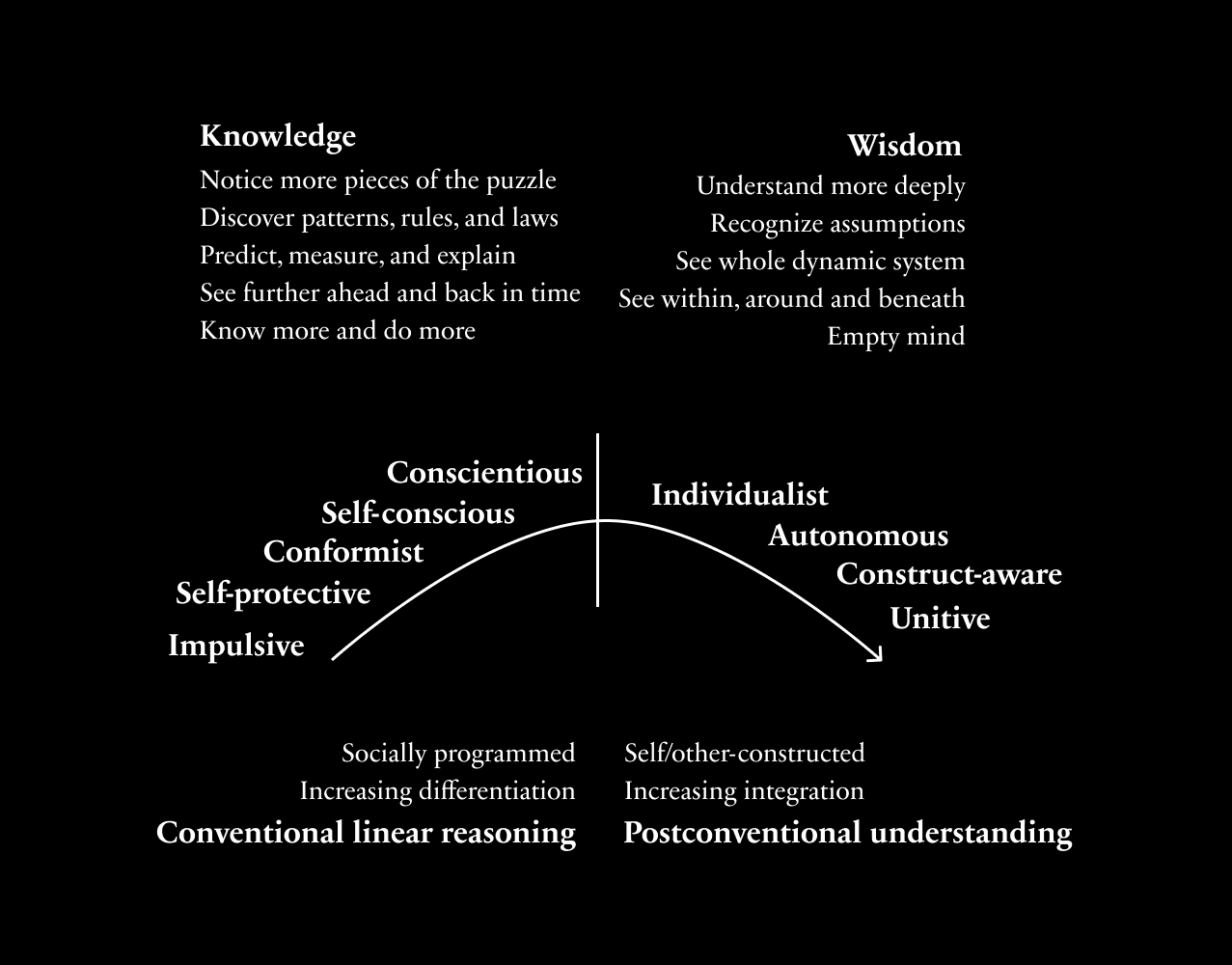
The most durable advantage is not access to the tool. It is the ability to think clearly enough to decide what is worth building with it.
“He then learns, that in going down into the secrets of his own mind, he has learned into the secrets of all minds. “
“He learns that he who has mastered any law in his private thoughts, is master to that extent of all men can be translated.”
- Emerson (The American Scholar)