


Everyone is racing to be successful right now.
As you'd guess, 99.99% of them will not, in fact, become successful.
Because they're all obsessed with the wrong thing.
The latest Claude Code skill that went viral on Instagram.
The YouTube video that teaches them how to start a business in 5 actionable steps (I still don't get how people don't realize that their thirst for “actionable steps” isn't going to help them in the slightest).
Their obsessed with tactics.
You know... the same knowledge that everyone else has access to. Do you not realize that all the information you could ever need to make $100 million dollars is readily available to you online, in books, or inside of an AI conversation?
Have you ever stopped and wondered why everyone in the world isn't making millions of dollars right now? Have you ever considered that the “actionable advice” you crave so much won't get you anywhere unless you know how the pieces you're picking up fit into the entire puzzle?
It's obvious why most of these people won't actually achieve the success they're so desperately aiming for.
One, because they've just exchanged one form of cheap dopamine for another, more insidious form. The one that makes them feel like they're making actual progress when they aren't moving an inch. I'd argue that endless tactic collection is worse than doomscrolling ragebait videos.
Two, because they don't have a strategy that allows them to use the tactics they're collecting to their highest degree. They don't have a strategic bone in their body. Hell, they aren't even thinking half the time. They're just being thrown around like puppets by people who are good at internet marketing (it's not the marketers fault you can't control your own mind).
Now, if you fall into this camp, I don't mean to put you down.
6 years ago, I fell into the same trap. I still fall into it quite often. This article is to me as much as it is to you. I started business after business (Facebook ads, SEO, dropshipping, digital art, and a few more), but they were hobbies more than anything. I wanted to make money and quit my job, like everyone else, but my actions didn't reflect that. I did everything except for make money.
I learned the “high value skill.” That felt good.
I built the website. That felt good.
I registered my LLC. That felt good.
But when it came time to ask someone to pay for my service, I was nowhere to be found.
The missing piece was a strategy.
But not just a strategy... the ability to think strategically, which is an incredibly difficult skill to learn.
I may not teach you everything in this article, but I do want to share 4 of the most compelling ideas I could find or come up with.
We will discuss why a lack of strategy means a lack of control over the outcome of your life, the 9 traits of a master strategist, and finally how to create your own life strategy and develop the capacity for strategic thinking.
This will be long, as are most of my articles.
I'd recommend setting aside time to read this, and resisting the urge to indulge in infinite scrolling.
I - Strategy is getting yourself into a superior position, while at the same time making sure your opponent is in a worse one.
Tactics flow from a superior position.
– Bobby Fischer, Chess Grandmaster
Let's walk through a simple chess match.
I'll try not to bore you here so we can get to the point.
Player one spends the first part of the game doing things that look boring.
They aren't attacking or capturing any pieces.
From the outside it looks like they're not doing anything... they're just moving their pieces to certain squares on the board.
In a game like chess, you're playing on a grid, but not all squares on that grid are created equal. A piece in the center of a board can reach more places than a piece stuck behind a corner.
Player one slides a rook onto an open lane where nothing blocks it.
They place a bishop on a path that points straight at the enemy king.
They place a knight on a square near the middle of the board.
Meanwhile, player two has pieces getting in each other's way.
Their most powerful pieces are trapped behind their own pawns.
Their kind is stuck in the middle of the board because they never found a safe moment to tuck it away in the corner.
They were only reacting to player one's moves.
Player one moves their knight to a square where it can attack player two's king and queen at the same time.
In chess this is called a fork. Your opponent can only save one. And losing either is not good.
So, player two has to move his king, obviously, so it doesn't get captured, but that led to player one being able to take their queen, which is the most powerful piece on the board. Game over.
The crowd goes wild.
The thing is, any player who got to that exact arrangement of pieces could have played it.
The reason player one got there is because they spent the entire game building up to it.
If you were to remove any of those boring steps from the start, the fork, or the game winning tactic, wouldn't exist. The knight would have gotten blocked and the king would have escaped as a defending piece arrived.
The lesson: Strategy is getting yourself into a superior position, while at the same time making sure your opponent is in a worse one.
Strategy is the work of making your position better and your opponent's position worse, move by move, until the gap between the two is so large that tactics start appearing on their own.
But in the game of life, you are both the player and the opponent. Every decision you make changes your position, and most people are completely blind to where they are.
If the average person's life were a chess match, they would never reach the fork position, and if they did, they wouldn't even realize it. One of the strongest tactics in the game would be both unavailable and unconscious to them.
That's why strategy must come first.
If you want to actually succeed in the side business, building an aesthetic physique, or simply getting what you want out of life, you can't be like most people.
Most people spend zero time strategizing.
And if you observe society, you'll see that the outcome of tactic-level thinking is disastrous. If you do not spend time engaging in strategic thinking to overcome your own inadequacies, you will inevitably fall into the same mindless routine as everyone else.
II - The average person lives in a mindless cycle of struggles they can't escape.
Thank God you aren't actually on a battlefield.
Because if you were, you'd be dead already.
Most people commit highly predictable strategic mistakes that if they were in a truly violent setting, they would lose, and winners would be studying what they did so that they can do the exact opposite.
Getting married too early (or late), not developing mastery in anything, trusting that AI can do everything for you (I'm saying this as someone who is pro-AI), chasing money over meaning, irresponsibly going into debt, staying in a bad relationship, not investing in education, climbing a corporate ladder that leads to nowhere. The list goes on.
The average person does not try to solve their problems or struggles. They get stuck in a routine and live the same day over and over. It does not cross their minds to snap out of it, engage in strategic thinking, and change direction so they can eventually reach a more advantageous position in life.
If you want to get ahead of 99% of people, all you have to do is pause, think, and actually attempt to overcome the struggle you're faced with, while considering a path where you won't have to face that degree of struggle again.
Now, you may not be on an actual battlefield, but you are always on a metaphorical one. A battlefield where you are both the protagonist and antagonist. Before you turn 18, your parents are largely in control of your life strategy, which is largely influenced by their own parents and culture. For most people reading this, that means that your entire “strategy” is to go to school, get a job, and retire at some age, but you have a voice tucked somewhere inside you whispering about how that path will lead you to certain regret.
Once you enter adulthood, your mind is operating from a certain position, with a set of tactics that largely won't help you, and that's exactly when the enemies start attacking. You're slowly hit with a barrage of bills, responsibilities, thoughts, emotions, and what you want to do for the rest of your life.
It doesn't help that modern comfort allows people to coast through life and still survive, when in actual warfare, the general's own life was on the line. That forced strategic depth. You, on the other hand, just do “what you're supposed to do” and leave it at that, because if you tolerate most of a meaningless day, at least you get to go home and play video games or slam a few beers with your friends.
You need pressure.
Tactical stress.
Putting yourself in a position where you must craft a strategy, or you lose.
Move into an apartment you can't afford. Book the plane ticket to somewhere you've never been. Invest in the business software, course, or coaching even if you think it's a scam, because at least your finances will be put on the line and you can't live in a shroud of false comfort anymore.
Alright, you get it.
You need a strategy, and you need to develop the skill of strategic thinking, because without those, every decision you make becomes arbitrary.
And if the outcome of your life is the accumulation of results that stem from your decisions, paying attention to this may finally give you a more fine-tuned control over your life.
III - How to build a superior life position by going so deep you see patterns in everything you do
In The Book of 5 Rings by Miyamoto Musashi, there are 9 precepts/principles every strategist should follow:
Don't think dishonestly
Training is the Way itself
Get acquainted with every art
Know the Ways of all professions
Understand gain and loss in worldly dealings
Develop intuitive judgment about everything
Perceive what can't be seen
Attend even to small things
Do nothing useless
A strategist, in Musashi's mind, is someone who has gone so deep into one discipline that they hit something universal at the bottom of it.
You notice patterns that aren't specific to business or relationships or swordsmanship or chess. They are a constant, and once you see those patterns and notice them across domains, you become far more effective within all domains, because you are never really starting from scratch - you have an understanding of reality as a whole on your side.
The 9 precepts define what this type of person looks like on the outside.
The modern idea of a generalist is usually someone who knows a little about a lot. A jack of all trades, but what Musashi is describing here is a bit different.
There's the generalist.
There's the specialist.
Then there's the master (the strategist).
This also maps quite well to the stages of ego development and spiral dynamics - the strategist stage is quite achievable and comes with the following qualities:
Systems thinking - Strategists see competing systems and perspectives simultaneously, while Achievers (self-helpers, businessmen) operate within a single system of success and achievement.
Comfortable with paradox - They hold contradictions (like being both pro and anti AI) rather than resolving them into clear (false) answers.
Process over outcome - They care about how things happen and the principles at play, not just results.
Awareness of constraints - They see how their own assumptions and frameworks shape what they perceive.
Meta-awareness - Strategists can observe their own meaning-making and not just deploy expertise or navigate social dynamics.
Principled flexibility - They have strong values but adapt methods fluidly, versus rigid rules or social conformity.
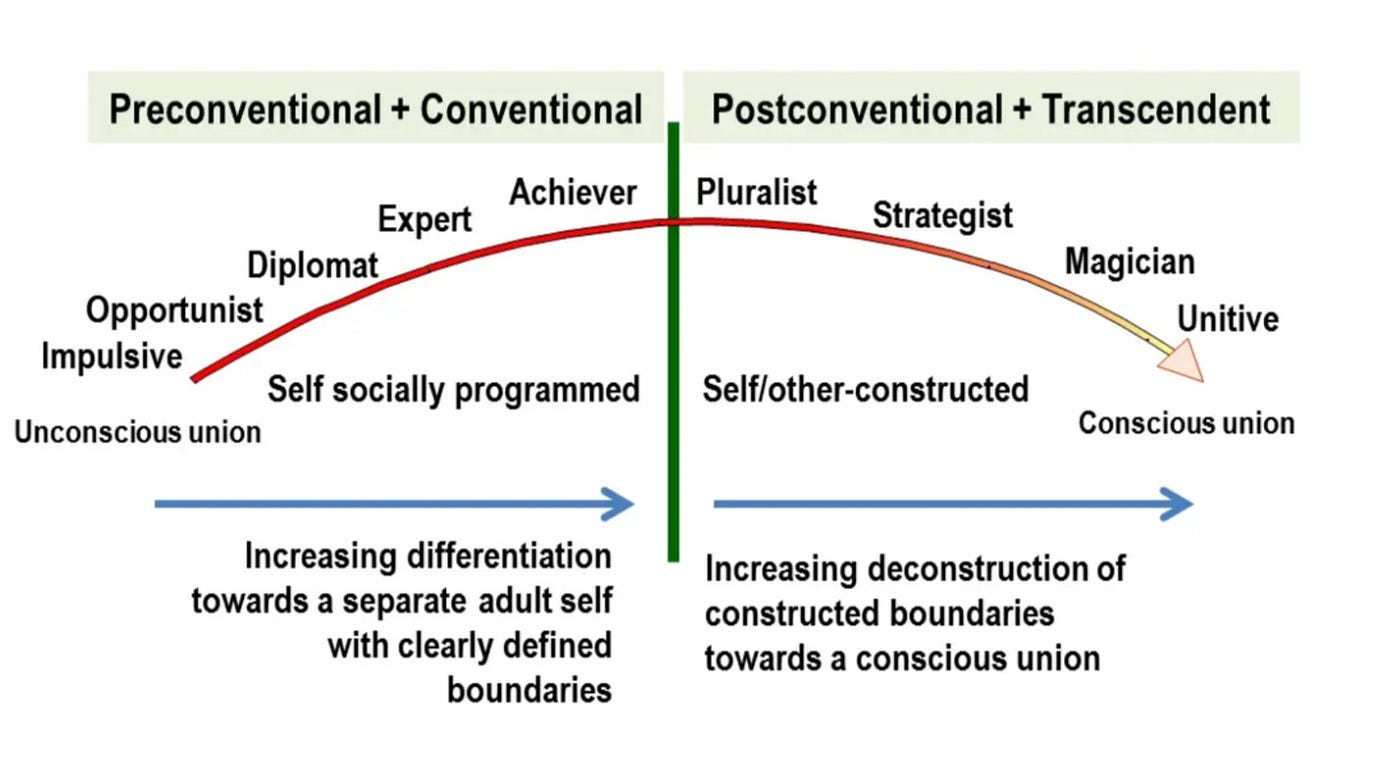
Most importantly, the strategist's core trait is the ability to hold multiple frameworks or perspectives. They are often non-dogmatic and do not choose a black or white side. Most people on social media argue themselves into oblivion because they do not yet have the mental capacity for this.
Strategists see their own constructions as choices.
Their identity, values, and worldview.
The master/strategist receives the benefits of both the generalist and the specialist. Both the ability to be good at many things (so they don't narrow their mind to one area of study, limiting their potential) and the ability to excel significantly at one thing (so they can get outsized results, preferably in a meaningful domain).
That is our goal, and you can easily see how many people do not adhere to these precepts.
Most people are so identified with ideology (see: religion, pro/anti-AI, flavor-of-the-day distractions) that they could not fathom the precept of “Don't think dishonestly,” because they are in a constant cycle of self-deception. Their mind is hijacked by extreme black and white takes (the lowest form of intelligence) and their thoughts are not in close proximity to truth. And the further from truth you are, the more of a liar you are, by definition. Most extreme takes are blind lies, and you see them everywhere on the internet. See through it.
I will give a different lens to view these precepts of principles when we learn how to think strategically, but “don't think dishonestly” ties in well with “do nothing useless,” because being in a constant state of lying and unconsciously scheming is useless.
The mindless way of life is a useless way of life.
If you were to simply audit your thoughts and behavior for usefulness, you would rapidly turn your life around.
The questions now are:
What do you master?
What is your form of “training?”
How do you begin to understand gain and loss?
How do you begin to embody the principles of a master strategist?
And most importantly, in my eyes, how do you do something useful?
IV - how to think so strategically you finally take back control of your life
Most people's lives suck, not because of bad luck, bad circumstances, or lack of opportunity, but because the average person does not even think to solve the problems in their life.
The problems are just something they live with.
They have not developed themselves to the point of seeing problems as puzzles, and that all problems are ultimately solvable on a long enough time scale, with access to the proper resources, and with the prior series of problems already being solved (i.e. You can't build a rocket without first building an engine. Rockets seemed impossible in the past, yet the problem of space travel was ultimately solved, thanks to strategic long term thinking.)
You may not care to build a rocket, but you can have a similar magnitude of impact on your own life. You can build a business that makes life changing money, completely turn your health around, or really achieve whatever you set your mind to, if you do not get distracted.
Thankfully, we can study what makes a good strategy.
The principles have been refined for centuries in military, business, and sports. You have a massive amount of historical wins and losses that you can reverse engineer and study.
And the beautiful thing about it is that they all apply to your personal life and success. Principles cross domains.
I've compiled 7 of them.
If you sit down and take the time to actually do this, your life will change.
This doesn't guarantee your strategy is a winning strategy, but it sure helps with not being trampled by your opponent, which is often yourself.
Principle 1 - Vision
No one ever suddenly gets lucky, if the stars suddenly align for you, you actually aligned them, consciously or not, by choosing where to live, who to learn from, who to marry, who to befriend, what lifestyle to maintain, what risks to take, and what vision to believe in.
— @orangebook_ on X
If you do not have a vision, you are lost.
You do not have intention behind your actions. You are holding 10 darts in your hand - 10 bold decisions that determine the outcome of your life - but you don't even have a dart board to aim at.
You don't even have a chance to hit the board... let alone get a bullseye, even though a bullseye isn't the highest scored shot in darts, which is silly in the game of darts, but in the game of life it as an apt rule, because a bullseye teaches you nothing.
Of course, there is benefit to being lost.
You either let entropy drag you into oblivion, or you make the decision to figure it out, collect vision, and begin on your path. The void is where success is born.
A vision is the ultimate outcome you're going for.
It is not a vague wish. It must be as specific as it can possibly be. It must be compelling enough to motivate and guide every action. Because until you're clear about what you want, you can't have a strategy at all. Once you are clear, you can reverse-engineer every step and iterate as you go.
If you want to become someone who is emotionally resilient, deeply self-aware, and financially independent by 35 - that's specific. That allows you to evaluate every daily decision against. Scrolling social media for two hours probably doesn't move you toward that, and without vision, you wouldn't even register that as a problem in your life.
If you want to build a 50k-audience newsletter in the personal development space that generates enough revenue to quit your job in 18 months - now every piece of content, every platform choice, every monetization decision can be evaluated against that intent. Plus, all the tactics people shove down your throat on social media can be filtered for what actually applies to you. It is simply your job to say no to distractions. Everyone's talking about personal brands these days, so I made a little bot that researches your niche and gives you a strategy + swipe file of posts that are performing. It's pretty cool and free here.
However, vision is very difficult to cultivate just by thinking “what do I want?”
Instead, it's easier to start with an anti-vision and post-mortem, so you understand what complete failure looks like and use that as an inversion mechanism to find what you really want.
That's step one.
That's what you stop reading and do right now.
Anti-vision – Think of exactly what you don't want the outcome to be.
Post-mortem – Reverse engineer why that anti-vision would have happened in the first place. What mistakes were made and how do you avoid them?
From there, you are in a much better position to create an MVV - a minimum viable vision that grows stronger and clearer with each step forward.
I created this life strategy prompt if you want to be brutally interviewed and figure out what your MVV is.
Principle 2 - Research
Worry less about which 'career skills' AI will take over, and more about whether you are training to be, and training your kids to be, high-agency, perceptive, self-motivated people who can navigate an unknowable future with an adaptable mind.
— Devon Eriksen
In war, a general sends out spies, studies the terrain, and learns the enemy's habits and tendencies, because you need intel before you act.
When was the last time you studied yourself? When was the last time you audited your habits and what kind of life they are compounding into? When was the last time you paid attention to how your mind reacts to silly little things that end up clogging your headspace for hours on end, removing you from your path?
Most people have zero intel on how to build a career, how healthy relationships work, what the mastery process looks like, etc. They get a spurt of motivation and decide they want to finally achieve the goal they've been putting off, but it's obvious why they fall flat.
Before you begin improving your life with something like a spirituality practice, study multiple traditions, read the research on different techniques, talk to people who've done it for years, follow a range of social accounts, and understand your own psychological patterns and what tends to trigger you.
Don't just grab the first meditation app that shows up as an Instagram ad.
Before you write a social media post or article, you research what is winning and losing and let that inform your strategy (I recommend using a research tool for this so you don't spend days filtering through nonsense). You curate lists of creators, watch and read competitor content, and begin thinking of how you can wedge yourself into a winning position.
If you “just want to write,” then feel free to do so, but again, don't expect anyone to give you their attention just because you have clever thoughts. Writing can be an incredible hobby, but if you're doing this as a form of meaningful work, these strategic principles apply, because at that point, it is a business.
Principle 3 - Preparation
You must identify your resources and gaps.
Because you wouldn't just drop into the battle with no food, no logistics, no weapons, and no support.
Once you know what your resources are, and what you are lacking, you start building reserves like money, time, knowledge, skills, location you live, connections and relationships.
Before attempting a major life change (quitting a job, ending a relationship, starting a new project or venture), build your financial runway, decrease expenses, develop the emotional regulation skills you'll need, and line up support systems. Don't just rush into battle.
In other words, you need to hedge against risk.
Every goal comes with risk, and the higher the risk tends to mean there is a higher reward, and you must adjust for it.
For someone looking to make more money, you can build software, sell an info product, start an agency, learn crypto trading, and a plethora of other options, each with their own level of risk.
The market is saturated with info products because (1) they work and (2) they are low risk. The profit margins are beautiful. But for a SaaS, even if they're easier to build, have a much higher risk profile, and the margins are becoming smaller because more accessibility only means more technology that you have to pay for in order to build it.
For more people, the best thing you can do is hedge against risk by whatever means you can.
If you're young, that means selling everything you own, living in a horrible apartment, and cutting all expenses so that you have maximum leverage in building your own thing.
Young people have the resource of time, but they don't have money, so they need to make up for that by controlling the variables they can.
A person who quite literally has nothing to lose is in a much better position, with far greater tactics available to them than the ones who are financially irresponsible.
Principle 4 - Focus
Is there a point at which doing more does not produce more? Is there a point at which doing less (but thinking more) will actually produce better outcomes?
— Greg McKeown, Essentialism
Concentration of force.
This is the military principle of focusing your resources at the decisive point rather than spreading thin.
The best example is France in 1940.
The French had more tanks and troops than the Germans. They had far more raw resources. But they distributed their armor evenly across the entire front, so every sector had a few tanks.
The Germans took every Panzer they had and drove them through a single point (the Ardennes forest), which the French thought was impassable, so they barely defended it.
Focus is about where you put what you have.
In life, you only have so much of it at any given time. Most people try to change their life and place 10% of their attention into diet, sleep, exercise, meditation, relationships, their side hustle, and more - when they would get better at all of them faster if they focused on the single bottleneck holding them back the most.
If you focus on solving a massive financial struggle first, that frees up more resources you can focus toward the next problem, like diet. Then, you can easily afford higher quality food, which gives you the resource of energy that can be put toward your relationships.
The same applies to business. On something like social media, there is more to growth than content. Cross-posting to all platforms takes away time you could spend building connections with people that will help you grow. You'd gain for more followers by focusing on one platform first, which can then be used as leverage to grow on other platforms - faster than you would have in the same amount of time spreading your force across all platforms. This is a major teaching point in the Creator Bootcamp, how relying on the algorithm is not a sufficient strategy.
Focusing on one thing allows you to do all things better, given time.
Principle 5 - Execute
Strategy is how you choose to allocate your limited resources against unlimited options.
– Alex Hormozi
Proper execution of strategy is the continuous act of jumping between macro (vision) and micro (daily action), ensuring that the decisions you make have aim and intention.
This is the core of what strategy is - doing the opposite of what 99% of people do, because most people do not think outside of their conditioning, assigned goals, or repetitive routines.
But how do you execute effectively?
This is where everything comes together.
Practice holding your vision in the back of your mind, write it down somewhere and look at it every morning. It must become a part of who you are through repeat exposure.
Take note of what you learned from studying your opponents or yourself. Meditate on it. Contemplate it. Let it marinate in your mind so that it can start to make connections.
Identify the primary resource you can leverage. For young people, it's time and freedom, most likely. For some, it's capital. For others, it's an internet audience. For more, it's a weird set of interests and knowledge. And yes, for many, it's AI - but not from the low level sense.
Choose your concentration of force play. Where is the single highest-leverage point? The one that would unlock progress in more than one domain? The thing that makes everything else easier?
From there, we have a soft plan, but it needs to be crystal clear.
We must reverse engineer our vision down into a hierarchy of goals that allows us to gain perspective on our daily actions.
Work backward to 1-year goals, 90-day objectives, weekly priorities, and daily habits. Every step should trace back to the intent or vision. If it doesn't, set it aside.
As mentioned, I've created a prompt that helps guide you through this, as I think it is useful.
Principle 6 - Adapt
It is not possible to experience a feeling of control unless one is willing to give up the safety of protective routines. Only when a doubtful outcome is at stake, and one is able to influence that outcome, can a person really know whether she is in control.
— Mihaly Csikszentmihalyi, Flow
A rigid strategy is a losing strategy.
Especially in today's world. The environment changes every 3-6 months, and the rate of change will only increase. In my eyes, the future belongs to the strategists, because masters can adapt on the fly. They don't need a vast amount of upskilling and reeducation. They can intuitively flow with what life throws at them.
Your job is to respond to what's actually happening, then and there, on the battlefield. Not your mental fabrications of worst case scenarios or your fantasies that are not yet real.
If you committed to a morning routine, but your job schedule changed, you don't abandon the routine. That's what most people do. Don't do what most people do. The vision and intent of your strategy doesn't change (becoming more disciplined and grounded), but the tactics do. If a particular meditation or business strategy stops working after six months, experiment.
Systems fall apart with time. You should expect that. The Notion template you downloaded won't matter in 3-6 months. Nor will your Claude skill. Nor will any AI strategy. You still have to be skilled enough to know when something isn't working.
I have people come to me all the time about how their posts don't do well on social media. The answer is to adapt. Find a new tactic. Experiment. Do something different. You obviously aren't going to continue getting results if you just do the same thing.
Review, reflection, and prediction.
Schedule them weekly.
Review your week. See if you are on track. Reflect on your progress. Predict where you are heading, and adjust if need be.
Principle 7 - Study of Principles
I encourage you to adopt the belief that anything is a skill.
Anything is a field of study that you can stack experience in.
Strategy itself is a field of study with principles that hold across domains. The more you study the principles, the better you become at applying them to your own life situation. It is a lifelong ongoing practice.
Read Sun Tzu.
Read about cognitive biases.
Study how habits form.
Learn the principles of negotiation.
Study why content goes viral.
Study how attention economics work.
Don't just copy what other creators do. Understand the principles so you can come up with your own moves (and actually understand why you're taking that action).
Beyond that, I believe the best way to study the true principles is by studying reality itself. Because strategy is just the application of reality's principles to human goals.
I want to leave you with a list of areas you can study and leave it up to you to go down a few rabbit holes and start making connections.
I'll leave a few links at the end so you can start reading immediately.
Formal systems:
Cybernetics - The study of feedback loops, control, and self-regulation in any system (mechanical, biological, or social).
Systems theory - The study of wholes, interconnections, stocks and flows, emergence, and leverage points.
Thermodynamics - Especially the Second Law, entropy always increases. Every ordered system requires energy input to resist decay. Your habits and routines will fall apart otherwise. Clean your room.
Philosophical traditions:
Taoism - The Tao as the ineffable underlying principle of reality. Wu wei (action in accordance with nature, not forced action), yin yang (complementary opposites), and cultivation of effortless mastery.
Perennial Philosophy - The claim that all major wisdom traditions share a common metaphysical core. There's an ultimate reality, the human self can participate in it, and the purpose of life is to realize this.
Intagrative meta-frameworks:
Integral Theory (Ken Wilber) - Maps reality across quadrants, levels of development, states of consciousness, and types.
Spiral dynamics - A model of value-systems development through tiers. It models how humans construct meaning at different stages, which, for a strategist, is studying reality, because it's constructed by the observer.
The esoteric / symbolic:
Hermetic Principles (The Kybalion) - Mentalism, correspondence, vibration, polarity, rhythm, cause and effect, and gender. A compact set of lenses that have influences a lot of new thought traditions. “As above, so below.”
Jungian Alchemy - Psychological and spiritual process of transformation. A framework for how deep change actually works in a person or system.
The strategic / mathematical:
Game Theory - The mathematical study of strategic interaction. Zero sum vs positive sum games, the prisoner's dilemma, nash equilibrium.
Evolutionary Theory - Selection, adaptation, fitness landscapes, variation and retention.
All of these are lenses that point at how a different facet of reality actually works.
If you were to simply study these for the next year, your understanding of almost every other skill, domain, or area of learning would rise with it. You will naturally be better at everything you do in this life.
If you want to continue reading, I'd recommend Human 3.0. My own synthesis of many of these frameworks, including more from flow and performance psychology.
I hope all of that was helpful.
Talk soon.
– Dan
If you want a place to save, read, and highlight articles, links, PDFs, and ePubs, try out Eden here.
And if you're a creator, you can use Eden to research what's trending, study creators top posts, schedule content on all platforms (this was written and scheduled from Eden), and more.
It is the ultimate advantage so standing out online.
Hmmm…I respectfully disagree. Neither tactics nor strategy will lift you out of the self-generated rat-race of competition. There will always be 99% left - you'll never run out of people you have to beat. The answer is evolving, from the competitive mindset to the creative one. When you finally let go of comparison and competition as motivators, you become a powerhouse of sovereignty with unlimited creative capacity.
You missed it Dan.
Anybody can learn strategies.
You mastered marketing.
Online economy persuasion.
You did it at the right time.
It’s a hustle factory.
Not a business system.
My first company.
In the 90s.
Was a freedom business.
How?
I hated selling clothing.
Driving door to door.
Why did I succeed.
My destiny was to dare to dream big.
I didn’t care about business.
I wanted to watch cool films.
Drive around Chile.
Spend a month in Poland.
I liked like a local.
Followed my bliss.
Then worked myself out of all the jobs.
We were the smart strategists.
At the top of our market.
That’s when I walked.
You may be surprised at what’s next.
Follow your own dream.
Don’t learn strategies.
Ask yourself one question.
What do you want.
Then go for it.
All dreams come true.
Only for those who take action.
Despite the pain, pressure, and obstacles.
The online economy is getting old.
Don’t think Dan made it.
He is figuring it out.
Despite it having worked.
Years ago.
What you know what to do matters.
I’m not a professional writer.
I’m an expert in freedom businesses.
Don’t be lost in virtual space.
The answers are inside.
All human beings.
Instead of strategy.
Tactics.
Old ideas.
Look there.
Take action
Find your direction.