


Watch the video version of this letter on YouTube.
Listen to the audio version of this letter on Spotify.
There’s been a shift this month.
And I know everyone says that... and everyone has been saying AI will change everything for years now. Most people started to tune it out. But something changed recently. The tools got better. People became angrier. The people who tried to find useful applications for AI started to pull ahead of everyone else (I’m seeing this firsthand with my dev team).
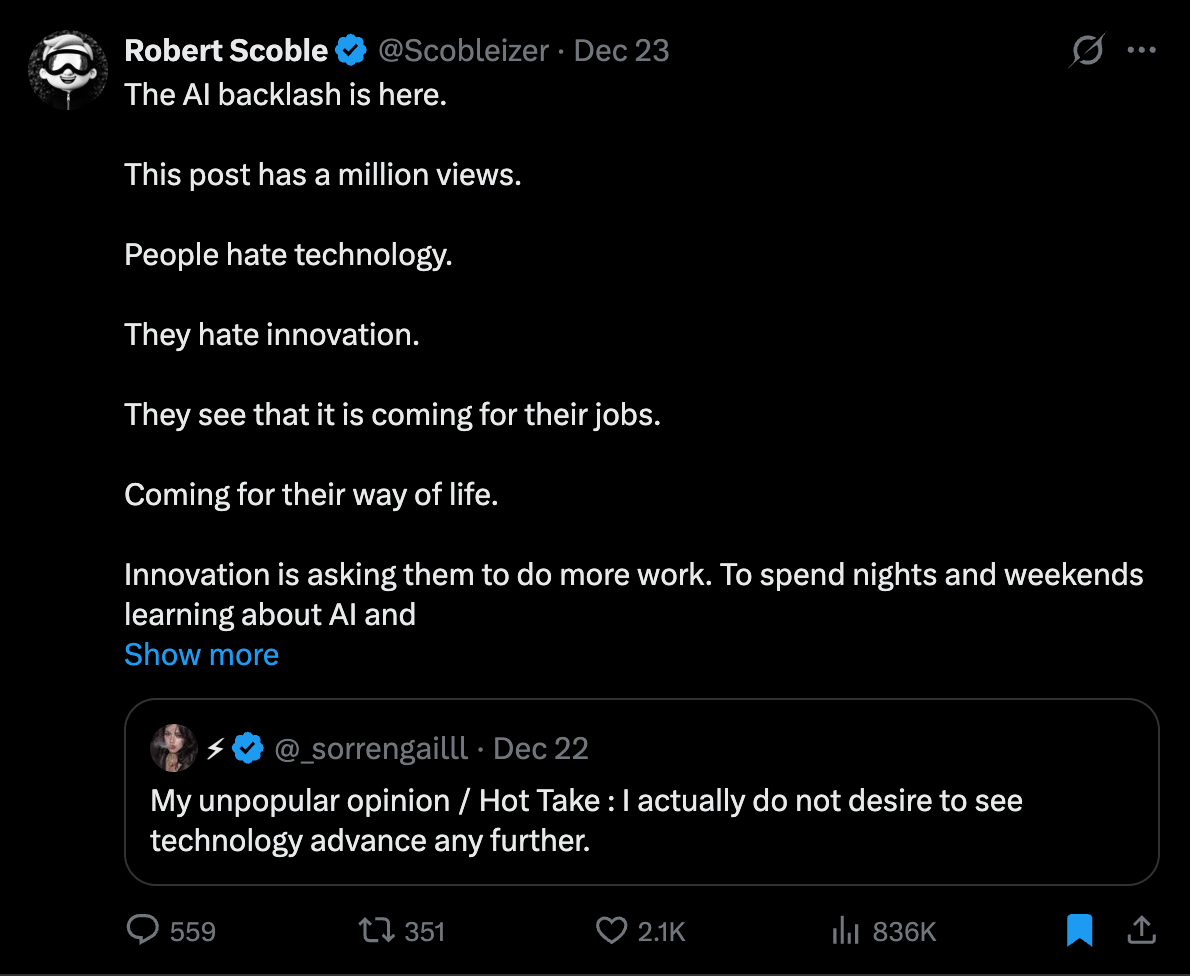
This is one out of many examples that my feed is flooded with.
Whenever there’s a shift like this, the same pattern emerges. Three types of people reveal themselves.
1) The resisters
They attach their identity to the way things were done. They see any new tool as a threat to their sense of self. The artists screaming that anyone who uses AI is a bad person. The writers (like myself) saying that good writing can’t be replaced. And of course the creatives rage-posting about the death of creativity while refusing to learn how the new tools work.
If you can, avoid these people. And if you are one of them, keep an open mind.
2) The waiters
They see the change happening, but they tell themselves it will “blow over.” They keep their heads down because for most of their life, they’ve been dependent on someone else for the job, the life direction, and the ability to survive. They don’t know any other way of doing things.
The problem is the penalty for starting late.
In previous shifts, you could wait a few years and catch up. The gap was linear. But AI is different. The gap is exponential. The people experimenting today are compounding their skills every month (I hate sounding sensationalist, but I’ve personally experienced this). The worker who waits until 2027 will wake up to find the entry-level is gone and everyone else is years ahead.
3) The curious
They stay curious, experiment, build, and figure out how to adopt the new way in their own way without romanticizing the past or fearing the future. They understand that new things have a time lag before they become useful, and that just like any other skill, it takes trial and error to make it useful for you.
It has always been important to become the 3rd person, as the main drivers of meaning are struggle, status, and curiosity.
But now is as good a time as ever.
In this letter I want to share 4 ideas that may change your mind about AI, what skills you should learn going into the next 1-2 years, and the single decision that matters to take control of your life.
I – Why this time is same same but different
People act like technological disruption is new.
It’s not.
The printing press rendered scribes obsolete. Before Gutenberg, bookmakers employed dozens of trained artisans to hand-copy manuscripts. A skill that took years to master. Before they knew it, that skillset was worthless. A single press could produce 3,600 pages per workday. The scribes who refused to adapt disappeared. The ones who learned to operate the new machines thrived.
The scribes were replaced by people who learned to use machines.
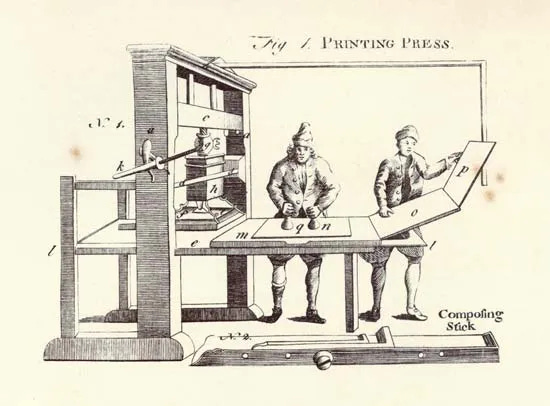
The same pattern repeated in the Industrial Revolution. Hand-weavers protested. Some even smashed the machines. Meanwhile, mechanized cotton spinning increased output per worker by 500x. New jobs emerged like printers, typesetters, machine operators, and engineers. The nature of work changed. Work didn’t disappear.
In 1814, The Times of London secretly installed the steam-powered printing press. They printed the November 29th issue at night because the pressmen had vowed to destroy any machine that threatened their jobs. The new press rolled out 1,100 pages per hour instead of 250. The pressmen lost. The newspaper industry exploded. Literacy rates climbed.
The pattern is that skills abstract upward.
The scribe became the editor. The hand-weaver became the machine operator. The typesetter became the designer. Each wave of technology pushed humans to operate at a higher level.
David Deutsch, influenced by Karl Popper, calls humans “universal explainers” capable of understanding anything understandable within the realm of possibility. We create knowledge through conjecture and criticism. Trial and error. Guessing and correcting. This is how we adapt.
The people worried about AI think it will render humans irrelevant. But there is no limit to what humans can understand or create given the right knowledge. The tools change. The capacity to wield them does not.
So why is this time different?
The timescale is compressed.
The printing press took decades to spread across Europe. The Industrial Revolution unfolded over a century. AI is moving faster than all of them.
Many people still think this is speculation because “AI isn’t that impressive.”
That’s because most people still have the get-rich-quick cheap-dopamine-addicted brain that wants AI to solve every problem with a single query. Doesn’t work that way.
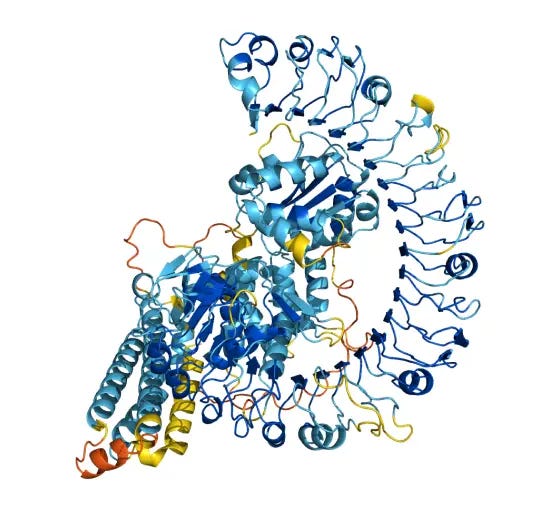
In 2020, DeepMind’s AlphaFold solved the protein folding problem that stumped biologists for 50 years. Proteins are the molecular machines of life. Their shape determines their function. Knowing how a protein folds means understanding how diseases work and how drugs can target them. What used to take a PhD student months of lab work now takes minutes.
The gap between those who adopt and those who wait is compounding every month. The person who starts experimenting today will be unrecognizable in 2 years. The person who waits will spend those 2 years falling behind.
The pattern of history is clear. The question is whether you see it.
II – Skills are abstracting up a layer
I said I’d never use AI to write.
I meant it. Writing is my craft. It’s how I think. Outsourcing it felt like outsourcing my mind.
But something has changed as I’ve started acquiring more of the skill beyond using it as a box to type questions. Of course, having AI generate the entire piece without any of my own thinking, direction, or ideas still gives me the chills. But I’ve found a process where AI handles a lot of the labor while I stay in control of the thinking, and personally, I think this is the future of writing. It will take me an entire newsletter or two to fully explain how it works, because it truly is a skill, and it’s one I’m enjoying more than manually putting words on the screen. I get to think from a higher level of what impact I want the writing to have.
As a brief explanation that doesn’t do it much justice: I start with an outline of the points and ideas I want to write about. This can get pretty extensive. I practically write the piece without worrying about grammar. I feed my books and past content into context so the AI understands how I think and has my core worldview and philosophy. Then I flesh out the ideas while the AI researches alongside me. It pulls information and surfaces patterns I know and understand, but would take me hours to find because I can’t remember textbooks of information. This is actually becoming the foundation of the research feature we are building into Eden. After that, I comb through drafts, make cuts, redirect when something feels dead, push harder when something feels alive, and give my “commentary” on places that feel like they’re lacking, which helps me think deeper about the subject.
The words on the page are still mine. But my job changed, and surprisingly I’m writing more than ever. It’s like a little game that I want to keep playing.
For those unaware, I created a mini-course on how I use AI. This doesn’t include what I’m doing right now, but I still feel like it will blow most people’s minds if they haven’t “felt” what AI is capable of.
This is the same pattern from every technological shift. The scribe copied letters. Then the printing press made copying irrelevant, and the job of the editor emerged... someone whose job was deciding what’s worth printing in the first place. The skill abstracted up a layer but the craft remained.
Writing is going through the same shift right now.
Anyone can generate 2,000 words in 30 seconds. Competent, forgettable writing is now $20/month via a ChatGPT subscription. The baseline got flooded. If your writing was already average, you’re now competing with infinite average.
The ceiling hasn’t moved though. What makes writing great hasn’t changed. Originality of thought, a voice that’s unmistakably yours, and the ability to make someone see something they hadn’t seen before.
The difference between average and great is taste.
The future belongs to those who can filter signal from noise. When anyone can produce anything, choosing what deserves to exist becomes the skill.
And taste is harder to develop when the friction disappears. Writing by hand was slow, and the slowness forced you to think. When AI removes that friction, you have to supply the judgment that friction used to provide
That’s where the gap opens.
I’m telling you this because most people try AI once, get mediocre output, and decide it doesn’t work. This is like falling off a bike and concluding that bike didn’t work or was somehow a bad product.
AI has a skill curve. The barrier to entry looks low because anyone can type a prompt. But using AI at peak capacity takes experimentation. It takes failing, adjusting, trying again. It takes intelligence (as discussed here). It takes experimenting until you find a workflow that fits how you think, which is infinitely unique.
III – What to actually learn in 2026
You have my permission to ignore all “best skills to learn in 2026” lists.
No skill is going to save you. The ability to learn any skill fast, however, will.
Devon Eriksen talks about the “liberating arts,” the skills that free people have always needed to act on their own behalf:
Logic: deriving truth from known facts
Statistics: understanding the implications of data
Rhetoric: persuading, and spotting persuasion tactics
Research: gathering information on unknown subjects
Psychology: discerning the true motives of yourself and others
Investment: managing and growing assets
Agency: deciding what to pursue and acting without permission
These aren’t necessarily skills, but rather capacities that you develop by doing things that demand them
There are 3 things that demand them at once, and I believe these are critical going into an age where job loss is a large threat:
1) Build your own thing and put it in front of people.
A product, a project, a piece of work with your name on it. This forces rhetoric because you have to persuade people to care. It forces practical psychology because you have to understand what others actually want, not what you think they should want. It forces agency because you have to act (and especially iterate) without permission. You learn these by getting feedback from reality, not from books.
I believe we are witnessing the return of the artisan, but from a completely new point of view.
2) Write publicly, consistently, even if you do it with AI.
Writing is compressed thinking. It forces logic because weak arguments collapse on the page. It forces research because you can’t fake depth. It exposes where your ideas are thin. And it builds an asset (audience, reputation, proof of work) that compounds.
Frankly, and I’m still not sure how I feel about this, most people are going to be writing with AI. But there will still be skilled and unskilled writers. And AI has a very identifiable flavor that most people are already tired of. Personally, I believe the distinction between skilled and unskilled writing lies in the density of ideas, the quality of argument, the synthesis of concepts, and the novelty of perspective rather than the labor of putting words on paper.
If you’re just saying “generate a newsletter on productivity for me,” you have quite a bit more to learn.
3) Use AI to do things you couldn’t do before, not just things you didn’t want to do.
Most people use AI to avoid work. The edge goes to people using AI to attempt work that was previously impossible for one person. Research that would have taken weeks. Synthesis across dozens of sources. The question isn’t “how do I do less?” It’s “what can I do now that I couldn’t before?”
For utility-based tasks, use AI all you want.
For meaning-based tasks, be very careful that you aren’t using AI as a way to avoid struggle and skill development, because that will quickly diminish the meaning you can derive from it.
IV – The only questions that matter
After reading this, I want you to question three things:
Every skill you have.
Every habit you repeat without thought.
Every default way you spend your time.
Now if you were to do those same things, every day for the rest of your life like you are set to do right now (because it’s human nature), is that going to lead to a future you want?
Really think about that in relation to how fast the world is changing.
Are you on the cutting edge, or are you settling for the average life reserved for average people?
There is something you can do that won’t be entirely replaced.
Some combination of your taste, your judgment, your way of seeing problems.
Your job is to find that thing. And you aren’t going to find it by waiting or resisting. You must experiment at the edge of what you know. You must discover what your edge actually is.
The people who figure this out in the next 12-36 months will be seen as a different species. The fruits of exponential progress are reserved for those who lean into the risk and figure it out along the way.
– Dan
Watch the video version of this letter on YouTube.
Listen to the audio version of this letter on Spotify.
If you want to read more, here are some letters I recommend:

The most important skill to learn in the next 10 years

Most skills will be irrelevant in 10-20 years.
Unfortunately, you completely avoid any discussion of the environmental degradation which is already occurring from the need to create even larger data-centers which use up crucial natural resources - water, land, non-renewable energy, etc. There is a historical analog which continues to the present with the pollution and the same degradation due to the industrial revolution.
I think you owe your readers as clear a discussion of these negative issues as you do the positive. Note: I’ve been in the educational IT side of things for four decades, and there is great concern about our students using AI as a substitute for their own cogitation and work. My school has the wherewithal to be proactive about this, but many are not.
Echo with this sentence, “Some combination of your taste, your judgment, your way of seeing problems.”
#taste: Steve Jobs once said, “Ultimately, it comes down to taste.” In a 1995 interview, he explained that taste is cultivated by exposing yourself to the best things humans have created and then weaving those elements into your own work. Build your own Substack publication with a good taste.
#judgement: “A wealth of information creates a poverty of attention.” Herbert Simon mentioned it in his book, The Sciences of the Artificial. Judgement is where taste becomes decision.
#yourwayofseeingproblem: ”You have to be opinionated, but that’s how you’re going to win. There’s no unopinionated software that’s been successful.” Bob Baxley, a designer with more than 35 years of experience at Apple, Disney, Pinterest once said.