


Society made you think that having multiple interests was a weakness.
Go to school.
Get a degree.
Get a job.
Retire at some point.
But there is so much wrong with that sequence of events.
We don’t live in the Industrial Age anymore. Specializing in one skill is almost certain death. I feel like we all know by this point how dangerous mechanical living and siloed learning is for your psyche and soul. And people can feel that we’re going through a second renaissance. Your curiosity and love for learning are your advantage in today’s world, but there is something missing.
For the longest time, I learned and learned and learned. I was stuck in tutorial hell. Some may call it shiny object syndrome to point out your lack of focus. I got my dopamine from feeling smart, but my life didn’t change all that much. Honestly, I felt like I was just falling behind. I tried so many different things in college. I had dreams of doing my own thing... earning an income from something creative... but after spending 5 years “learning,” I was met with the reality that I had to get the best job I could find just so I could survive.
The missing piece was a vessel.
A vessel that would allow me to channel all of my interests into meaningful work that I could earn a decent income from.
If you’ve ever felt guilty for not being able to pick one thing, if you’ve been told to niche down when your mind wants to expand, if you’ve wondered whether there’s a path you can take that doesn’t lead to the misery you see in everyone else’s eyes – this is the greatest time to be alive.
Here are 7 of the most compelling ideas I could come up with. We’ll start by understanding why having multiple interests is a superpower in today's world, then I’ll give you practical steps to turn that into your life’s work. We have a lot to talk about, so I hope you’re here for the ride.
I – The 3 ingredients of individual success & the death of the expert
The man whose whole life is spent in performing a few simple operations... generally becomes as stupid and ignorant as it is possible for a human creature to become. — Adam Smith
Funny you say that Mr. Smith, because you created those people, and we’re still dealing with the backlash.
Specialization took over during industrialization because, in a pin factory, for example, one worker doing every step could make 20 pins a day. Then workers, each doing one step, could make 48,000.
So we built an entire world around this model.
Humans became assembly lines working 9 to 5 because frankly, governments don’t serve the national interest, they serve their own interest. Corporations don’t serve the employees interest, they serve their own.
Schools were designed to serve that interest. Their sole purpose was to create factory workers who were punctual and obedient.
But this is no way to live.
If you want to have specialized knowledge so that you could never run an operation, especially your own operation, then be dependent on schools for your education and jobs for your wage. Be duped into believing the promise that specialization is what makes a human valuable when it is clear that the system does not need you, specifically, to perform that task.
In lies the distinction.
If pure specialization makes people stupid and dependent, what makes an individual smart and sovereign?
Three ingredients: Self-education, self-interest, self-sufficiency.
Self-education is clear, because if you want to achieve a result different from that of traditional education, you must direct your own learning.
Self-interest raises some flags. It sounds selfish and short-sighted, which many people view as bad without thinking through it, but it simply means “concern with one’s own interest,” because the only other option is to serve the interest of the organizations that compose society as it is, which we’ve discussed. In other words, follow your interest, because your interest can very well benefit others in a selfless way - depending on your level of cognitive and moral development. Oh, and by the way, indulging in short-lived pleasures (cheap dopamine) is usually not your interest, but the interest of corporations that benefit from your mindlessness.
The truly selfish person, in Ayn Rand’s view, is a self-respecting, self-supporting human being who neither sacrifices others to himself nor sacrifices himself to others. This rejects both the predator and the doormat.
Self-sufficiency is the refusal to outsource your judgment, learning, and agency. If self-education is the engine and self-interest is the compass, self-sufficiency is the foundation that prevents your life direction from being hijacked by another force. They collaborate, but are not fully dependent.
The generalist emerges naturally from this triad.
Self-interest motivates self-education.
You learn because it genuinely serves your flourishing, not because someone assigned it.
Self-education enables self-sufficiency.
You can only be sovereign over domains you understand.
Self-sufficiency clarifies self-interest.
When you’re not dependent on others’ interpretations, you can actually perceive what serves you. Most people pursue multiple interests as an escape from their work. When your interests become your work, or your life’s work, most of them start to filter out.
When we look at every CEO, founder, or creative that we actually admire, they are generalists.
They understand enough about marketing to direct it, enough about product to build it, and enough about people to lead them. But they also need to direct the ship. They need to learn and adapt when circumstances change.
More importantly, they understand that ideas across domains complement each other and create a unique way of viewing the world, which allows them to catch novel ideas from the aether and translate them into market value.
When we look at where the world is today, and if you understand the opportunities available to singular individuals, not just leaders, you will find that the options you have as a natural polymath are extensive. It should spark an immense amount of excitement in you.
II – You are living through the second renaissance, take advantage of it
Study the science of art. Study the art of science. Develop your senses—especially learn how to see. Realize that everything connects to everything else. — Leonardo da Vinci
The ultimate moat, or the final competitive edge worth paying for, in my opinion, is an opinion.
A perspective that only you can see, because the uniqueness of your life experience created it. That may just be the last thing anyone else can replicate.
And since that’s always been the case, why not prioritize that now? Especially when automation is at our doorstep?
But how do you prioritize it? How do you develop it?
By pursuing multiple interests and building something with them.
You see, every interest you’ve ever pursued leaves behind a residue. Every interest increases the number of connections that can be made. Every interest expands and increases the complexity of how you model and interpret reality. The more complex your model of reality, the more problems you can solve, opportunities you can see, and value you can create. Specialism completely halts this process, and your shiny object syndrome has been trying to tell you this whole time.
From birth until now, you are cultivating a way of seeing things that others can’t. A way of seeing things that AI can only think if you tell it what to think.
A person who studied psychology and design sees user behavior differently from the pure designer. A person who learned sales and philosophy closes deals differently than the pure salesman. A person who understands fitness and business builds health companies that MBAs can’t comprehend.
Your edge lies more in intersection than it does in expertise.
This is the exact pattern we see in the Renaissance that is coming back with a much stronger force now.
Consider what made it possible...
Before the printing press, knowledge was scarce.
Books were copied by hand. A single text could take a scribe months to reproduce. Libraries were rare. Literacy was rarer. If you wanted to learn something outside your trade, you either had access to a monastery or you didn’t learn it.
Then Gutenberg changed everything.
Within 50 years, 20 million books flooded Europe. Ideas that once took generations to spread now moved in months. Literacy exploded. The cost of knowledge collapsed.
For the first time in history, a person could realistically pursue multiple domains of mastery in a single lifetime.
The Renaissance was the result.
Da Vinci didn’t pick one thing. He painted, sculpted, engineered, studied anatomy, designed war machines, and mapped the human body. Michelangelo was a painter, sculptor, architect, and poet.
Unique minds are finally free to operate the way they are supposed to.
They were supposed to cross disciplines, synthesize connections, and follow curiosity wherever it led, but most of us never realized that.
The printing press was the catalyst for a new type of person to emerge. A person who could learn anything, combine everything, and create what no specialist ever could.
III – How to turn multiple interests into a lucrative way of life
There are a few things we know so far:
You have multiple interests but feel like you can’t keep learning forever
You have a love for interest-based self-education but have to carve out time outside of your career to do it
You understand the need to become self-sufficient but you feel like you don’t have value worth paying for, yet
You need to be able to adapt fast because we don’t know what the future of work looks like
The question then is, how do we combine all of these things into one way of life?
How do we combine learning and earning into something you can do for work?
I’ll try to make this as logical as I can.
To make money from your interests, you need other people to become interested in them too. That part is trivial. If you became interested in something, other people can too, you simply must learn to persuade.
Further, you need a way for them to pay you. In this context, that usually means you need to sell a product, because you probably aren’t going to find a job that allows you to express your interests, and investing in stocks or real estate (to any effective degree) requires a good amount of capital.
In other words, you need attention.
Attention is one of the last moats.
Because when anyone can write anything or build any software, which ones are going to win? The ones that people know about. You can have the greatest product in the world, but if nobody knows about it, the person who can capture and hold attention will run laps around you.
As an aside, and if you’ve been keeping up with the tech space, no, I don’t think everyone will just “build their own software.” Most people don’t even spend 20 minutes cooking their own food. They would rather pay a few bucks for Uber Eats. And people have their own things they want to spend their time on.
Back to the point:
You need to become a creator.
Now, before you cringe and leave, I don’t exactly mean becoming a content creator (well… it’s complicated).
I mean that the solution to stop creating for someone else because you need them to give you a paycheck is to create for yourself.
Humans, by nature, are creators who were convinced that being a machine would lead to the American Dream. We are tool builders at our core. We thrive in any niche because we create solutions to problems. If a lion were put in Alaska, it would not build shelter and clothing. It would die. A lion belongs in its own niche.
The thing is, every business is a media business now. And remember, you need attention. Where is the attention? Mostly on social media until the next attention preference platform comes around - you’ll need to adapt at that point. So yes, if you have multiple interests, it would be wise to become a “content creator,” but it may be easier to think of social media as a mechanism to get your interests in front of other people. It is one piece of the puzzle to do independent work.
Plus, that covers all of our bases.
You love learning? Great, reframe it as “research” and now that’s literally your main job. Most of the things I write about simply come from me learning about my interests and treating social media like I’m “taking notes in public.”
(You’re already spending time learning, now just spend that time learning in public and boom you have the foundation of a business).
You need to become self-sufficient? Well, you’d need a business to do that, and every business needs to attract customers, and you probably don’t give two f*cks about paid ads, SEO, or any other form of marketing. This is what trips many people up because they are only used to doing one specialized task within a business as an employee.
You need to be able to adapt? Amazing, you can build and launch new products to your audience as fast as you can build them. I have a solid audience, and if my next product were to fail, I have people who would be willing to invest, be a part of the team, or support the next product. You can build your little SaaS company, but if you don’t have distribution, you are putting in marathons of extra leg work into getting capital, finding talent, and getting things off the ground.
No other job or business model allows you to do just that with so much freedom.
But how do you actually start building it?
How do you tie all of this together?
IV – How to turn yourself into a business
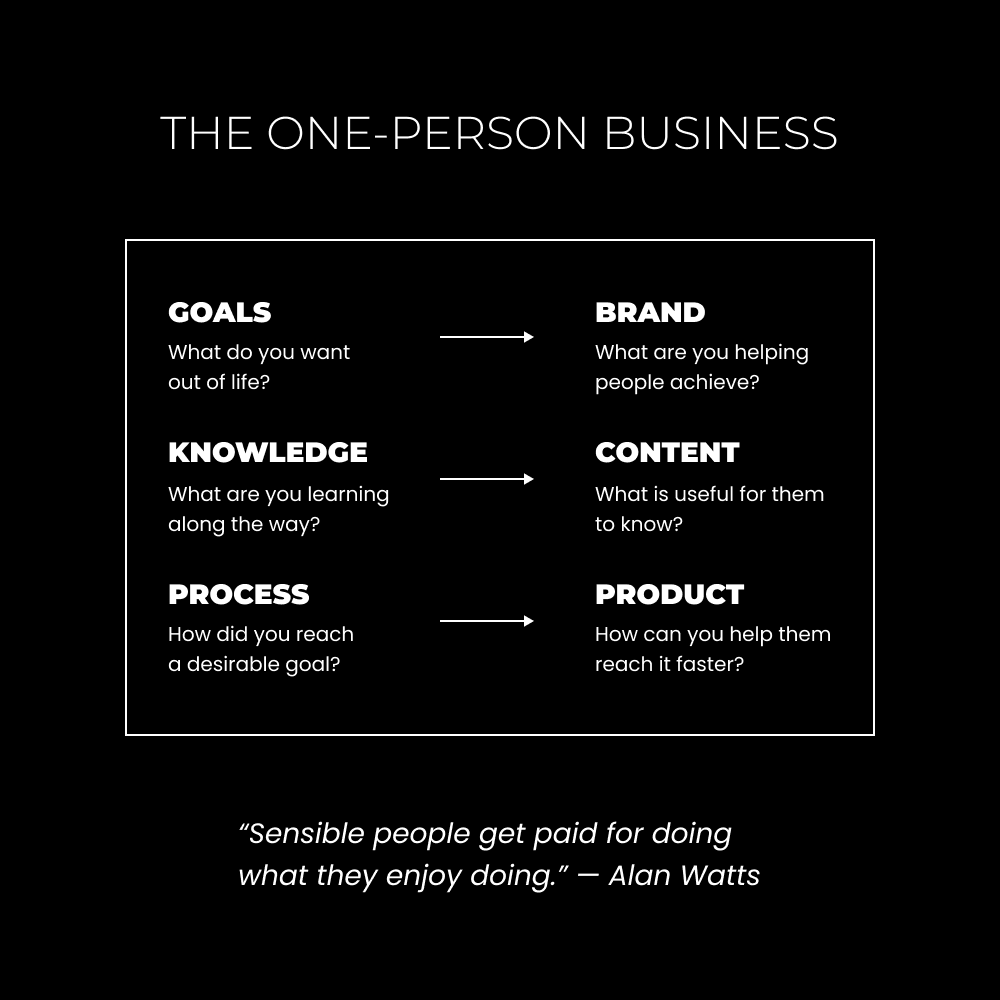
It’s unfortunate that “entrepreneurship” and “business” have become dirty words that make people think they aren’t qualified to take that path, so much so that when an opportunity comes up, they don’t even notice it.
If you’ve ever helped someone with your interests, you’re qualified to start a business.
They no longer require upfront capital. They are not reserved for unethical elites. They are not only for people who want to make a lot of money. And they are not only for talented or special people.
The reality is that entrepreneurship is in our nature. It is modern survival. We are wired to create and distribute value to a tribe of like-minded people. We are wired to hunt, explore the unknown, seek novelty, and never stagnate. Psychologically, this is the most enjoyable way of life, even if there are low periods, because those are what allow the (non-artificial) highs to exist.
Further, the barrier of entry has collapsed.
All you really need is a laptop and internet connection.
Distribution is now free thanks to social media (well, not free, but skill-based, which can be expensive in time). Anyone can post an idea that reaches millions, and if they have a product, those millions of eyes can result in millions of dollars if you know what you’re doing, and that’s a big if. Most people just love becoming really good at an interest or skill that doesn’t directly impact their success, potentially because they’re afraid of it.
Tools and technology now handle what used to require teams of people. You have access to AI and a plethora of useful software.
Now, there are 2 paths you can take to start.
Path 1) Skill-Based
This is what dominated the internet for the longest time. You “learn a marketable skill.” You teach that skill through content. Then you sell a product or service related to that skill.
The limitation here is the limitation of being a specialist. It is one-dimensional. You put yourself in a box. You “niche down” because you were told it is more profitable, and since you’re chasing profit over interest, you tend to build yourself into a second 9-5 where you do work you don’t care about for people you don’t care about.
Path 2) Development-Based
The creators that win right now are those without a niche they can be pinned down to. Typically, they are focused on one of the 4 eternal markets: health, wealth, relationships, happiness. Or even all of them. Technically, everyone’s niche is self-actualization, they are just all taking infinitely unique paths to get there.
They pursue their own goals (brand).
They teach what they learn (content).
They help others achieve the goal faster (product).
For those with multiple interests, I obviously recommend this path, because it goes a bit deeper.
First, when you take this path, you are also taking the first path. Because building your brand, content, and product requires you to become good at all of the relevant marketable skills, so even if you fail, you have something worth paying for. You are building your business, and you can help others with a specific part of theirs if you are good at it.
Second, it flips the traditional model on its head.
You don’t create a customer avatar so that you can niche down and only focus on that. You turn yourself into the customer avatar.
That makes things much more palatable.
You pursue your goals in life and develop yourself → you have already validated the usefulness of what you will offer → you help the past version of yourself reach that same goal.
Don’t be a YouTube creator.
Don’t be a personal brand.
Don’t be an influencer.
Be you. But in a place where your work can be discovered, followed, and supported. Right now and for the foreseeable future, that’s on the internet.
Jordan Peterson (or others like him) isn’t a “content creator,” even though that’s how it seems on the surface.
He goes on tours, writes books, leverages social media as a base, and uses all of the tools at his disposal to spread his life’s work. He isn’t worried about the latest content idea trend. His mind outperforms any of those myopic growth strategies. The quality of his ideas is what sets him apart and changes people’s lives (regardless of your opinion on Peterson).
With that, I want to provide a different perspective on brand, content, and product. That way you can use this as a vessel for your life’s work.
V – Brand is an environment
Stop thinking of your brand as a profile picture and social media bio.
Brand is an environment where people come to transform.
Brand is the little world you are inviting others into.
Brand isn’t illustrated when a reader first visits your profile.
Brand is the accumulation of ideas in your reader’s mind after 3-6 months of following you.
You illustrate your worldview, story, and philosophy for life across every single touchpoint. Your banner, profile picture, bio, link in bio, landing page design, pinned content, posts, threads, newsletters, videos, and the rest.
In other words, your brand is this:
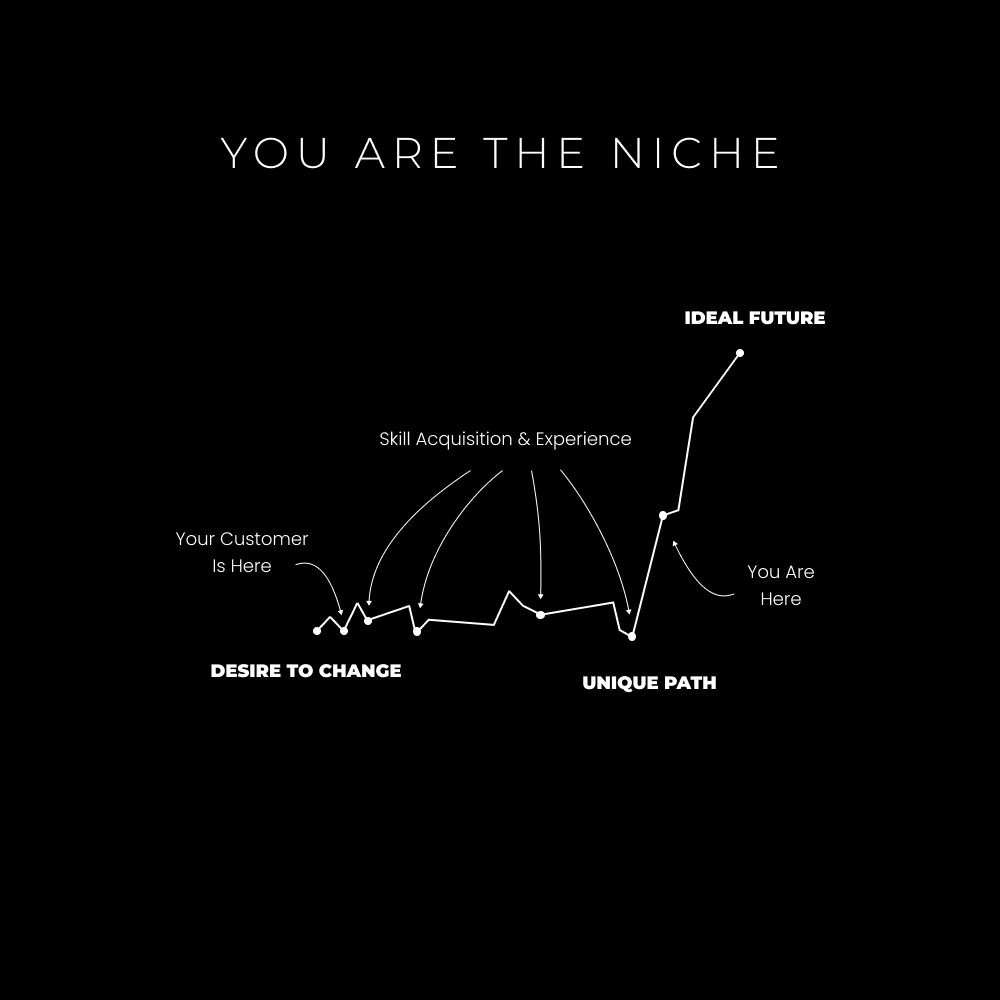
Your brand is your story.
It would help to spend a day writing out where you came from, the “low” points of your life, the experiences you’ve had and skills you’ve acquired, and how those things have helped you the most.
When you’re thinking of ideas, content, or products, you should filter them through your story. This doesn’t mean you have to talk about yourself all the time. It means you have to align what you’re saying so that your brand is cohesive.
The difficult part is realizing that your story is worth telling, even if you think it’s boring or haven’t reflected on your growth.
The point:
Your bio and profile picture do not matter. There are literal people with one word in their bio and a singular color for their profile picture.
My recommendation:
Make a list of 5-10 people you respect online
Look at their profile picture, bio, and content
Take mental note of patterns between them
Start formulating what you should do for your own brand, with your own little spin
In all honesty, I wouldn’t overcomplicate this or even worry about it. Your brand will take shape as you start writing content. We could even say that brand is content, so we need to get that right.
This article on the content ecosystem to build your own world may help.
VI – Content is novel perspectives
The internet is a fire hose of information.
AI is only adding more noise.
That means trust and signal are more important than ever.
In my opinion, the guiding light for your content should be to curate the best possible ideas in one place. Your brand is a collection of all the ideas you care about, in your own words, under one account on the internet.
If you have any plans to do podcasts or public speaking, notice how the best speakers always have 5-10 of their best arguments or ideas top of mind. They repeat these over and over and that’s how they build influence. If you don’t have a set of those 5-10 ideas, then you won’t be as impactful as you could be. Writing a truckload of content is how you discover those ideas.
Once the “idea density” of your content increases with time and effort, that’s what creates a brand worth following and paying for.
The goal of curating ideas to include under your brand should fall at the intersection of:
Performance – the ideas have the potential to “do well.” This is the measure of how much other people will care.
Excitement – the ideas give you a sense of excitement to write about them. This is the measure of how much you care.
Art and business.
Metrics and performance shouldn’t determine everything, but they do mean something.
Step 1) Build an idea museum
The secret of most creatives you love is that they keep a ruthless curation of notes, ideas, and sources of inspiration.
In other words, they have a “swipe file,” as marketers call it.
You can use Eden (if you have access), Apple Notes, Notion, or whatever else you want, but I want to make this very clear:
You need somewhere to jot down ideas as soon as they come to mind.
This is a critical habit.
Whenever you find an idea that is useful, either now or in the near future, write it down. You don’t need content pillars or 2-3 topics to talk about. The ideas you curate should simply be important to you. That alone means they are relevant to a specific niche of a person: you. However, you can create a content map if you’d like.
I don’t care how you structure this. It can be a neat and organized set of documents, or it can be a messy running note without structure. The habit matters more than the format.
You gauge performance by glancing at the likes, views, or general engagement of a post to see if it has the potential to resonate. If the idea falls flat or does worse than their other content, it probably won’t do well for you.
You gauge excitement by noticing when you feel as if you are wasting something valuable if you don’t write it down.
Step 2) Curate based on idea density
How do you start filling your idea museum?
You need 3-5 sources of information that have high idea density.
When I say “idea density,” I mean an idea that is high signal.
It’s difficult to explain how to find something that is high signal, because that is subjective. It’s dependent on your level of development (what’s useful for you), your audience’s level of development (what’s useful for them), and your translation from one to another.
The most basic piece of advice could be the most valuable thing in the world for someone else, but it may seem like common knowledge to you.
With time, you will tune your own signal-to-noise ratio by seeing what ideas resonate with your audience and which don’t.
The most idea-dense sources of information:
Old or little-known books – I have 5 books that I reread over and over again because the ideas are so good. These are where the timeless principles live, untouched by trends.
Curated blogs, accounts, or books – Blogs like Farnam Street curate the best ideas from modern intellectuals. Accounts like Navalism curate Naval’s best ideas. Books like The Maxwell Daily Reader have one of Maxwell’s best ideas one day at a time for a year. These do a lot of the heavy lifting for you, allowing you to pick and choose the best of the best.
Heavy-hitting social accounts – I have a list of maybe 5 social accounts that always post great ideas. If I don’t have something to write about, I’ll scroll through their page and find something I have an opinion on and write about that.
Finding these sources takes a few months of discovery. But the result of maintaining an idea museum of dense ideas leads to you creating idea-dense content.
Your idea museum becomes a representation of the mind you are attempting to create.
That’s the ultimate goal.
To have a library of content so good that people can’t help but open your emails, turn on post notifications, share your ideas with friends, and think about your ideas often.
You become a curator of ideas that people wouldn’t even think to ask AI for, and that people would never come across organically.
That’s how you become less dependent on the algorithm for your success.
Step 3) Write 1 idea 1000 different ways
Becoming a good writer or speaker isn’t only about the idea, but how the idea is articulated.
The idea does a lot of the heavy lifting, but the structure is what makes it engaging, unique, and impactful.
Let me show you what I mean.
Take this post structure:
One pattern I’ve noticed in happy people: They’re obsessive about maintaining their mental clarity.
The idea here is that happy people maintain their mental clarity.
The structure is formatted in 2 parts: a hook in the form of an observation, and the delivery of what the observation is.
It seems simple, but the difference in the structure of an idea can make all the difference.
Now, if I take the same idea but use a “list” structure:
Happy people are clear-minded people:
– They take time for rest
– They focus on one singular goal
– They ruthlessly eliminate distractions
In other words, happy people are obsessive about maintaining their mental clarity.
Same idea. Different structure. Different impact.
If you wanted to, you could practice writing the same idea with every single post structure you come across.
Here’s how to practice this:
First, break down 3 ideas into their structure.
Choose 3 posts from your idea museum that resonated with you. Then, try to break down each part of the idea and write why it works.
If you don’t have experience with content psychology, that’s okay. You learn it as you practice.
This is the perfect time to employ AI for help. Try this prompt for each post:
Do a comprehensive analysis on this social post. The overall idea, how the sentences are structured, and choice of words. Analyze why people engage with it, why it works so well, what psychological tactics are being used, and how I can replicate this style step-by-step with my own ideas.
Then paste the post below the prompt.
I’d recommend Claude as the model to use for this over ChatGPT or Gemini.
Continue doing this for any idea you find along your journey that you want to incorporate as part of your writing style. You can use this for videos as well, not just posts.
Second, rewrite 3 ideas with different structures.
Go back to your idea museum and choose one idea you didn’t use in step one.
Then, try rewriting that idea with the 3 post structures you just broke down.
This is how you develop range.
This is how you stop staring at blank screens.
This is how you turn one idea into a week’s worth of content.
Why are we doing this?
Well, you now have all of the secrets to creating content that stands out and coming up with good ideas.
Seriously, those are the secrets. Any results that come from them are a matter of practice.
VII – Systems are the new product
Okay, this is getting long so I’m going to speed things up.
And I have an entire guide on creating your first product here... so don’t want to be redundant.
At this point in time, we are in a systems economy.
People don’t want a solution to their problems.
They want your solution to their problems.
There are tons of writing products out there, so what’s different about my 2 Hour Writer product, as an example? Or even Eden, the software that I’m building that could “easily be replaced by Google Drive or Dropbox,” according to super smart people who have definitely built successful products in the YouTube comments?
They’re systems that I created by getting results for myself.
2HW doesn’t teach a bunch of academic writing nonsense that doesn’t help you achieve our shared vision of living a creative and meaningful life.
I had a few problems:
I had trouble having an endless source of content ideas.
I didn’t want to waste a ton of time creating content for all different platforms.
So, I started experimenting with my own system.
My goal for the system was clear: write all of the content I need to in under 2 hours a day. That way my audience growth is handled and I can focus on building better products and enjoying life.
I started testing solutions to have more content ideas.
I created swipe files, steps to generate ideas, and templates if I still couldn’t think of anything.
I mapped out exactly what I was going to attempt to write each week: 3 posts a day, 1 thread a week, and 1 newsletter a week.
During that process, I realized I could cross-post my writing to all social platforms (this is public, you can see it). I also realized that threads could be turned into carousels, and newsletters could be turned into YouTube videos.
If the system didn’t flow, I would try new things the next week.
From there, I realized I could copy paste my newsletter to my blog, embed the YT video in that blog, promote my products in that blog, and turn that blog into more content ideas.
Then, I could link that blog under my content each day.
This led to more newsletter subscribers, YouTube subscribers, and product sales.
I realized that if everything I did was newsletter centric, that’s all I had to worry about for both growing my audience and promoting my products.
That’s how you stand out in a world of copy paste products.
Yes, it takes time and experience.
But the end result is so worth it.
That’s it for this letter.
Thank you for reading.
– Dan
First, if you made it this far, I like you. You read long things.
If you want to support this letter, consider joining the paid tier. I have everything from a full course on how to start a one-person business to prompts to reset your life to writing strategies I use when I can’t generate ideas.
I got the notification for this newsletter within one minute of thinking about my multiple areas of interest and wondering how there could ever be enough time in life to pursue them. I take this as confirmation that it can be done. I'm going to pick 2 artistic projects and finish them this month.
Its so true! Everyone always says “Jack of all trades is a master of none”, but they don’t add the rest which is “But often times better than a master of one.” Its true that you shouldn’t bite off more than you can chew, but we set unrealistic standards too fast and get discouraged when we don’t see progress, but by taking on more and more gradually, youll find yourself more fulfilled and better at time management!