


Unfortunately, all jobs will be gone in like the next 5 seconds.
At least that’s what it feels like if you take loud people on social media a bit too seriously.
You may even adopt the Anti AI ideology as your new identity, screaming “f*ck AI” so you can feel like you’re making a difference without actually changing your behavior, broadening your skill set, or adapting to the new world, because who would do that when you could just stay the same and cry about how much of a victim you are?
AI isn’t the threat you think it is.
The real threat is what it’s always been:
You are dependent on everyone but yourself for your survival and well-being. Your employer and government have their own survival to look out for, and when something threatens that, they drop to a lower level of thinking and quickly attempt to reconcile the threat. It’s human nature. You can argue that they’re “supposed” to care about your well being, but if you blindly trust that they will follow through, you are bound to be very, very disappointed.
AI is too big to control by crying about it.
Posting how much you hate AI on social media isn’t going to stop jobs from being replaced, and it definitely isn’t going to stop the skills required to become successful from evolving.
My hope with this letter is to give you both perspective and a potential solution (that has been around since the dawn of time).
I have 4 ideas to share with you on wage slavery, becoming high agency, and why all of these ideas don’t mean a thing unless you fundamentally change who you are.
At the end, I have a short practice, with 6 questions, which may open you up to a new way of life - even if it seems simple.
Before we begin, self-sponsorship, 2 things (skip if you get mad at people promoting):
Eden now has social scheduling for all platforms (Substack too), and you can do it from Claude, along with researching outlier posts on any platform - it’s the complete content workflow. 50% off your first month here.
The next personal brand bootcamp starts July 8th. You learn the set of skills that people actually need in the AI age, and you learn how to position your own brand and business. Join here before the enrollment date.
Okay sales promo done, here’s the letter:
I – How to escape wage slavery
Wage slavery is doing meaningless grind work you didn’t choose, for someone else, just to survive.
I am not anti-job.
I think jobs are worthy stepping stones for practical experience and skill acquisition.
But whenever I talk “badly” about jobs, there are always the people who can’t help but say, “You’re an idiot! I actually enjoy my job!”
That’s great. I’m not speaking to you (and I partially think you’re lying just to avoid facing your potential, while being unconscious of it at the same time).
I’m speaking to those who understand the psychology of true enjoyment, and can’t stand the thought of: one third of life doing work you didn’t choose, one third of life mentally exhausted to do anything worthwhile, and one third of life asleep... for 40+ years.
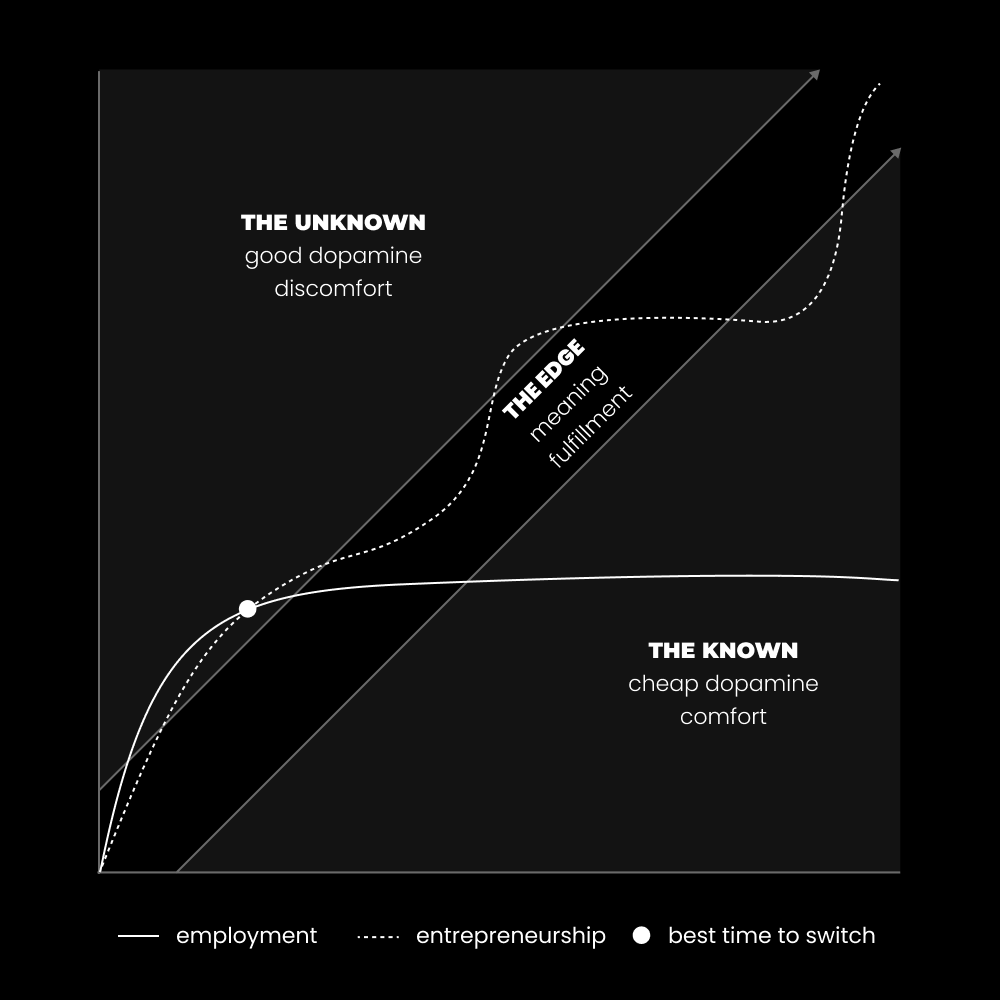
You see, enjoyment, meaning, and fulfillment come from living at the edge of your abilities. This is pretty well studied. No I won’t cite sources. Enjoyment comes from pursuing a challenge just above your skill level. Not so challenging that you get anxious, and not so underwhelming that you get bored. Video games exploit this. You take on quests that are just challenging enough, because if you were a level 1 character doing a level 100 quest, you would die immediately and hate the game. This is the single greatest driving factor of getting into the flow state, and if you can create a life structure that increases the likelihood of this flow trigger, enjoyment is abundant.
The thing about jobs is that after a few months, you know everything you need to know. You just clock in, do the tasks, and clock out. You get bored. It’s against your nature. You feel it. Your attention is no longer immersed in the tasks and shifts toward, “What else could I be doing?” For most people, that “what else” doesn’t involve a meaningful goal. It involves opening your phone and rotting your brain. It is very rare that a job requires you to consistently improve your skill to match a greater challenge.
Climbing a career ladder can help, but again, you aren’t in control of the level of challenge. You aren’t working on your own projects. Curiosity, passion, purpose, autonomy, and mastery are bound to be in lack - and those are the 5 drivers of flow.
What does this have to do with wage slavery?
Well, civilization was quite literally built by tribes enslaving other tribes. That dynamic never disappeared. Instead, it abstracted into employment, law, and culture. Society has essentially become a pyramid scheme. There are more people at the bottom than at the top, and it’s mathematically impossible for everyone to be at the top. One boss, multiple employees, dependent on the boss for their survival.
Most of us were raised with industrial standards.
Become a specialist. Study one domain hard. Get a high paying job so my friends think that my son/daughter is successful. And since that’s what you did, you stayed blind to most of the process. You understood the one skill to do your job, but didn’t try to understand the system that paid you. You didn’t dedicate time to other domains, so you don’t know how to build your own thing. All you know is how to fill a role in someone else’s thing.
Before you know it, your ability to think is crushed, even if you were considered “smart” in the skill you chose. You make a decent wage, but you don’t feel financially stable, so you get caught in a chaotic stress loop. Stress narrows the mind. It becomes even more difficult to fathom a life where you do build your own thing.
You have no capital to do what you want. You have no time for personal development. And you’re probably too tired (spiritually, not physically) to re-educate yourself because most of your waking life feeds someone else’s vision.
That’s how you survive mass replacement, by the way, you commit to your own thing.
The problem is that slaves don’t know they’re slaves.
This goes far beyond wage slavery. We are all slaves, usually to ideology and belief systems, in some way or another.
Slavery is about force, and when we hear the word, we think about the physical form. But wage slavery is financial. If you cannot stop showing up to work without catastrophe, and you have no skills to create alternatives, you meet the definition of a slave, no matter if your “feelings” tell you otherwise.
Worse, if you’ve identified with your job, you may take this as an actual attack. You’ll feel the threat response. You’ll want to argue with me, and that’s fine, but it only proves the point further.
I think you get the point.
It sucks. I hate the thought of it.
Let’s talk about what’s possible now and what you can do about it.
II – The five ingredients of success
If you don’t create a routine, you will be assigned one.
Most people, for most of their lives, have been trained to learn things they don’t want to learn, to get a job they don’t care about, working for people they would never want to be associated with in their everyday life.
While I think AI, technology, and social media have accelerated us to the point of understanding that schools and jobs aren’t the only path, I also think people are just tired of the sheer meaninglessness in the world around them.
For those who are tired of the default path, there are five ingredients to becoming future-proof, allowing you to do meaningful work even when/if all jobs are replaced:
Agency - the ability to “just do things” without permission. To see an opportunity and act on it when nobody asked you to.
Taste - the experience to know what’s worth putting out into the world.
Persuasion - the skill to get people to care about what you do, not to be confused with manipulation.
Persistence - the understanding that mistakes do not equal death, and that they are necessary.
Iteration - the process of error correcting toward a goal based on feedback (if something doesn’t work, learn and pivot until success).
Everyone is obsessed with being “high-agency” right now.
I get it. It’s important. You need to be able to initiate action toward a goal. It’s one of the traits that most distinguishes entrepreneurs from employees. Entrepreneurs are people who put something into the world that nobody asked for.
But it’s only one piece of the entrepreneurial puzzle.
The 5 ingredients above actually boil down into two skills: the ability to figure it out and the experience to know what needs to be done.
AI so far is really great at asset creation, but hit creation is not asset creation. Asset creation is a necessary but insufficient condition for hit creation.
Anyone could make a video game last week like anyone could make a video game 5 years ago. The technology is readily available. It’s commoditized. You know how many mobile games get put out a year? Thousands. You know how many hits are made in a year? Zero to five.
– Strauss Zelnick
Anyone can build anything now, meaning that the barrier of entry for entrepreneurship (the antidote to wage slavery) continues to get lower, but that doesn’t really matter:
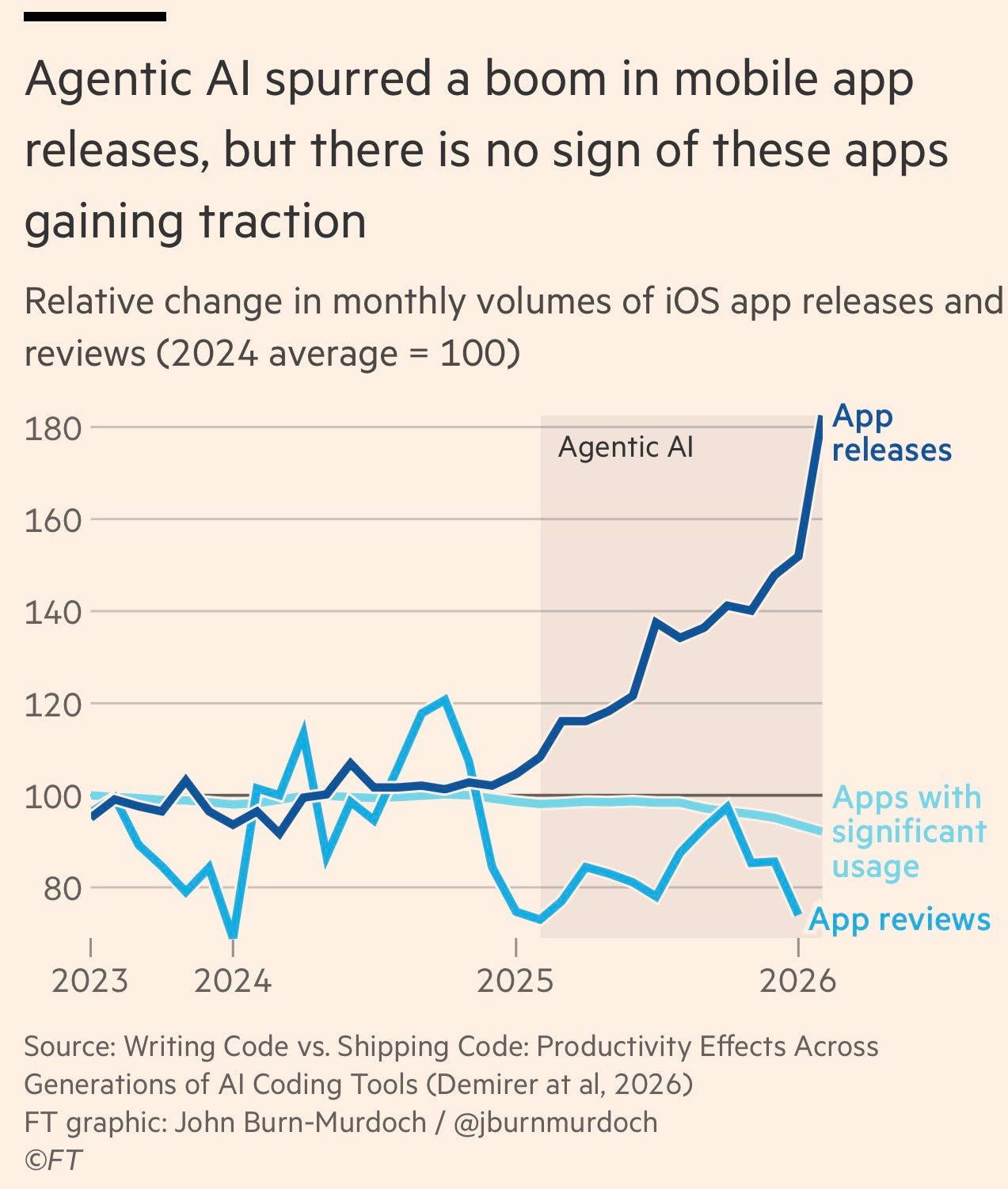
You, right now, can go and build an app.
Not the next Notion, but an app or tool with a maintainable scope, focused on a desired outcome people actually benefit from. Something that doesn’t need to be a hit to be valuable.
I’d actually recommend it. I think software will be the next info product. And by that I mean building software will be the default option for creators, solopreneurs, and other one-person businesses. Info products dominated for so long because anyone could create them, but that doesn’t mean all of them succeeded, of course.
The problem is the image above.
You can build anything, but that doesn’t mean (1) it’s worth building (2) people will care and (3) you have the ability to iterate and persist according to feedback so that it becomes something worth building that people care about.
If you truly understand that sentence, you will do just fine.
The second problem is that agency, taste, persuasion, persistence, and iteration aren’t your typical “high value skills” that you can go watch a few YouTube videos about.
Theory and tweets about becoming high agency will not make you any more high agency.
The only way to practice them is to start doing your own thing.
III – The antidote to employment is becoming unemployable
I remember the day I landed my first web design client.
I believe they paid me $300 for a horrible hand-coded site. It was for a local mattress company, and they just wanted a place for people to see their mattresses.
That was it.
$300.
That’s when it clicked for me. I knew that if I could repeat, improve, and iterate on whatever I just did to make that money, I would somehow be able to gain more control over my lifestyle and future. It made me unemployable. It formed a deep conviction that I would never accept a job again, and I would fend for my own survival, as dramatic as that sounds.
But that number alone, $300, doesn’t account for everything that led up to that moment - the identity change and tricking myself into believing it was possible in the first place. And it doesn’t account for what I learned over the next 7 years.
I want to provide you with two things: the start of an identity shift so you become the person who is unemployable, not just the person who likes the idea of it, and an action plan that anyone can run with in their own unique way.
1) Hurl yourself into an environment that forces growth
The fastest way to change your life is to rip yourself out of your (physical and digital) environment. Change everything overnight. The places you go, the accounts you follow, the info you consume, etc. It’s difficult but it absolutely works.
Behavior change = identity change.
You can try to go on a diet and lose 30 pounds, but if you aren’t the person who values health, and you don’t enjoy living a healthy lifestyle, you will always feel like you’re running up hill. You will, like most other people, gain all the weight back unless you fundamentally change who you are.
How do you do it?
Well, it helps to know how you became who you are today.
You were born into a family and culture with specific values
You were indoctrinated with those values, even if your parents didn’t force them on you
You went to a school with specific values and were taught by teachers with specific values
You were exposed to an absurd amount of information that may have shifted your values toward rebellion, laziness, victimhood
You got a phone, and that conditioning process increased exponentially thanks to social media and our monkey brains not being able to control ourselves
There’s a bit more to that process, of course, but you get the point.
Now, this isn’t bad, it’s somewhat necessary.
I’ve heard plenty of authenticity bros say they hate the thought of “imitation” or copying, and yet they still walk on two feet and speak english because well, that’s what you do. You imitate. It’s called learning.
It becomes bad when your behavior isn’t conducive to the life your core is calling for. That inner voice that is whispering “you are meant for more.”
To begin the reconditioning process, it starts with your environment.
You must become incredibly conscious of all stimuli, because it is all feeding into who you are.
What you do is this:
Flip the switch over night.
Wake up tomorrow and do nothing the same, for atleast the day.
Set your alarm for a different time. Plan exactly what you’re going to do when you wake up. Eat different foods. Talk to different people. Consume different content. Everything.
As we progress, you’ll start to understand the direction in which you should curate your environment.
2) Choose a vessel where feedback is as close to reality as possible
The most dangerous lifestyle is one removed from continuous trial and error.
To be removed from the process of error correction is to be removed from challenge, discovery, and hard earned wisdom that leads to growth that leads to fulfillment.
This does not only apply to jobs where the level of challenge you are exposed to normalizes after you become accustomed to the tasks. It applies to business and entrepreneurship, as well as to those who carry over the employee mindset: always needing to be told what to do, or always needing a handbook to feel confident in their steps.
My question to you:
How did people figure things out before the internet? Before “how-to” guides and step by step processes were abundant? How was the first rocket built?
They tried. They failed. They didn’t let failure convince them into believing it was impossible, or disorient them to the point of indulging in quick pleasure. They set a new direction according to the feedback reality had given them. And eventually, they found the needle in the haystack.
They were intelligent.
Because the mark of an intelligent system is that they course correct according to feedback. They have a lighthouse, and they don’t quit when they get blown off course.
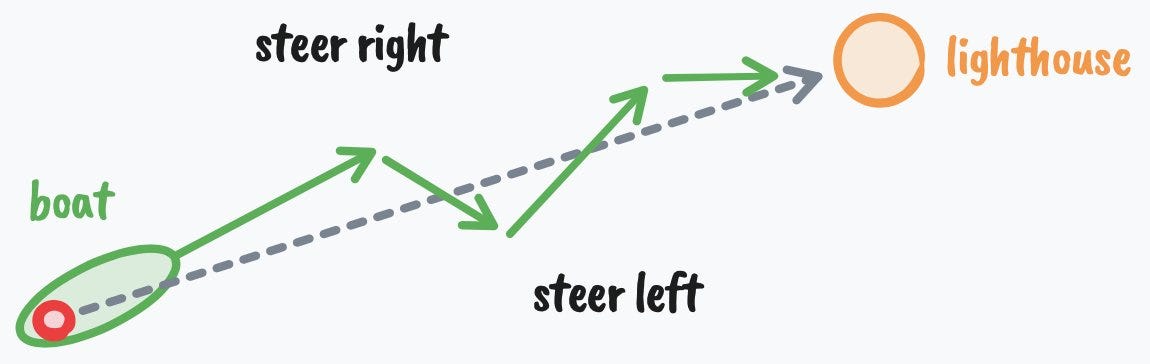
When I talk about entrepreneurship, this is what I mean.
I mean engaging in your natural state. Engaging in creation. Pursuing unknown goals that demand failure to achieve.
This is the singular trait of most successful individuals.
Failure is not a negative concept to them, it is a constant that is necessary for a good life.
That all sounds great, but how do you actually apply this in today’s world?
3) Learn 1 of these 2 skills if you want to thrive in the future
Code and media are permissionless leverage. They’re the leverage behind the newly rich. You can create software and media that works for you while you sleep.
– Naval
You, as a beginner, as one person, do not recognize how much leverage you have available to you, especially with AI.
And I’m not talking about the lower levels of AI use, the casual ChatGPT question-askers and the artists who get mad at AI for stealing their work.
I’m talking about the level where understand that you can build almost anything, because AI puts you in the stream of trial and error. Sure, most of the first outputs aren’t what you expected, but if you have agency, if you iterate, if you persist, if you accumulate taste, then you can build almost anything, and this is likely to only become more true. Then, if you are able to persuade, what you built can pay you while you sleep.
This was possible before AI of course. The core problem is that most people don’t understand that anything is possible with a long enough time horizon if you possess the 5 ingredients of success. AI has simply allowed you to do more, faster, and has given you access to things you didn’t have access to before - like the ability to create software and a supercharged version of learning and research.
With that said, I believe media is more important than code.
And by media, we’re talking about content.
Posts, videos, podcasts, or writing that you publish once and it can be seen by thousands if not millions of people. That, in my opinion, will be the skill worth having, especially as more people try to do it all with AI.
Because with content, you need to know what good looks like.
You still need education that AI can’t give you, because you haven’t started the process of trial and error. You don’t know what to ask.
The value of content is subjective. Every person reading every single sentence is going to interpret it in a different way. In other words, there is no one right way that gets results.
The value of code, on the other hand, is relatively objective. It doesn’t really matter how you write it, as long as it gets the result you were looking for. Like we saw above, there are more mobile apps than ever, but their downloads and usage have actually decreased.
Why?
Because they they don’t have distribution. They don’t understand media and content. They can’t get people to use it, and they especially can’t get people to care about it enough to pay for it.
By the way, I’m not talking about the type of content where people on Instagram say “I gave Claude access to my social media and it grew my account by 100k followers overnight.” That is practically worthless unless you are building trust and loyalty through narrative and authority. You can do this in Eden, but it helps if you know what you’re doing.
As JK Molina says, likes ain’t cash.
Intelligent content creation is much more than just posting rage-bait for likes and follows.
By the way, if you haven’t already guessed, the environment you expose yourself to for the sake of identity change should consist of the people, places, and habit triggers that are aligned with the life you want. This is a part of it.
IV – How to start - set aside 15 minutes to change your trajectory
You have changed your environment.
You have chosen your vessel.
You know that media beats code because the value of content is in the eye of the beholder, which commoditizes AI-generated content rapidly because it becomes normal, opening up space for true creatives - whether they use AI or not, because again, AI isn’t the problem.
Now you need to answer the only question that matters:
What is your life’s work?
That’s what we’re building. A life’s work, not a personal brand.
Peterson, Huberman, Watts - they all have “personal brands,” but they are deeply aligned with their purpose. They know what they want, and they use social media as the tool to actualize it, because that, plus AI, is the technology you use to do more as one person right now, because you probably won’t get much success on TV or on the radio or with a book publisher if you’re starting from zero.
(Alan Watts, of course, didn’t intend to have a “personal brand,” but he absolutely does, and the point stands.)
Their personal brand is who they are.
It’s their identity.
If you want to see your identity live, in front of your eyes, just go through the welcome flow of Eden. It builds it out for you as a graph you can explore.
Most people love the idea of this, but they get stuck fast. They seek the quick dopamine hit, searching “what’s the best niche to make 6 figures in with content creation” rather than digging into the value they already have from years of accumulated experience and story that they think is worthless because it’s normal to them.
The raw material for your life’s work is already inside you, buried under years of being told to specialize, to be practical, to stop asking so many questions. This process isn’t meant to give you some new and novel idea. Instead, it’s meant to show you what you already have.
Take this seriously.
Close your tabs. Open a blank document. Set a timer for 15 minutes. Answer every question below in writing. Do not skip the uncomfortable ones.
Step 1: Excavate your raw material
Most of what makes you interesting has been trained out of you. Your curiosity was treated as a distraction. Your varied interests were labeled as a lack of focus. The system wanted an obedient worker.
Your content will only work if it comes from material that is actually yours.
Answer these, and if you don’t have an answer, move on and let the question sit in your subconscious:
What do you know too much about for it to be an accident? What topic have you researched across dozens of sources, for years, without anyone paying you to?
What problem did you solve for yourself that you assumed everyone else already figured out? What comes naturally to you that seems to break everyone else?
What did you get in trouble for as a kid that was actually just early taste? What did you obsess over before anyone told you it was impractical?
Now circle one answer. The one that made you feel something. That is raw material.
Don’t worry about your niche, content pillars, or any of that. Worry about the quality of your ideas, because that’s ultimately what wins.
Step 2: Name your contrarian spine
Nobody needs another person repackaging common sense. Your content needs a perspective that only you can see. That perspective comes from the one thing you believe that the mainstream gets wrong.
Taste is not about knowing what is good. It is about knowing what is broken and being unable to look away.
Answer these:
What piece of mainstream advice actively made your life worse? What did you have to unlearn to become functional?
What do you believe about your domain that experts would call naive, but you cannot shake?
What is everyone in your industry pretending not to see?
Look at your answers from Step 1 and Step 2 together. Where they overlap is your direction.
Your answers to these questions are your first posts.
The best brands are that persons world, published in public for people to explore.
Step 3: Post your first idea tomorrow
This is a letter, not a course.
I wish I could have 20 modules here, but I can’t. That’s what the bootcamp is for.
The final ingredient, to mark the beginning of the end of dependence on someone else for financial stability, is actually doing the thing, and actually doing the thing starts with one post.
You literally have post ideas written down from the last step.
Take one.
Think of how to make the hook attention grabbing.
Think of how the word the body for impact.
Embrace that the first iteration will suck and that you can’t improve what doesn’t exist.
If you want a little help, here’s a prompt/skill for you to brainstorm angles and draft variations so you can get a feeling for what “good” looks like. These are all built on what works. We talked about this previously in the growing on social media is easy letter.
Your task is simple.
Take one answer from Step 1 and one answer from Step 2. Combine them into a single sentence that only you could write. Then publish it tomorrow as your first piece of content. A post. A video. A newsletter. The format does not matter (yet).
Now you actually have feedback against reality.
If it doesn’t work, good, you have to learn. You have to study, find a persuasion tactic you can try in your next post, and then the next, until you master the skill because skill acquisition is just stacking techniques as you encounter problems.
If you are one of those that is now saying “I wish this is more practical,” you are blind. I just gave you the formula to do anything.
And you just received feedback from your own mind that you did not register as an error to correct.
That’s it.
Talk in the next one.
– Dan
I highly recommend anyone who is just starting on Substack to read high-quality articles from writers like you, Craig, and several other great publishers.
Reading high-quality writing at the beginning helps you develop a sense of what "good" looks like. Then, instead of getting lost in an ocean of posts and Notes, you naturally start recognizing the ones that align with your own internal North Star.
Over time, that North Star becomes your taste. It shapes not only what you choose to read, but also the kind of writer you gradually become.
Reading this, I realized something.
AI is not the real threat. The real threat is elsewhere. The wage slavery structure we’ve been conditioned into through decades of education, the ideologies and belief systems we’ve inherited without questioning.
That structure worked when civilization was expanding. But we live in a different world now. Wars, addictive substances, extreme economic inequality. We are surrounded by things that collapse civilization from the inside. In that world, continuing to follow that structure is not just limiting. It’s dangerous.