


If you need to remember it, it’s not important. If it’s important, you will remember it.
For some reason, it’s become an obsession to remember everything you read. There are hundreds of videos about it with millions of views.
People feel like if they don’t retain the knowledge from what they read, they’re a failure, or they wasted your time, when that’s not the point of reading at all.
Why would you want to memorize every word of a book in the first place?
I know why.
You want to sound smart.
It’s an unconscious status symbol for you.
You want to impress others with your articulation and intelligence, but you don’t realize that sounding smart comes from understanding, not memorization, and understanding requires a much different approach to learning. It also doesn’t help that schools tested you on your ability to memorize. You studied for hours just so you could pencil in the right answer. That’s not how life works.
I get it.
You want to acquire knowledge so that you can make better decisions and work yourself into a more advantageous life situation with more money and power so you don’t have to worry about your day-to-day survival. Everyone wants that, but memorizing facts is the least effective way to get there.
That’s what we’ll talk about first - how to acquire knowledge in a way that actually sticks, so you can create a better future for yourself.
Then, we’ll talk about why your note-taking system, bookmarks, and even your precious “second brain” (the sex doll for mental masturbators) are largely useless.
Skip to the rest of the article if you’re allergic to self-promotion:
Speaking of second brain software, we just added Library, Reader, and Highlights to Eden. Now, not only can you research creator’s top content and find your next viral topic (and schedule posts to be published), but you can build an interconnected library of posts, links, and ideas that Eden organizes for you - and allows you to search based on meaning.
And, you can save any Substack article, X article, or YouTube video, read the transcript, and highlight so you never lose an idea.
Get 4 months and the Creator Bootcamp free (normally $499) here.
How to actually learn anything fast
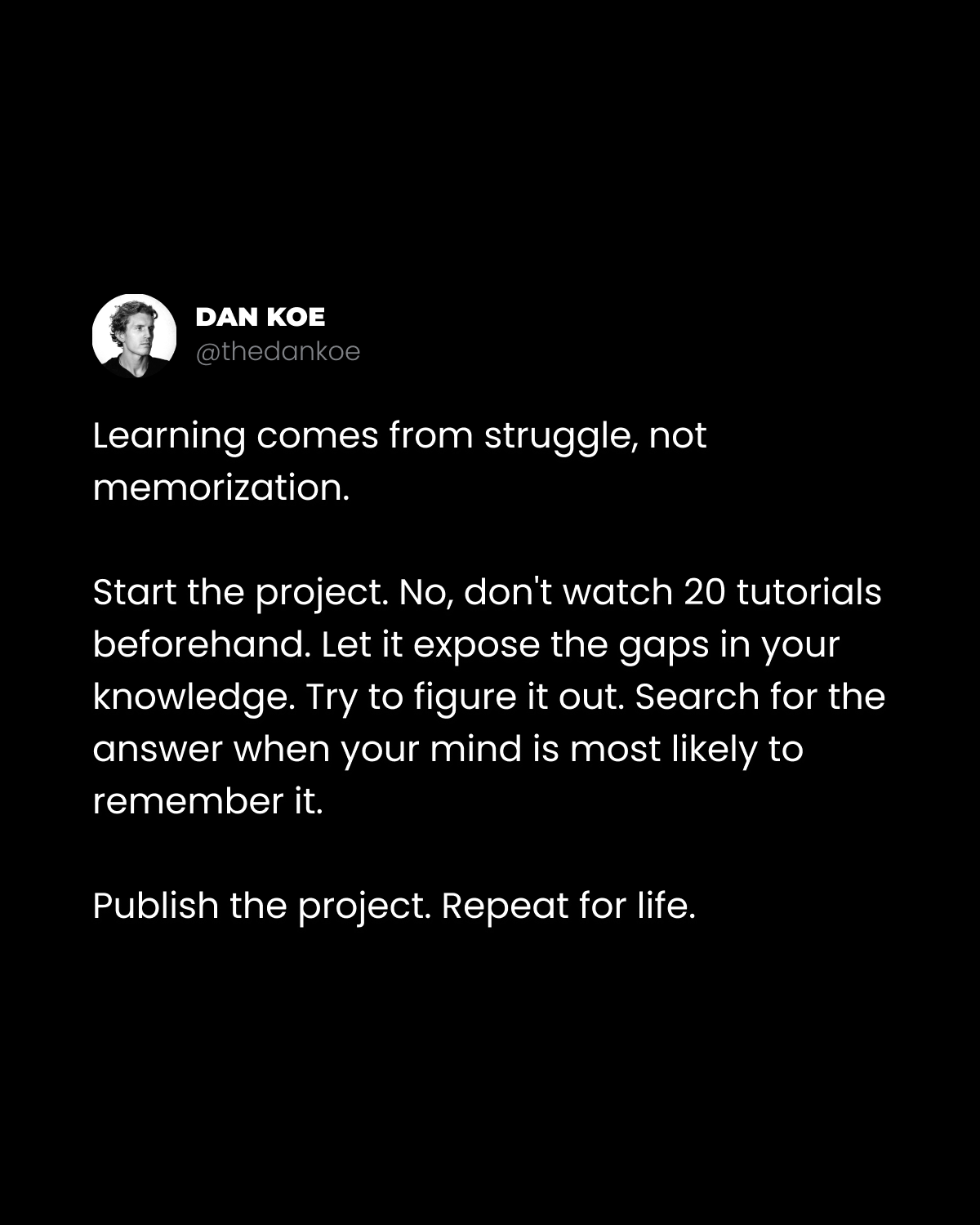
Most people have no idea how to learn.
Because most people have no idea what the learning process is.
The reason most learning fails is that there is no negative feedback loop.
Think of it like this.
If you don’t have the goal of getting in shape (and I’m talking a deep intrinsically generated goal not a superficial goal you’re pursuing to fit in, like a new years resolution) then a night of heavy drinking and partying won’t register as a problem (negative feedback), because it doesn’t impact your non-existent goal of performing on your morning run or gym session the next day. You can go to work just fine with a hangover because you don’t give a shit about how well you do at your job.
Learning is a cybernetic process.
Cybernetics sounds like something relating to cyborgs, but it stems from the Greek word kybernētēs, meaning steersman or helmsman. The person who steers the ship.
The word “cybernetics” was chosen because the helmsman is the perfect image of a feedback system. The helmsman doesn’t just point the ship in a direction once, he constantly reads the current state (wind, waves, heading), compares it against the intended course, and adjusts. In other words, the process of trial and error, and so few people have the direction that allows them to notice errors in their life.
Cybernetics illustrates the properties of intelligent systems.
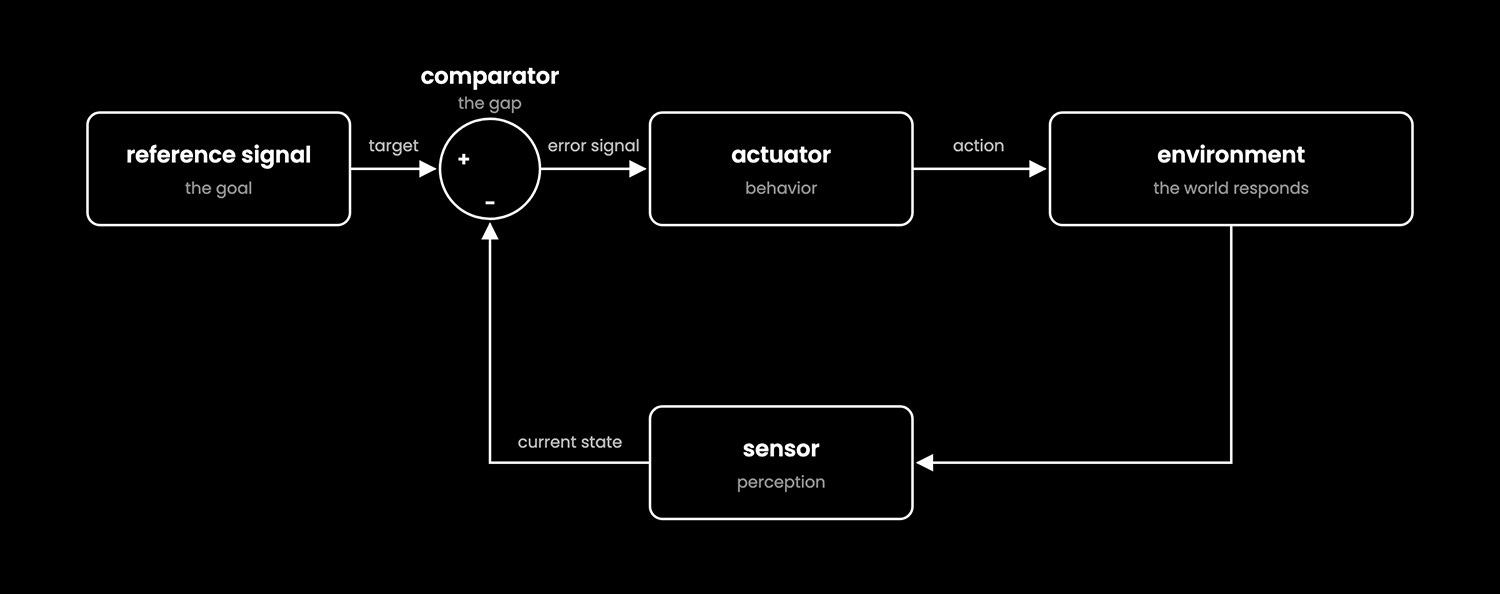
Reference signal (the goal) – The system holds a target state.
Sensor (perception) – The system reads its current state.
Comparator (the gap) – The system computes the difference between target and current state. The difference is the error signal.
Actuator (behavior) – The system acts to reduce the error.
Like how a thermostat turns on the heat when it gets too cold, or how your pancreas releases insulin when blood sugar rises.
That exposes the issue nicely.
When most people try to learn something new, they focus on content. They hoard material and try to absorb it with space repetition, flashcards, courses, and learning the fundamentals. They assume learning is an input process.
In reality, learning is an output process, because output demands input.
A goal creates the error signal.
The error signal creates the filter.
The filter creates relevance (most people fill their mind with noise and things they will never use).
The relevance creates retention.
A person who has been conditioned their entire life to have the nearly unconscious goal of going to school and getting a job will naturally learn and behave in that direction. The destiny they were assigned will inevitably come true.
The person who is deeply conditioned to go down the default path will not even notice money-making opportunities outside of a job, because their brain is filtering it out. The big life goals they were assigned at birth dictate their behavior and learning. They are a puppet of someone else’s ideals. They are not in control of their life.
But if you consciously create your own frame, by knowing exactly what you don’t want out of life and comparing it to an evolving vision of what you do want out of life, you are only then able to sense when you are off track, notice the error, correct the direction you are heading, and learn as a byproduct.
Makes sense, but what do you actually do?
Step 1) Become obsessed with a meaningful goal.
The way you become obsessed is to look at your current actions and realize where your life will end up if you don’t change.
For most people, that outcome is not pretty.
Sit with that image, let it fill you with potent emotion, and redirect that emotional energy toward a better direction for your life.
Only then can you actually align the goals you pursue with the aim of your future. Only then does a useful learning process start, the opposite of schooling, where your learning is determined by the direction and goals society sets for you.
Being extreme changes your brain and enhances neuroplasticity. In my eyes, you’re better off making an extreme change than making a lot of small changes.
Burn the boats. Change your life.
2) Don’t start learning.
The life you want lies at the end of a series of meaningful projects.
Your mind is to be treated as a project. As is your body, relationships, and financial situation. A project is simply a structured set of goals and milestones. A project creates a frame for your learning (by filtering unimportant noise). Anything that does not directly move the project forward is not worth learning (right now), because you won’t retain it anyway.
In other words, when you want to learn something new, don’t start learning, take the first step toward the goal instead.
3) Seek specific knowledge.
I ultimately think that everyone should be figuring out what it is that they uniquely do best—that aligns with who they are fundamentally, and that gives them authenticity, that brings them specific knowledge, that gives them competitive advantage, that makes them irreplaceable. And they should just lean into that. And sometimes you don’t know what that is until you do it.
– Naval
Schools teach general knowledge, or knowledge required to do a job.
They do not teach how to navigate your own path. They narrow you into one area of study, which by nature does not prepare you to direct your own work through the path of entrepreneurship - or simply doing what you want to do.
Self-education is the process of learning what’s necessary to achieve self-generated goals. Again, no hoarding general knowledge to feel like you’re learning.
As an example, let’s say I want to learn After Effects - the animation software.
It would be stupid to go and watch a bunch of general After Effects tutorials and learn every little thing about the software.
Instead, you need a vision for the project you want to build.
You start the project with the knowledge you have, and if you don’t have knowledge, then you find a specific tutorial that is as similar to the project you want to create as it can be.
Now, since you have a filter (what you want to create), most of the tutorial will be useless, but you will find one little technique that allows you to at least start the project.
You apply that and then repeat until you’ve stacked so many techniques that when you go to create your next project, then the next, it becomes easier and easier.
Same with learning the guitar or an instrument.
You don’t go and study music theory.
You choose a song you want to play.
Then you learn the first chord of the song. Then the second. Then the third. And eventually you learn to tune it a specific way, and you pick up little hacks that allow you to play better.
After learning a few songs, you feel as if you could then create your own simple song.
That is how you learn.
The Second Subconscious (Delete Your Note-Taking System)
I’ve tried all the systems before, and I loved them. I started with Roam Research, and it completely changed how I write. I built a knowledge base of potent ideas, and pulled from those every time I sat down to put words on a screen.
A few years ago, I even built Kortex, which wasn’t meant to be second-brain software, but that’s what it ended up being before it inevitably failed. Well, it didn’t really fail, but it painfully evolved into Eden, which has become the best tool on the market to find what’s trending on social media (for creators), and capture ideas from anywhere (for creatives).
So, I’m not here to say that second brains are useless.
I simply think they’re misused.
You bookmark and take notes just for them to never be seen again. You quite literally wasted your time thinking you were learning when you could have been actually learning, as we discussed.
In the past, people didn’t have a popularized “second brain” that markets well. They had a commonplace book.
Marcus Aurelius’ book, Meditations, is essentially a private commonplace book with notes to himself and digested philosophy. It was never meant to be published.
Leonardo da Vinci filled thousands of notebook pages with sketches, observations, questions, and borrowed ideas.
Mark Twain, H.P. Lovecraft, Thomas Jefferson, Ronald Reagan, Montaigne, Rick Rubin, and many more each had some variation of this.
But there is one major difference between the every day second brain stan and them.
Their collection of ideas were fuel for their creations.
Their inventions, writing, and music would not be what they are today, and I would go as far as saying you wouldn’t even know who those famous people are if they didn’t have some variation of a commonplace book.
When you create something, your subconscious spits out relevant ideas that contribute to the quality of the creation, but it’s still limited in processing power, and sometimes it decides to not help you at all, leaving you in a creative rut.
A metaphor that Seneca used was to gather pollen from many flowers, then digest it into your own honey.
In modern terms, steal like an artist.
This is the antidote to writers block. You don’t have ideas for your writing, content, or videos because you don’t have a repository of ideas to pull from. Every single thing I’ve written in this letter is from articles, videos, social posts, random ideas, and highlights I’ve saved before.
I think you get it, but how do we actually build this?
How do we create a digital commonplace book, or second subconscious, that we can build throughout our lives that doesn’t turn into a cluttered note-taking app where your ideas go to die?
Step 1) Choose The Right Software, Or Create Your Own AI System
Don’t get breathless about how “smart” AI is. It’s dumber than a sack of wet hammers.
Leverage, instead, its ability to do rapid input and output for simple tasks on large datasets.
– Devon Eriksen
Most note-taking and “second brain” software still require manual upkeep.
Some of them have an AI chat tacked on, which is absolutely useful, but they’re missing the most useful application of them all: making it so your ideas don’t disappear into the void - because your creative work depends on your ability to resurface them.
You have 2 options here.
Our goal is to have somewhere to drop ideas and easily be able to resurface the right ones for our project.
Option 1 - Use a combination like Claude Code + Obsidian to store your knowledge in one place and retrieve ideas with AI
Option 2 - Use a software like MyMind or Eden, which auto-tags, categorizes, and embeds your knowledge in “meaning space” so it can connect seemingly unrelated ideas to birth novel insights
There are plenty of tutorials on the internet for option 1. It’s very popular right now because people swapped their precious collection of Notion templates for a collection of Claude skills (a fad that will fade as they all do), but here’s the 80/20 of how to do it yourself:
Download Obsidian and Claude
Open Claude Code or Claude Cowork and select your Obsidian vault folder on your computer as the folder you’re working in
Create a “save an idea” skill - ask claude to create a skill that creates a note in an inbox folder with a clear title
Create a “process my inbox” skill - ask claude to create a skill that goes through your inbox folder, add tags, move it to the right folder, and add backlinks to other related notes within the vault
Ask Claude to help you define your taxonomy so it knows what tags/categories to use
That allows you to capture ideas, notes, and knowledge into a time-tested note-taking tool.
Then, you can ask Claude at anytime to “Search my vault for everything related to [idea I’m writing about].”
That works for finding most ideas, but good writing and creative work come from novel connections, not keyword search or the AI brainstorming synonyms to find related matches.
If you don’t want to do all of that manually, then you can use a software like MyMind, which allows you to save any link or idea to one big and searchable library.
Eden does the same thing (you can capture anything fast into your library), but takes it a step further. When you save a link, like a Substack article or YouTube video, it transcribes it, and allows you to highlight it. Plus, you can integrate with Kindle to pull all previous highlights in - which are potent creative fuel.
The way MyMind and Eden differ from Obsidian and Claude is that everything you add to your library is automatically tagged, categorized, and embedded. So you can do the same search that Claude allows you to do, without wasting precious AI usage (Eden also has an MCP if you do want to build and access your knowledge base with Claude.) Plus, if you’re a writer or creator, Eden has an outlier search feed where you can find what social posts are performing in your niche and save them straight to your library.
I am not entirely sure if MyMind does this, but with Eden, it also differs in that it can search based on meaning.
Obsidian can show you “what’s related,” Eden can show you “what’s nearby” because each idea is embedded with ~1500 numbers that act as GPS coordinates for an idea. They can be found even if they share zero of the same words. This is what allows you to just drop an idea in and forget about it, because you know you will find it exactly when you need it.
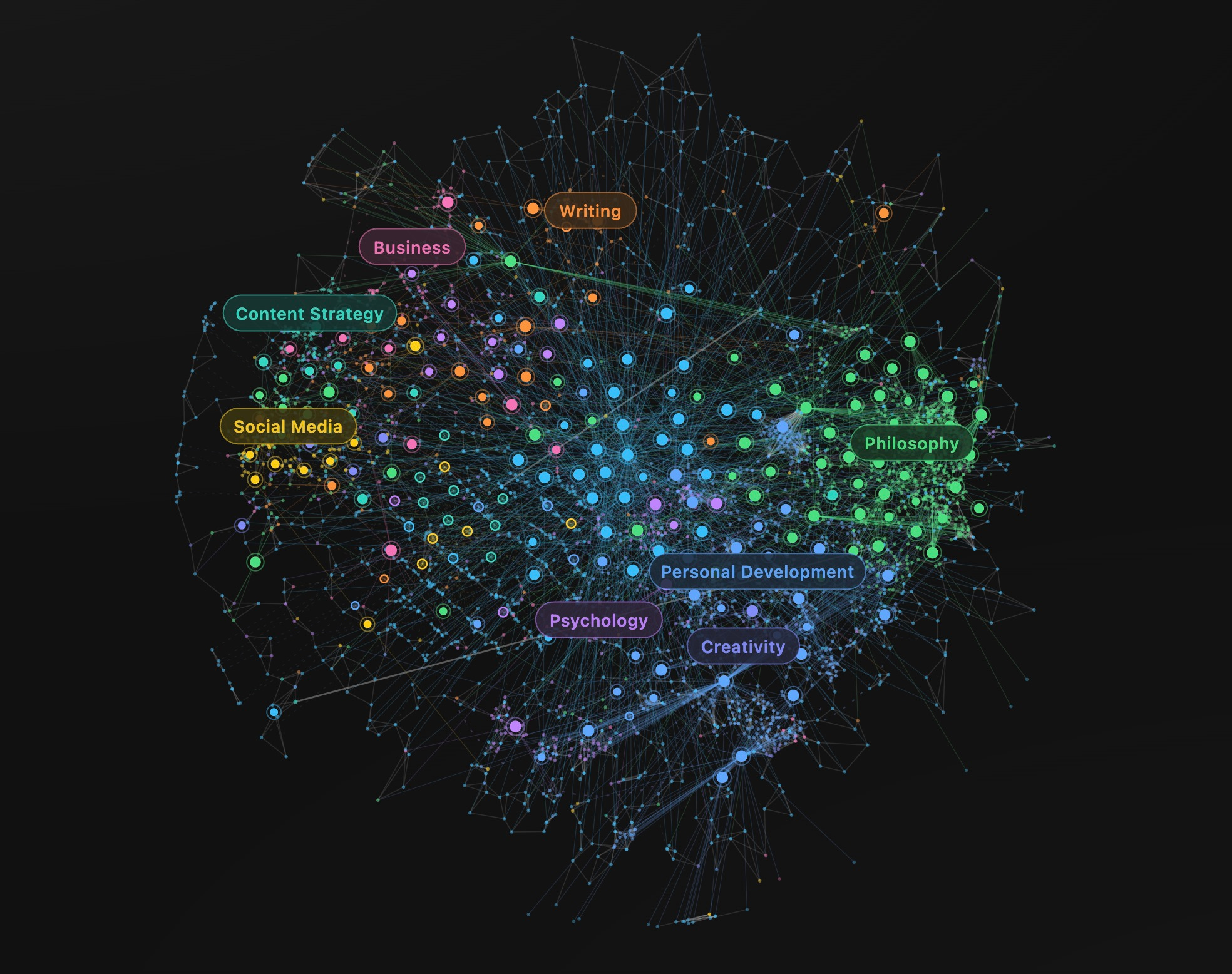
It can pull up novel connections without re-searching through your entire knowledge base every time, costing hundreds of thousands of AI tokens.
You probably don’t want to maintain a vector database, an embedding API, indexing scripts, re-embedding when notes change, keeping the index in sync when files are renamed or deleted, and caching so you don’t re-pay for unchanged content.
All of the tools do this for free, but if you want a true “second subconscious” that you can research while writing, creating, or building projects - Eden may be worth trying out.
Step 2) Capture The Ideas That Best Represent Your Ideal Mind
Now that you have a place to drop ideas without worrying about organization (because you only organize things if you want to find them later, which we just solved), you don’t just dump everything in their.
When AI can create anything, curation matters more than ever.
You need a curated space for ideas that spark inspiration. The opposite of an endless fire hose of noise we call a social media feed.
As a writer, creator, or someone trying to do independent work (meaning you need to build an audience by attracting them to the ideas you put out), people don’t follow you for your content anymore.
There’s Google, AI, and plenty of information that can be found at the click of a button.
They follow you for your point of view. Your opinion. Your interpretation. Your personality. Your story. And all of those things are downstream of the ideas that compose your worldview. The ideas you use to make sense of the world.
As an example, when I get into a conversation about the nature of reality, my mind jumps to ideas about history, integral theory, spiral dynamics, and more - because I’ve deemed these the most useful lens from which I can view that conversation from. It makes the most sense out of the other ideas I’ve heard that tend to fall flat.
Those are the ideas you capture.
You curate a large set of knowledge that would best represent your ideal mind.
Because that’s what your fancy note-taking system was meant to be, right?
You just never got around to solidifying those ideas as a part of yourself, usually through the act of thinking, writing, and sharing in public so that you can receive feedback from the market and let the best ideas win.
How do you do this?
You read more books. You let your curiosity guide you. You reject doomscrolling and embrace curated lists of authors and thinkers who are dedicated to producing good ideas. You make time for “research,” because as a writer or creator, that’s 80% of your job.
The rest of your job is just synthesizing that “research” into something that’s beneficial to other people.
Step 3) Build Your Ideal Mind Through The Act Of Creation
Let’s close the loop.
We have the system for capturing and retrieving knowledge.
But now we need the project to apply it too so that it doesn’t go to waste.
And, we still aren’t capturing specific knowledge because we don’t have a reason to learn. We aren’t giving our mind the frame from which it can effectively signal that ideas are important enough to capture, as we discussed.
That’s the entire goal we’re after, right?
We want to be smarter. We want to retain and remember what we learn. We want to sound articulate. For superficial reasons, maybe, but also because the outcome of our lives depend on the decisions that we make, and our level of smartness and ability to articulate our own value absolutely contribute positively to that.
I can’t tell you what to create.
But if you’re interested in writing, I can give you a part of my process that recently helped someone else.
For something like writing a Substack article, YouTube script, or X article, here’s what I would do:
1) Choose a topic.
Obviously.
The best topics are the ones that lie at the intersection of performance and excitement.
Performance = topics that have already proven to do well.
You find these by saving social posts that have gone viral, or using a research tool that allows you to find outlier content and study creator’s top posts.
(This article I’m writing now is based on “How to remember everything you read,” a topic that has gone viral more times than I can count, but I applied my own contrarian perspective to it).
Excitement = topics and ideas that you want to explore more out of curiosity.
Your job is to pair the topic you want to write about (that probably wouldn’t do well on social media) with a topic that has already proven do well, so that you can write about what you want and increase it’s potential to actually gain traction.
That’s where most beginners fail.
2) Braindump → Outline → Draft
Don’t start writing yet.
Writer’s don’t just open one page and then expect all of the ideas to linearly fall into place.
Start with a braindump. Write down all potential ideas that could fit under the topic you’re writing. Look through your notes, ideas, and links and add them inside it too.
Then, start to add some structure with an outline. Take all the ideas in your braindump and try to fit them into a general storytelling framework: Problem → Insight → Solution.
Organize ideas under each of those sections in the outline.
Then, have your outline, ideas, and library of knowledge open and ready to pull from as you string together the ideas in the form of an actual draft.
3) Use AI to remove friction, not write for you.
I’ll write about my thoughts on AI writing in a future letter, but when I say “don’t use AI for writing,” I’m actually saying “don’t use AI to articulate your own beliefs and opinions.”
Now that Substack has their AI writing estimator, people are going to start pointing out how certain accounts use AI in their writing. I’ve had a few point out that some of my articles have AI writing in them.
Don’t be dense.
Yes, I copy paste straight from AI when providing pure information - like explanations of Greuter’s 9 stages of ego development, the same information you’d get from a Google search. I’m not going to waste my breath trying to rewrite it in my own words, because that doesn’t need to happen. It’s a disservice to myself and the reader.
I think there is value in struggling to articulate your own thoughts and beliefs, which is something the anti-AI people can’t seem to do very well as they are kept narrow minded by their new religion.
When I say “use AI to remove friction,” I am talking about using it like you would a course or mentor or editor while you are learning the skill.
If you don’t know how to structure your article, ask for a list of structures that your ideas could fit into.
If you don’t know what to write next, ask for a few directions the article can go.
If you don’t understand something, research it, like any writer would in the past with a less efficient method of scouring through the internet for the right information.
All in all, I trust that you have a brain.
You are ultimately the one who decides what gets published.
If it doesn’t represent the values, ideas, and beliefs you want it to, then refine it until it does.
I’ll leave it at that, because I have much more to say that I’ll save for another letter.
– Dan
If you want to write but don’t know where to start, what to write about, or anything about how to grow on social media, consider joining the bootcamp here.
Really resonated with the point of being extreme.
Paul Graham said, ““If you don’t try to be the best, you won’t even be good. In some ways it’s easier to try to be the best than to try merely to be good.”
Love the advice around setting up a digital commonplace book. The issue for me is that inspiration tends to strike during the most random moments. My phone’s notes app is filled with seemingly-random and unrelated thoughts (many of which were sweatily typed in during a run 😅). I’d be so curious to go back and analyze these ideas to find any common threads (or even to just revisit the ideas I never got around to pursuing). Thanks for the new ideas on archiving and actioning these thoughts!