


If you have multiple interests, you probably have no idea what to do with your life.
You felt like school was a waste of time. Maybe you went to college, but you felt like choosing something to study for 4 years was death to your curiosity (I switched majors 5 times I believe… and didn’t graduate after 5 years and tens of thousands in student debt.)
And you don’t know what to do for your career, because you want to do so many different things.
You’ve heard the advice on social media to start a business, but it’s all the same story.
“Choose a target audience.”
“Niche down and only talk about one thing.”
Advice like that.
Advice that if you listen to it, you just end up in another 9-5, working on projects you hate for people you hate, except you’re working 12 hours a day instead of 8, and you still can’t pay the bills.
I’m speaking from experience here, by the way. This is my exact story.
My first semi successful “business” was freelancing with web design. But I was tired of working on someone elses projects. I wanted to work on my own. So I started on social media (because if I could build an audience, I could build any kind of business I wanted and be able to kickstart it that way).
That’s when I saw what creators were actually doing. They weren’t just talking about one topic over and over. Because that’s not why someone follows you in the first place.
When you scroll on social media, are you just reading about the same exact topic? Or are you seeing different posts and ideas across many of your interests?
I realized that someone who is interested in self-improvement can probably become interested in psychology, philosophy, and weight lifting because well, I’m interested in all those things.
To think that you have to “niche down” is pretty damn stupid when you actually consider that you are talking to humans, and a human can become interested in anything if it is presented properly (that is the art of content creation).
At that point, it started to click.
If I learned how to turn my interests into social posts that appealed to a broad set of people, my audience would grow, almost indefinitely.
Then, I could turn my interests into a product that’s compelling and valuable enough for people to buy, and my income would increase accordingly.
Of course, there’s a bit more to it, but that’s what this letter is for.
To show you how to turn your interests, skills, and knowledge into a business.
This will be pretty long, but my hope is that it is more straightforward and useful than 99% of business content out there.
Enjoy.
Step 1 - The content map
The title of this letter, how to get rich from your interests, doesn’t mean what you think it does.
I’m not talking about making hundreds of millions of dollars here.
I’m talking about feeling rich.
I felt a lot more rich, and had a lot more money to spend when I didn’t have 2 teams, a software company, and an ecommerce company.
When it was just myself, or myself plus my editor, every dollar I made was almost pure profit. You will feel far richer making $1 million dollars a year as one person selling their knowledge than $10 million with a small team and traditional business model.
Let’s just call it “soft rich.”
The business model we’re going to focus on is incredibly simple.
Social media as a traffic source, because that’s where the attention is right now, and it’s free.
A micro-product or service based on your own knowledge so you can start monetizing fast.
That’s the entire business.
To do well on social media, you need to know what you post about and why other people should care.
The most effective practice I’ve found for this is building a content map.
Before we start:
Grab a pen and a piece of paper. Not a notes app or a Google doc. There’s something about writing by hand that forces your brain to slow down and actually think rather than just type whatever comes to mind first. Keep this paper next to you wherever you work. You’re going to come back to it often.
Most people quit because they don’t have a clear picture of what their brand looks like in 6 months, let alone 2 years. So they pick random topics, post a few times, get no traction, and assume they don’t have anything worth saying.
Stop thinking about your posts as individual darts you’re throwing at a board, hoping one hits the bullseye.
Start thinking about your posts as pieces of a puzzle. Each one adds to a bigger picture. A map, so to say. As it grows, people have more of a reason to binge your work. You no longer rely on one viral piece.
Your niche is how you help people transform their lives
There are 3 reasons people follow you (for the sake of a transformation-first personal brand, not a meme account or tiktok dancer):
Your post entertained, educated, or inspired them
You talk about things that they are interested in
They believe you can help them change their life
The first 2 are a natural byproduct of consistency and writing quality content.
But the third is the most impactful.
If we take the map analogy from before, the north star of that map is your mission.
It’s the desired destination you are helping your audience reach. It’s the interesting story you are guiding them through. It’s the solution to the current life they don’t want to live.
On your piece of paper, I want you to put two dots on either end:
Point A: In one sentence, what is the life your reader is trying to escape? What’s the situation they’re stuck in? This is your anti-vision. The thing your brand stands against. The “enemy.”
Point B: In one sentence, what is the life you’re helping them move toward? What does it look like when they “get it”? This is your vision. The destination.
This is your brand mission. Your mission is to help as many people as possible go from point A to point B.
Why does this matter?
Because everything on your content map needs to live between these two points. Point A is where your reader is. Point B is where you’re helping them go. Every idea you write about is a step on that path.
This is also how you solve the “I have too many interests” problem. You might care about philosophy, fitness, business, and psychology. That sounds scattered until you realize all four of those help someone move from a life of scattered focus toward a life of intentional self-mastery (or whatever your specific mission is).
Now that you have your mission, Point A, and Point B at the top of your page, it’s time to fill in the map.
Start with 2-3 broad topics. Think of these as the major territories on your map.
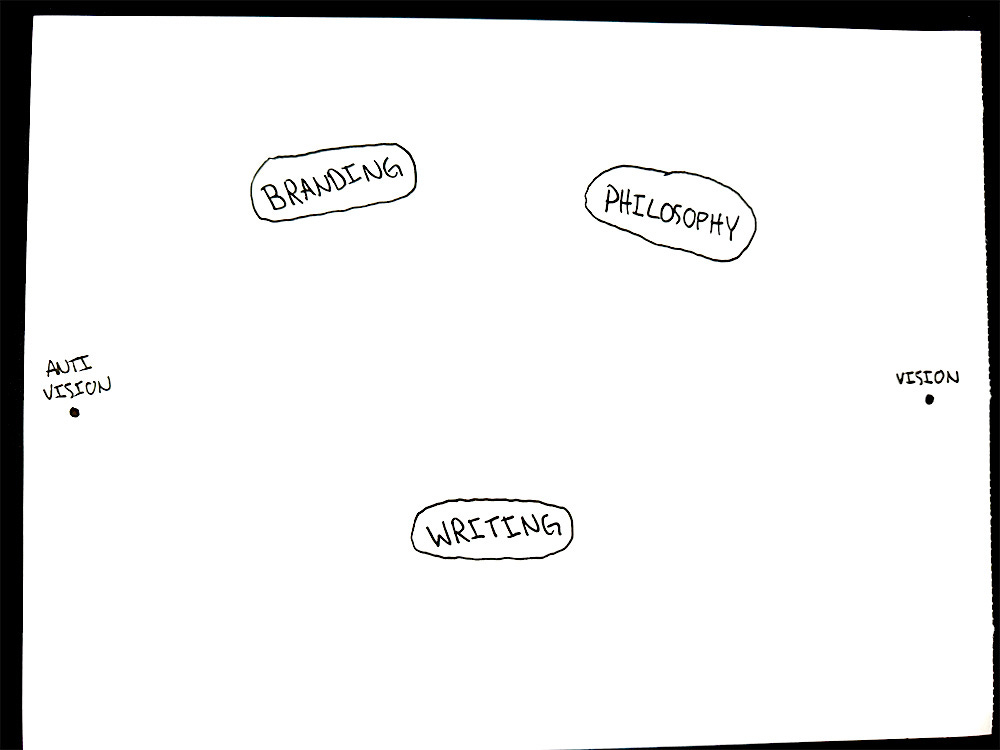
These should be broad. broader than you think.
Why?
People on social media aren’t searching for specific knowledge. They aren’t Googling “how to optimize my morning cortisol response.” They’re scrolling. They’re consuming whatever catches their attention. That’s what social media is for. Not value, attention. Your product is the value that you lead them into. If your topic is too narrow, you’re invisible to 95% of the people who would actually benefit from your ideas.
This is where my writing philosophy differs from others. I attract a broad net of people, then target specific people in my audience with various offers. The “niche down” route absolutely works, but I like to have the freedom to talk about whatever I want, so I needed to create a way to do that.
Some examples of broadening:
If you’re interested in lead generation for service businesses, your broad topic is “online business.”
If you’re interested in building AI automation workflows, your broad topic is “artificial intelligence.”
If you’re interested in the carnivore diet, your broad topic is “health” or “nutrition.”
You attract people with something broad that helps them achieve a goal in their life, then you later hit them with the specifics that they’ll be asking for. That’s when you create an offer, free guide, etc.
A few notes:
If you only have 1-2 broad topics right now, that’s fine. Start there. You’re allowed to iterate throughout your journey. I’ve pivoted more times than I can count.
If you have no idea what to put down, think about what content you already consume or books that have shaped who you are. What do you read, watch, or listen to because you genuinely find it interesting? That’s your starting point.
The best topics sit at the intersection of what you deeply care about and what has the potential to help other people. I guarantee there are already creators monetizing whatever you’re interested in. Your job isn’t to invent a new category. It’s to bring your perspective and opinion to an existing one.
We have the territories. Now we need the cities.
For each broad topic, write out 3-5 more specific subtopics branching off of it, like a mind map.
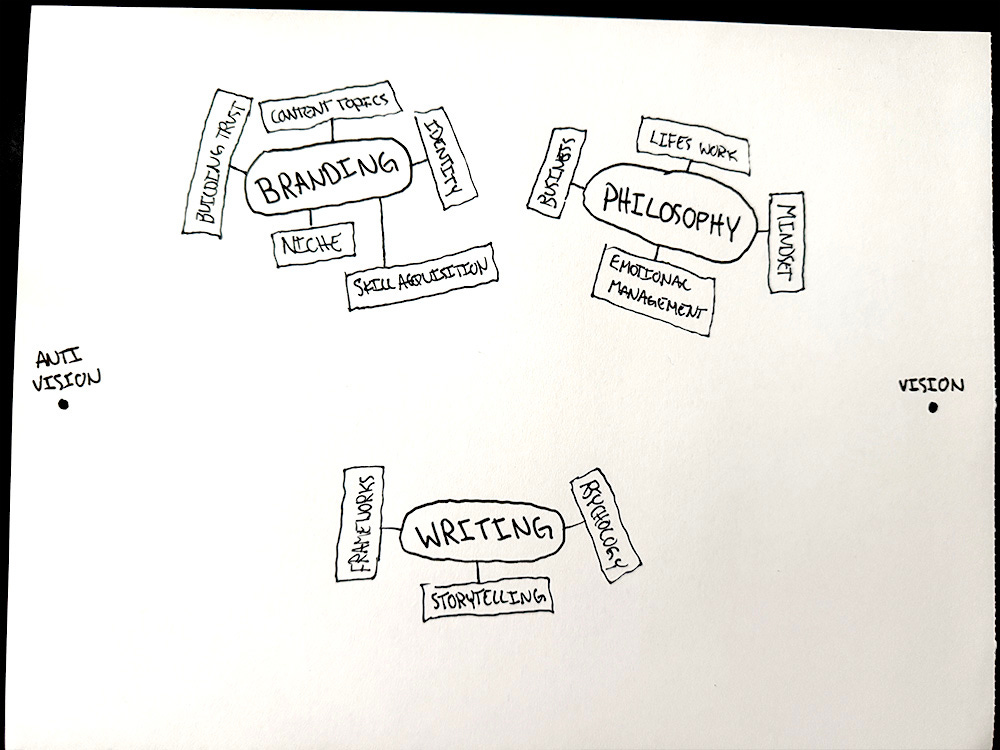
This is where your unique angle starts to emerge. Two people can both write about “business,” but one focuses on freelancing, sales, and client work while the other focuses on digital products, content strategy, and audience building. Same broad territory, completely different brands.
For a broad topic like fitness, subtopics could be nutrition, training, habits, lifestyle, recovery.
For a broad topic like personal development, subtopics could be mindset, focus, journaling, emotional regulation, goal setting.
For a broad topic like business, subtopics could be writing, digital products, audience building, skill acquisition, AI tools.
If you’re stuck, you can ask AI to give you a list of subtopics for your broad topic and then choose the ones that interest you most. But try to generate them yourself first. The ones that come to mind naturally are usually the right ones.
Write these on your paper, branching off each broad topic.
This is where the real value starts to show up.
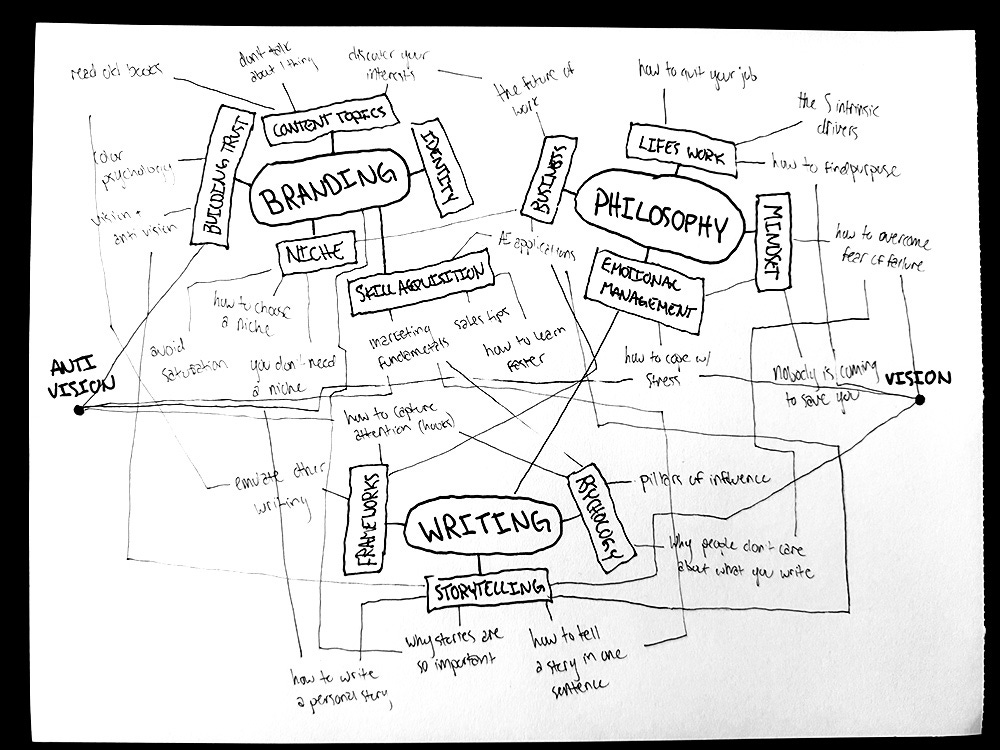
We have the territories and the cities. Now we need to give people something to actually engage with. Specific, concrete ideas they can learn from, disagree with, or share with a friend.
For each subtopic, write out 3-5 specific content ideas. Here’s what to think about:
Pain points people experience. What frustrates them? What are they doing wrong? What keeps them stuck? These make great posts because they immediately make people feel seen.
“How to” ideas. Step-by-step processes, methods, frameworks. People love actionable advice they can try immediately.
Lessons you’ve learned. What do you know now that you didn’t know a year ago? What mistakes did you make? What would you tell someone just starting out?
Why it matters. Why should someone care about this subtopic at all? What’s the cost of ignoring it? What changes when they get it right?
Harsh truths. What’s the thing nobody in this space wants to say? What’s the uncomfortable reality that most people avoid? These tend to perform extremely well because they cut through the noise.
Your opinion on popular ideas. What does everyone else say about this topic that you disagree with, or that you’d frame differently? What’s the common advice that’s actually wrong or incomplete?
(By the way you can paste this letter into AI and ask it to guide you through this.)
You might hit this section and think, “Who am I to write about this? I haven’t accomplished anything. I’m not an expert.”
Let me reframe that.
You don’t need to be an authority. You need to be genuinely interested and one or two steps ahead of the person reading. In fact, you don’t even have to be 1-2 steps ahead of them. You simply need a different way of thinking about the idea. That alone is valuable.
Some of the most compelling content online comes from people writing about what they’re actively learning, not what they mastered years ago. There’s a rawness and relatability to “here’s what I’m figuring out” that polished experts can’t replicate.
If you’re curious about it and it connects to your mission, it belongs on your map.
Write your specific ideas branching off each subtopic. Don’t judge them yet. Just get them on paper.
Step 2 - The software stack
Everything we talk about in this section is how you run your business.
These are the tools that you will be logging into every day or week.
It’s wise to sign up for them and bookmark them. Most of them are free to start.
When setting up an online business, you need 4 things:
Somewhere to generate traffic (to attract potential customers)
Somewhere to collect emails (so you have direct access to interested potential customers and can remarket to them)
Somewhere to accept payment and host your products or services (to offer to number 1 and 2 to make money)
Somewhere to save your ideas and writing (for marketing, client work, product planning, and content.)
I’ve tried every possible type of software on the market.
Since we are trying to keep things as simple and low-cost as possible, here’s what I would do if I were starting from scratch:
1) Somewhere to generate traffic
Many of you aren’t going to like this.
But the simplest, most accessible way to start generating traffic is by writing on social media.
Why?
Social media is free. Anyone can build an audience with enough practice (yes, social media is a skill, not luck).
You can post content and promote your products to a social media audience every day (paid ads and sponsoring podcasts or newsletters cost money).
You can endlessly test ideas with content to see what best leads to growth and sales, which can turn into more products or ads.
With writing, you don’t need to learn video editing, audio editing, or graphic design. Anyone can write and post an impactful idea.
With that, you have a few options:
X, Threads, Substack, or LinkedIn.
Pick the one you resonate with most and focus all of your energy on that.
X has a lot of potential and deep ideas.
Threads seems to be great for beginners right now, but has a lower level of market sophistication (like Instagram) so people troll a good amount.
LinkedIn has the most money, but it’s pretty boring and professional.
However, Substack is my personal pick of choice. It’s where deep thinkers live, and your “followers” are newsletter subscribers, so you don’t need an extra platform for collecting emails.
2) Somewhere to collect emails.
You are now generating traffic with social media.
Now, you need a place to demonstrate competency.
Because again, social media is for attention capture. Very broad audience. People who want more get nurtured on your email list. This is what almost every top creator does. Email is not even close to dead. Only those who aren’t in the game believe that it is.
You need a place where you can promote your product or service directly to a list of interested potential customers (this is where you are going to make most of your money).
That’s best done with longer-form content.
In other words, you need a newsletter.
Why?
I’m a fan of pairing one short-form platform with one long-form platform, or both in one if you choose Substack.
You could exchange a newsletter for a podcast or YouTube channel, but there are a few downsides to that.
You need audio and video equipment.
You need audio, video, and extensive social media skill.
You’ll have to build an email list anyway to have a place where you can speak off of social media to them.
If you give out a product as a lead magnet in your Eden Store - the only place you can create a course or digital product with an AI attached to it - it automatically imports them to your Substack, Kit, or Beehiiv list.
However, we also have newsletters and sequences. If you want to import newsletter subscribers to Substack, you can choose that, but you can also put free downloaders or buyers into nurturing sequences so you don’t need a separate subscription.
If you really want to, you can host your paid/free newsletter on Eden as well.
3) Somewhere for payment and product / service hosting.
Now that you have two customer touchpoints, social media and newsletter, you need somewhere to link to and promote so they can pay you for a product or service.
That’s how this business works. That’s how you make sales.
You have a product or service and send your social media / newsletter traffic to it. That’s it. Those are the levers. You have direct control over how good your content is, how often you promote, and how good your offer is.
And since we are keeping this as simple as possible, you also need a place that has landing pages, AI products, digital product hosting, courses, and coaching call scheduling.
I’ve gone through the ringer with different software.
There are so many to choose from.
Stan, Teachable, Kajabi, Clickfunnels, Gumroad, and more. Most of them are great, but my problem is that they still don’t have content research or project management in one workspace built for creators.
And frankly, all of them are scattered and expensive. So we spent a few years building Eden to be the best in the market. Simply by hosting on Eden, you make more money because of how it is structured.
It is the simplest way to set up an online business based on your knowledge.
4) Somewhere to save marketing and content ideas/writing.
80% of your work as an online business owner comes down to ideas and writing.
Ideas for marketing
Ideas for content
Ideas for newsletters
Ideas for products
Ideas for your service
Outlining and writing them all
A 1-2 hour timeblock dedicated to writing content, newsletters, and promotions is necessary.
Even further, you need a place to flesh out and write your digital product or service.
Sometimes you need a place to host templates, client worksheets, or client work in general. Notion works for this. Google docs works. Obsidian definitely works, and is a great pairing via the claude MCP.
But again, this is why we built Eden. It’s both a workspace and a store, because most other software don’t understand what creators need.
Of course, you can manually research top performing content, or take scattered notes you’ll never find again in Apple Notes, and those work fine, but eventually you will want something more serious, because this is a business after all.
The question now is:
What do I sell?
Step 3 - Micro products and services
If I started over from scratch, here’s exactly what I would do.
First, I would write down 5-10 creators who make content similar to the style I want to create. Why?
Because I can look at their top performing content, study how they grew, and come up with my own plan to replicate that using my own story, ideas, and experience.
I can also look at what type of products they sell, which can serve as inspiration for my own. Every great artist has references with them as they create. It helps you bring inspiration and structure to what you’re trying to accomplish.
Next, I would create two things - a micro product and a micro service.
A micro product is something stupidly simple, like turning a valuable newsletter I wrote based on a validated topic into a template, prompt, or written guide that helps them implement it, I would charge only around $19 for this. The goal with the micro product isn’t to make a ton of revenue yet since your audience is small.
A micro service is a pack of ~4 coaching calls to help them solve a problem based around what you talk about. I’d charge $500-$1000 for this. I could charge a one-off coaching call, but then I can’t charge as much, and frankly it isn’t that valuable. It takes zero extra work to just include more calls and make more money.
Then, my two levers are writing validated social media content to build my audience and promoting my product or service once a day. Now I have direct feedback from reality.
If I’m not growing on social media or making money, reality is telling me that my current actions are incorrect, or that I’m missing something, so I need to learn, experiment with new tactics daily, and iterate.
Let’s break this down further.
1) How to choose what to sell
Let’s not overcomplicate this.
Don’t worry about the type of product or service yet.
Focus on pain, passion, or process.
What is a pain in your life that you’ve solved, where someone else can benefit from the solution? Think health, wealth, relationships, and happiness. What have you overcome? No matter how small?
What is a passion or interest you have that adds to your quality of life, and would add to someone else’s quality of life? Philosophy, as an example, can obviously benefit someone’s life. Hell, Paul Musso turned his paid Substack into a philosophy school and is doing incredibly well for himself. You can monetize anything. I don’t want to hear your inexperienced objections.
What is a process or routine that brings you a specific result in life? It could be a morning productivity routine, a writing system, a nurition methodology, or something that you do which is even slightly unique.
Again, don’t overthink.
We just need a starting point. You don’t start with a fully chiseled block of marble. You start with the ugly block. You refine it over time.
2) Find a validated angle, that’s how you sell anything
I’ve been doing this quite a long time.
The biggest problem I see with beginners trying to build their first product is that they don’t search for the right angle first.
By angle, I mean how you position your product so people perceive it as valuable. You wouldn’t just title your product “Writing Course,” you would title it something that sparks desire in the other person.
Typically, you find the right angle through extensive and boring market research.
But in today’s world, you have access to social media. You can see exactly what people want. How? By looking at the engagement of a post.
If a youtube video titled “how to focus for 12 hours straight” goes viral, then you can assume that a product titled “How to study for 12 hours straight” will sell extremely well, especially when linked in the description of that video. It could be a curriculum with an AI study partner that helps you learn, plus a focus tracker template.
So what do we do here?
First, take the topic of your product.
Then, open Eden, or use Claude with the Eden MCP connected (which allows it to research trending posts, schedule posts, and run your creator business - like helping you build your product), then paste this:
I’m building a product about [topic]. It helps people [transformation]. I want you to research top performing social posts across all platforms that could act ask great angles for my product, then help me brainstorm for what to name my product. As a crude example, a viral YouTube video titled “how to focus for 12 hours a day” could serve as inspiration for a productivity product or study partner product.
It will then search through a corpus of millions of viral posts and find the ones that are most like your product.
Bonus: You can use these social posts as inspiration for your own posts. If you incorporate those ideas into your content, then plugging your product in the description or comment makes it that much more likely to both go viral and bring in a bunch of sales.
3) The Micro Product
You probably won’t believe it, but you already have a digital product sitting around.
If you talk about career advice, you could charge $10 for a copy of your resume with a breakdown of how it worked.
And in Eden, since you can create your own AI product, you could charge $49 for the same thing, but the AI helps them write their own resume.
That’s what a micro product is.
Taking knowledge you already have lying around in your notes, Google drive, or even the books you’ve read.
Or, the content you’ve written.
And if you’re a beginner, the validated content someone else has written in your topic or niche.
I’m not talking about stealing their content. Instead, try this prompt using the same Eden or Claude setup:
Research top performing YouTube videos in [topic], specifically ones that help people improve their lives in some way. Then, help me brainstorm my own unique product idea based around that. For a viral self-improvement video, the product could be something like a “30 Day Life Reset” with an AI that interviews them and creates a customized plan. For a fitness video, it could do the same thing, but for a custom nutrition or training program.
Don’t expect any AI to give you the perfect idea.
The AIs output is just inspiration that you can iterate on. Have a conversation and guide it in the direction that feels most authentic.
4) The Micro Service
A micro service is a pack of 4 one-on-one calls where you help someone get one specific result.
They pay you. You meet once a week for a month. You walk them through the steps, give them homework, and fix whatever they got stuck on last week.
That’s the whole thing.
It’s the happy medium for people who don’t feel ready to build a full coaching program, but also don’t want to do a bunch of work just to sell a $100-$200 call.
I’d charge $500-$1,000 for it.
If that sounds like a lot, it’s about what an online personal trainer costs. And the price is just a testing point. If 5 people pay $1,000, that’s your first $5k month. Now you have all the proof you need to raise the price or turn it into something bigger.
Why 4 calls and not 1?
You can start today. No website, no logo, no course curriculum.
One call is a pep talk. Four calls is enough time to actually change something.
Selling 4 calls takes no more work than selling 1, and you make 4x the money.
You hear your customers’ pain points firsthand, which makes whatever you build next 10x better. Your coaching notes become your course.
Here’s the mistake I see over and over.
Freelancers, coaches, and consultants think they need everything in place before they can sell. The landing page. The brand colors. The 12-module program.
Wrong.
You only need to be able to teach what you know. You’re probably 1-2 steps ahead of someone in some skill or interest, and that’s enough.
Pick your route: tutorial or coaching
There are two types of micro services.
1) Tutorial (skill-based). You have a skill people normally pay a freelancer for: web design, graphic design, coding, writing, video editing, lead generation.
Instead of doing it for people, teach it to them.
The “done for you” market is small and competitive. The “teach me” market is massive: people who want a new skill, solo business owners who can’t afford to hire, people who want a career change. Can you help them build their first website, design their first brand, or write their first 4 newsletters in 4 calls?
2) Coaching (interest-based). You coach someone toward an outcome in their life: fitness, nutrition, sleep, productivity, mental health, relationships, money, spirituality, or just getting direction back into their life.
There’s a guy who calls himself the BTC Coach. He teaches people about Bitcoin because he thinks it’s worth knowing. That’s his business.
You can monetize anything that improves someone’s life.
What a micro service actually consists of
This is the part most people skip. They know they want to “coach,” but they have no idea what happens on the calls.
Here’s what you need. (Grab the same piece of paper from your content map.)
1) Your story. Where did you start? What made you want to change? What did you struggle with? What were your “aha” moments? What do you wish you’d done differently?
When you look back at your own transformation, it becomes obvious what you have to offer. Bonus: everything you write here is content. It’s your first story thread.
2) Where they are now. Describe the average day of the person you can help most. What frustrates them? What have they already tried? What happens if nothing changes?
3) Where they want to be in 1 month. Make it specific and believable. Not “master web design,” which takes 6 months. Instead: “Build your first website in 30 days.” Not “get fit.” Instead: “Lose your first 10 pounds and build a training routine you actually stick to.”
4) The steps. What exactly do they need to know and do to get from point A to point B?
Don’t try to organize the steps yet. If you brainstorm and group at the same time, you end up with nothing. Just dump every step.
When I outlined a web design offer, my raw list looked like this: set up hosting, connect the domain, learn the basics of design, choose a template, pick brand colors and fonts, write the copy for each page, structure the pages, put the copy on the page, launch.
Then group them into 4 calls. If it takes more, charge more. If it takes less, do 2 calls and charge less. This is all flexible.
If some steps are fuzzy, research them. Read the bestselling books on your topic (most coaching programs are just a book taught one-on-one). Buy 3-5 products already selling to your audience and see what’s inside. You’re not copying. You’re making sure you don’t miss anything.
5) A name. Give your steps a name so people see them as something new. “The Web Design Starter Pack.” “The 30 Day Reset.” “The Creator Magnet.” Systems sell, and a name makes your steps feel like a system.
6) Homework. After each call, give them a short list of tasks, the way a personal trainer does. They do the work, write down where they got stuck, and bring it to the next call.
7) Onboarding. Before the first call, you need to know where they’re starting. A fitness coach asks for your weight and measurements. A web design coach asks what tools you’ve used. You can send a few questions, or add a “call zero” kickoff, which makes it 5 calls.
Every call after that follows the same 3-part structure:
Last week’s tasks. How did it go? Where did they get stuck?
Pain points. Work through what they’re struggling with. Teach as you go.
Next steps. Walk them through what to do this week.
Plan on 30-60 minutes a call. Sometimes longer. That’s fine.
If you help them enough over 4 calls, a lot of them will want 4 more. Now it’s $2,000 instead of $1,000.
If you want help outlining it, paste this into Eden chat, or into Claude with the Eden MCP connected:
Help me outline a micro service: a pack of 4 one-on-one calls priced at $500-$1,000. My skill or interest is [topic]. Interview me one question at a time about my story and the people I help. Then write: where they are now, a specific 1-month outcome, every step to get there grouped into 4 calls, the homework after each call, 5 onboarding questions, and 3 name ideas.
Setting it up in Eden
In Eden, a micro service is a Coaching product. It takes about 10 minutes.
Go to Store → Products, click New product, and pick Coaching.
Set your price ($500-$1,000).
On the Coaching step, set Calls included to 4 (or 5 with a kickoff call), pick your call length, and set coaching to last 4 weeks.
Under Booking, paste your scheduling link.
Under Applications, turn on People apply first. This is your questionnaire (more on that below). Your page now shows Apply instead of Buy.
Under Before the first call, add your onboarding questions. Clients answer them before they book.
Write a short page covering the pain points, the outcome, and what the 4 calls cover. Connect Stripe, publish, and add it to your link-in-bio page.
Every client gets their own private space for calls and resources, so you’re not juggling Google Docs and email threads.
The question now is:
How do I attract people who want to pay me?
Step 4 - How to get your first client
If you have a small audience (or none), you’re going to do this by hand at first.
That’s not a bad thing. It’s how you learn to sell, and it’s how you learn what your customers actually want. Over time, your content takes over and brings people to you.
Here’s the flow:
Social posts that target the pain points your micro service solves. These get attention and open the door to conversations.
Your newsletter, which proves you know what you’re talking about and goes deeper on those pain points.
A questionnaire where people raise their hand to work with you.
DMs with the people who fill it out, reply to your newsletter, or engage with your posts.
The link to pay.
Notice there’s no sales page.
That confuses people. Old business advice was built for paid ads and SEO, where strangers land on your site cold and need a long sales page to convince them. That’s not what we’re doing. Your content already did the convincing. All you need is a way to find out who’s interested so you can talk to them.
1) Build your questionnaire
Your questionnaire is a short application. It does three things:
It filters out tire kickers. You don’t want to spend an hour on a call with someone who was never going to buy.
It makes people aware of their own pain. Good questions make someone realize how stuck they are. That’s what makes them want help.
It lowers the pressure. “Here’s my calendar, book a sales call” is intimidating. “Fill out this quick form to see if I can help” is not. You’ll catch a lot of quiet, interested people who would never book a call.
At the top, write something like:
If you struggle with:
- [pain point]
- [pain point]
- [pain point]
Fill out the questionnaire below. If I think I can help, I’ll reach out with a few more questions.
Then pick 5-8 questions from this list:
Your social media handle (important: this is how you’ll DM them)
What do you do for work?
Where are you right now with [topic]? (revenue, fitness level, skill level, etc.)
Where do you want to be in [timeframe]?
What are you struggling with the most? (multiple choice)
How long have you been trying to get [result]?
On a scale of 1-10, how serious are you about getting [result]?
If we’re a fit, are you ready to move forward, or do you need someone else’s approval?
Make “What are you struggling with the most?” multiple choice, with your offer’s pain points as the answers. It’s the most important question on the form. People read the options and think “that’s me.” It sells for you.
In Eden, this is the application you turned on in your Coaching product. You can add up to 8 questions and mark answers that mean someone isn’t a fit. Every application lands in Store → Clients.
2) Put it everywhere
A questionnaire nobody sees is useless. Put it:
In your link in bio
In the middle and at the end of every newsletter (”If you want to work with me on this, fill out this quick questionnaire and I’ll reach out.”)
At the end of posts and threads that target your offer’s pain points
Inside your micro product (someone who paid you $19 is far more likely to pay you $1,000)
Then promote it once a day. Every day. Most people mention their offer once a month and wonder why no one buys.
3) Start conversations, not sales pitches
People overcomplicate this with crazy DM scripts. You don’t need them.
You need an interesting conversation. Here’s how most good conversations go.
Step 1: Ask about their goal.
People love talking about what they’re working on. Start there.
Where do conversations come from? People who reply to your posts. People who repost you. People who reply to your newsletter. People who DM you. And most importantly, people who fill out your questionnaire.
If they filled out the questionnaire:
Hey [name], got your response on the questionnaire. Can you tell me a bit more about your goals with [topic]?
If they replied to your post:
Picking up from your reply on my post since it’s easier to keep track of conversations here. Are you working on anything with [topic] right now?
If they replied to your newsletter, answer what they said, then:
What are you working on right now with [topic]? Anything you’re stuck on?
Step 2: Give an expert-level tip.
Once they tell you their goal and what’s in the way, show that you know your stuff. Give them one piece of advice they haven’t heard before.
Oh nice. I helped someone with this last week. What worked was finding a YouTube video that blew up in their topic, using it as their newsletter topic, then writing their own take without watching the video. Good newsletters work a lot like good videos. Have you tried something like that?
If you haven’t helped anyone yet, share how you got the result for yourself.
Step 3: Soft promote.
Reply to whatever they said, then mention your offer casually:
If you’re interested, I help people 1:1 with this. We do it over 4 calls, and I’d walk you through writing your next 4 newsletters. The goal is to make each one perform twice as well as your last.
No pressure. No countdown timer. Just let them know it exists.
Step 4: Follow up with value.
This is where the money is made, because most people never follow up.
If they don’t respond, wait 2-3 days. Find something that helps with their goal (a video, a post, a thread) and send it:
Hey, was listening to this and thought of you. Figured it might help with [their goal]. [link]
No response? Follow up once more the next week. Still nothing? Let it go. They’ll come back when they’re ready, and a surprising number do.
4) Close the sale
If they’re interested, they’ll ask a few questions. Answer them, then:
Here’s the page to sign up whenever you’re ready. No rush: [link]
In Eden, open their application in Store → Clients and click Approve. Eden emails them a link to pay, and you can copy the same link into your DM. Want to talk first? Click Invite to a call instead. Once they pay, they answer your onboarding questions and book their first call on their own.
That’s it.
There’s no magic here. If they want to buy, they will. If not, they won’t. Not everyone will buy, and that’s okay.
The math
Say you do this for a month:
Your posts get 1,000-5,000 impressions (any beginner can do this)
30-40 people fill out your questionnaire
You message 20-30 more people who liked, replied to, or shared your posts
Out of that much effort, I find it hard to believe you couldn’t get 5 people to pay you $1,000.
That’s $5k in a month. As one person. With no website, no team, and no ad budget.
And it only takes 1-2 hours a day: write your posts, promote your questionnaire, check your applications, and start 3-5 conversations.
Give it 2-3 months. Even if only one person pays, you’ve proven there’s demand. Then you can raise your price, turn your calls into a course, or build the product you actually want to build, because now you know exactly what people will pay for.
That’s soft rich.
“You don’t need to be an authority. You need to be genuinely interested and one or two steps ahead of the person reading.”
I cannot agree more. If you successfully transform from a personal fitness instructor into an entrepreneur, your audience is not other entrepreneurs, but the people who are still in the gym.
This is a Goldmine Dan!!